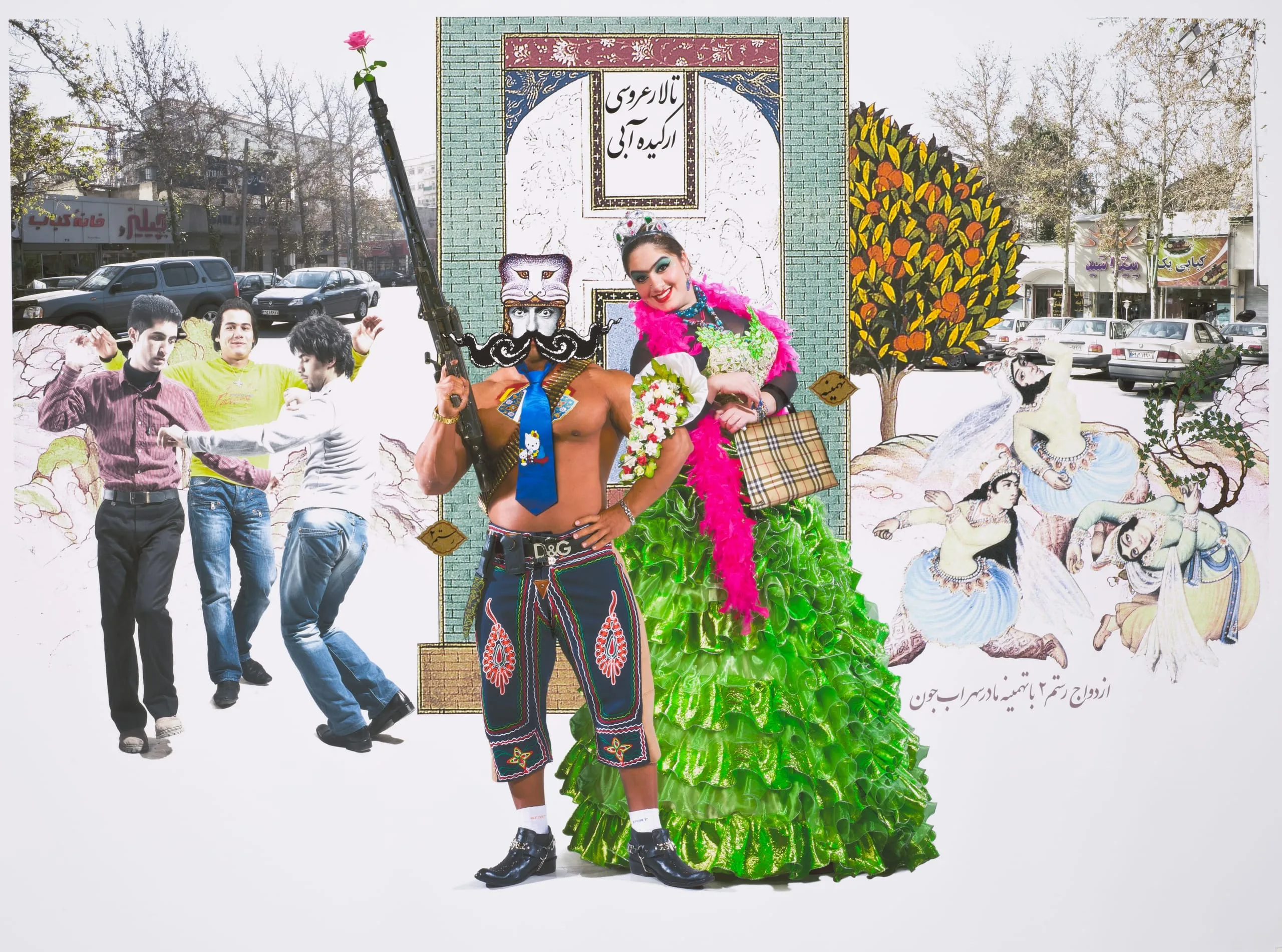
In his ingenious mixed-media series "Rostam 2 – Return," the Iranian artist Siamak Filizadeh transports the mythical Persian hero Rostam into the context of the present day. Riding a souped-up hybrid vehicle—half horse, half motorcycle—Rostam 2 performs his deeds of valor against the backdrop of twenty-first-century Tehran. Filizadeh has cleverly and seamlessly refashioned this ancient account, enacted across four generations and set amidst tragedy, romance, and heroism, in much the same manner as director Baz Luhrmann modernized Shakespeare’s Romeo and Juliet in the 1996 film version. But in his retelling of this classic Persian tale from the Shahnameh or Book of Kings, the Iranian national epic, Filizadeh bypasses its universalities in favor of more specific social commentary. As with other literary masterpieces, the Shahnameh has an appeal and an elasticity that has allowed successive generations to discover or invent new meanings.
Wearing a Hello Kitty necktie, Rostam 2 stands beside his bride, Tahmina. The pair has just exited the wedding chapel, which also serves to divide the print into two sections: the bride or women’s side and the groom or men’s side. To the right of the bride, who is clothed in a garish green flounced gown with a pink boa and carrying a Burberry bag, is a trio of dancing girls rendered in a distinctive Qajar style. The latter are balanced on the groom’s side by three contemporary jean-clad boys, one of whom provocatively shakes his buttocks towards the viewer. The middle ground includes traditional Persian landscape elements, beyond which are the shops and traffic of Tehran. If the scene is deconstructed along the lines of a Persian miniature painting in which spatial distinctions often are often not explicitly delineated, then the dancers on either side of the wedding pavilion occupy some inside/outside adjacency and are clearly engaged in the festivities. Their segregation by gender follows the traditional Iranian marriage celebration, which is enforced even today when held in a public space; the sexual nature of the dancing, also in accord with such contemporary events, is not so different from the so-called stag parties that often precede American weddings.
Neither the scene nor its caption "Rostam 2 meets Tahmina and straight away marries her" coincide with the original text of the Shahnameh but continue the convention of a later and more prudish interpolation of the account. There was no wedding. Instead, Rostam, having lost his horse, Rakhsh, is offered an interesting proposition by the daughter of his host, the ruler of Samangan. Tahmina comes to his chamber by night and offers to assist with the return of Rakhsh if Rostam will allow her to bear his child. He obligingly sleeps with her. In up-dating the scene visually to reflect contemporary customs and mores, Filizadeh also is in accord with earlier illustrators of the text. Among the first Ilkhanid depictions of this scene, a confident Tahmina, accompanied by a female attendant, is shown entering Rostam’s chamber, probably a reflection of the types of freedom enjoyed by Mongol women. In contrast, in later versions, the female attendant is replaced by a eunuch and Tahmina approaches her eager-looking lover with modest, downcast eyes. In shifting the setting to modern-day Tehran, it seems clear that with this badly dressed couple it is the bride, leaning into and towering above the groom, who is the more dominant figure.