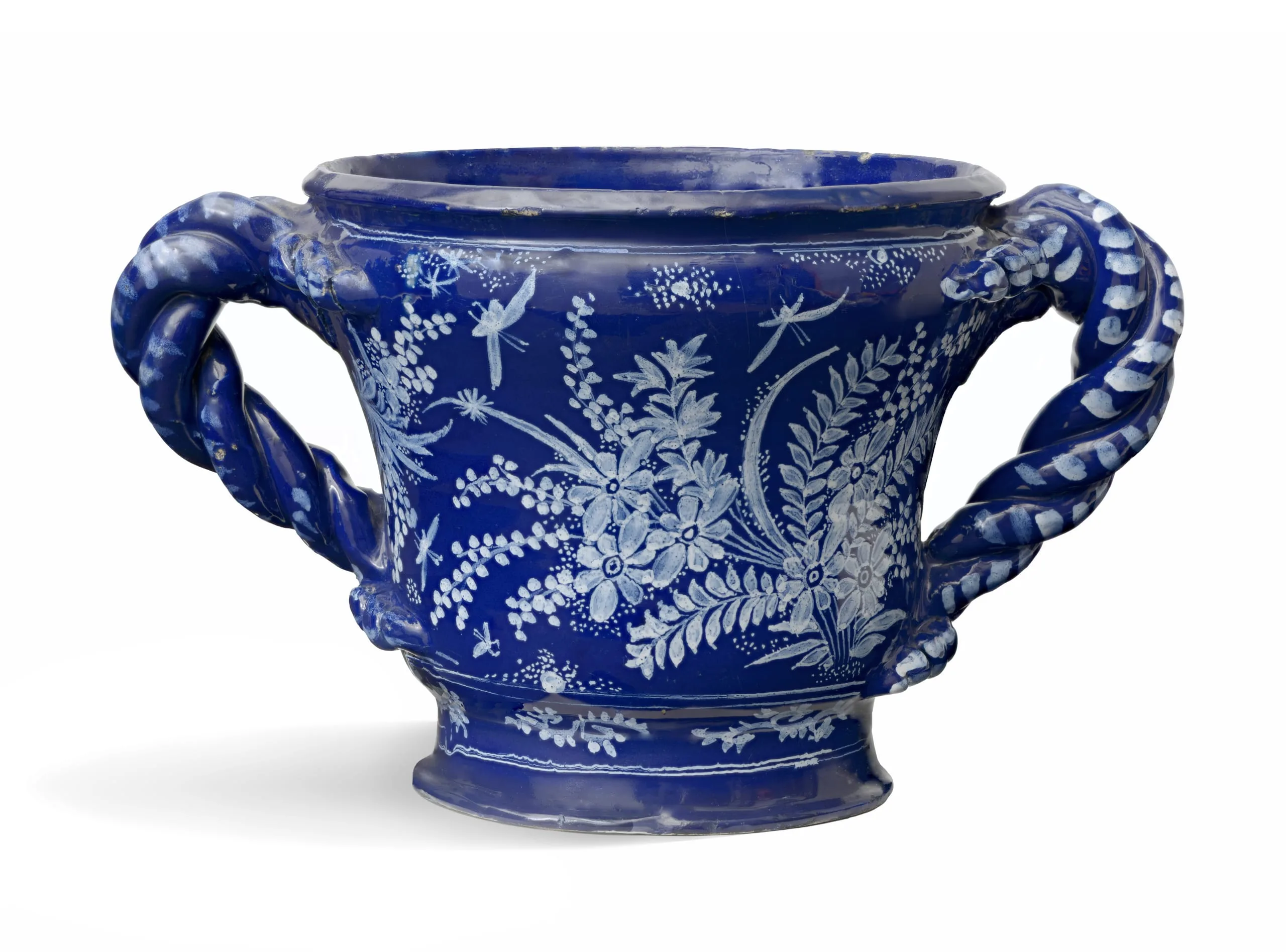
This flower vase is best understood in the context of the Trianon de Porcelaine at Versailles and the gardens designed by royal landscape architect André Le Nôtre. The Trianon was a short-lived garden pavilion built in 1670 for Louis XIV as a private retreat from the more formal palace. According to contemporary descriptions, both its interior and exterior were decorated with blue-and-white tiles and vessels like this vase made at Nevers. Chinese porcelain was rare, fragile, and costly, whereas sturdy French and Dutch earthenware had the same visual impact and was much easier to obtain. The gardens surrounding the Trianon were famous for having plants set in flowerpots rather than planted in the ground, so that they could be replaced with fresh specimens or easily moved indoors. Excavated shards similar to the braided handles on LACMA’s vase confirm the presence of Nevers pottery at Versailles. Contemporary views of other French gardens designed by Le Nôtre show garden beds, flights of stairs, and fountain basins all lined with earthenware pots, presumably also blue-and-white. At the Trianon, ornamental blue-and-white vases lined even the rooftop of the building.
Italian potters who emigrated to France at the end of the sixteenth century founded the pottery works at Nevers. Early wares were naturally indebted to Italian designs, but by the mid-seventeenth century, the factory had fully embraced the fashion for blue-and-white designs in response to the European craze for Chinese porcelain.