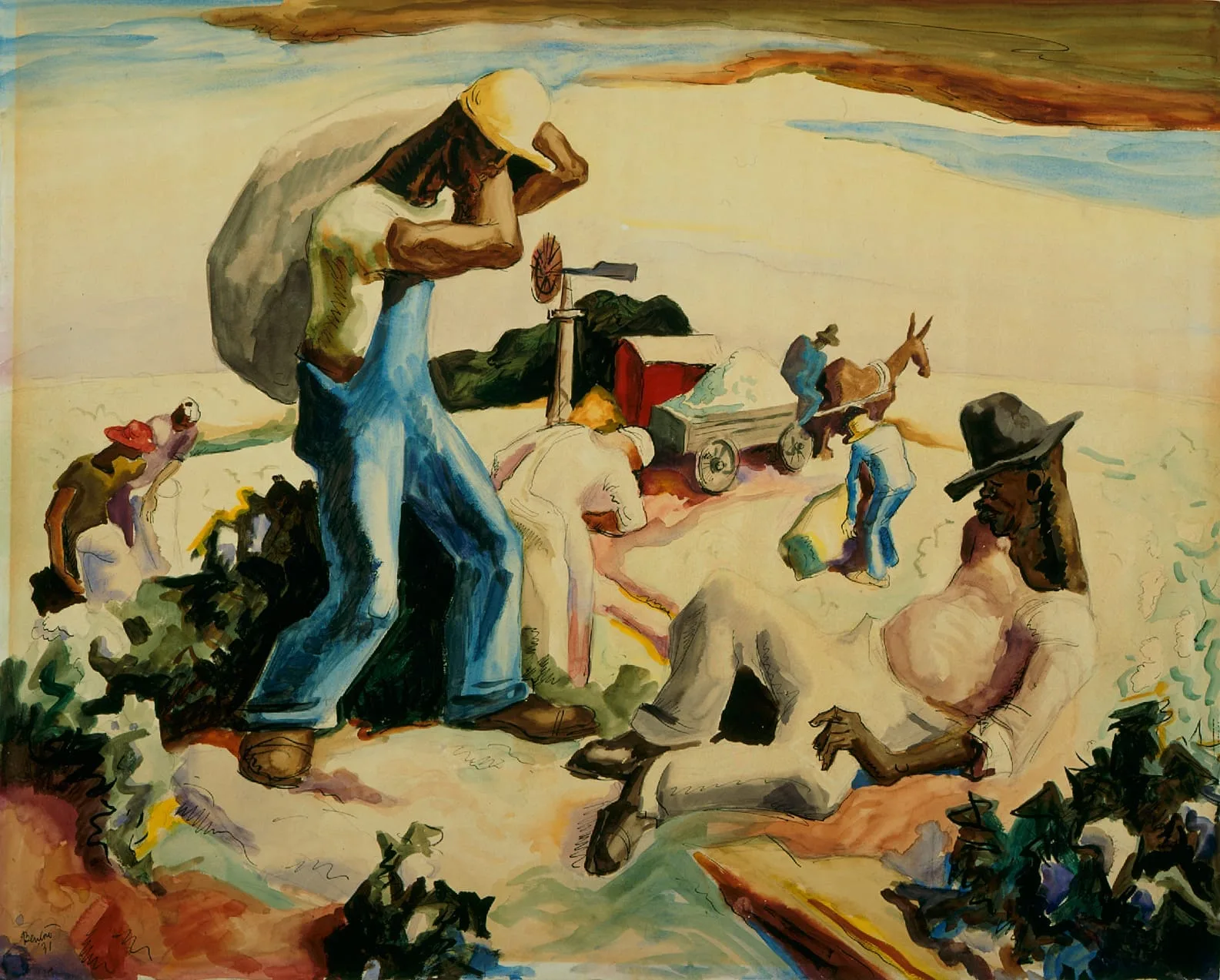
Thomas Hart Benton first visited the South in the summer of 1928 while on a sketching trip and chose to record the life of rural blacks because he considered the subject quintessentially American yet often overlooked. He sought to document a way of life that would soon succumb to mechanization, and in numerous drawings and watercolors he showed the manual laborers in the cotton industry. Although the picking of cotton may have been one of Benton’s favorite subjects, he depicted other activities as well: cotton being weighed, loaded into bins, and transported onto boats.
Cotton Pickers was probably made in the fields. Many of Benton’s Southern plein-air sketches are on the same cream paper used here. According to art historian Karal Marling, Benton would first lightly sketch a scene, draw over the main lines with India ink, and then add a tone of watercolor to preserve the sketch. With a wiry ink line Benton captured the shapes, outlines, and details and then modeled the forms with a very thin, delicately tinted wash.
In the 1930s Associated American Artists reproduced this watercolor as a gelatone print entitled Cotton Pickers: Georgia. The edition of this inexpensive, popular print numbered in the thousands.