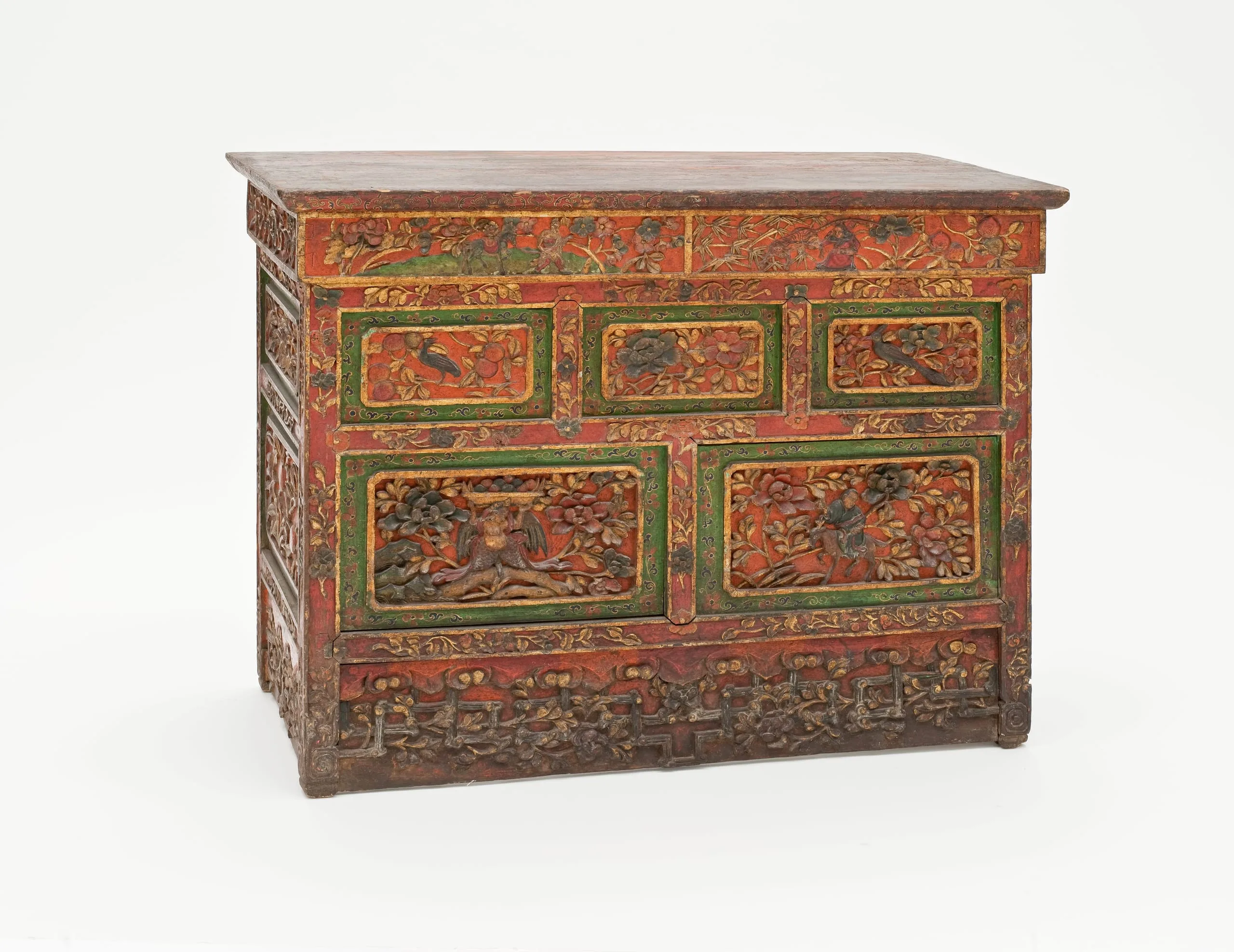
This large altar table is decorated with a Chinese-style aesthetic. It has five horizontal rows of figural and floral decoration with carved panels and inset carved panels. Immediately beneath the top board, the front panel on the left has a man leading a horse with a precious jewel on its back. The panel on the right depicts the legendary Mongol warrior Dugar Jaisang leading a tiger by a chain. Dugar Jaisang was believed to have supernatural powers and went to Tibet in order to promote the teachings of the Gelugpa (‘Yellow Hat’) school of Tibetan Buddhism over the Nyingma (‘Red Hat’) school. The next row has three inset panels with birds on branches flanking flowers on a branch. The row below has the primary decoration consisting of two inset panels. On the left, is a kinnari (Sanskrit: ‘what sort of woman’), a semi-divine being with the lower body of a bird. It is portrayed holding up an offering tray of precious jewels. On the right is the Arhat (Buddhist saint), Pindola Bharadvaja, riding a deer. He may hold a begging bowl in his left hand. (See also M.2005.154.5.). The bottom panel has a bamboo fence with a flowering vine. In the center is the mask of a mythical animal, the zipac, which is a Tibetan apotropaic symbol resembling the Indian "Face of Glory" (kirttimukha) and the Chinese gluttonous creature (taotie). The sides have floral panels. See David Kamansky, ed., Wooden Wonders: Tibetan Furniture in Secular and Religious Life (Pasadena: Pacific Asia Museum and Chicago: Serindia Publications, 2004), p. 222, no. 46. See also M.2010.78.17, M.2010.78.18, and M.2010.80.1.