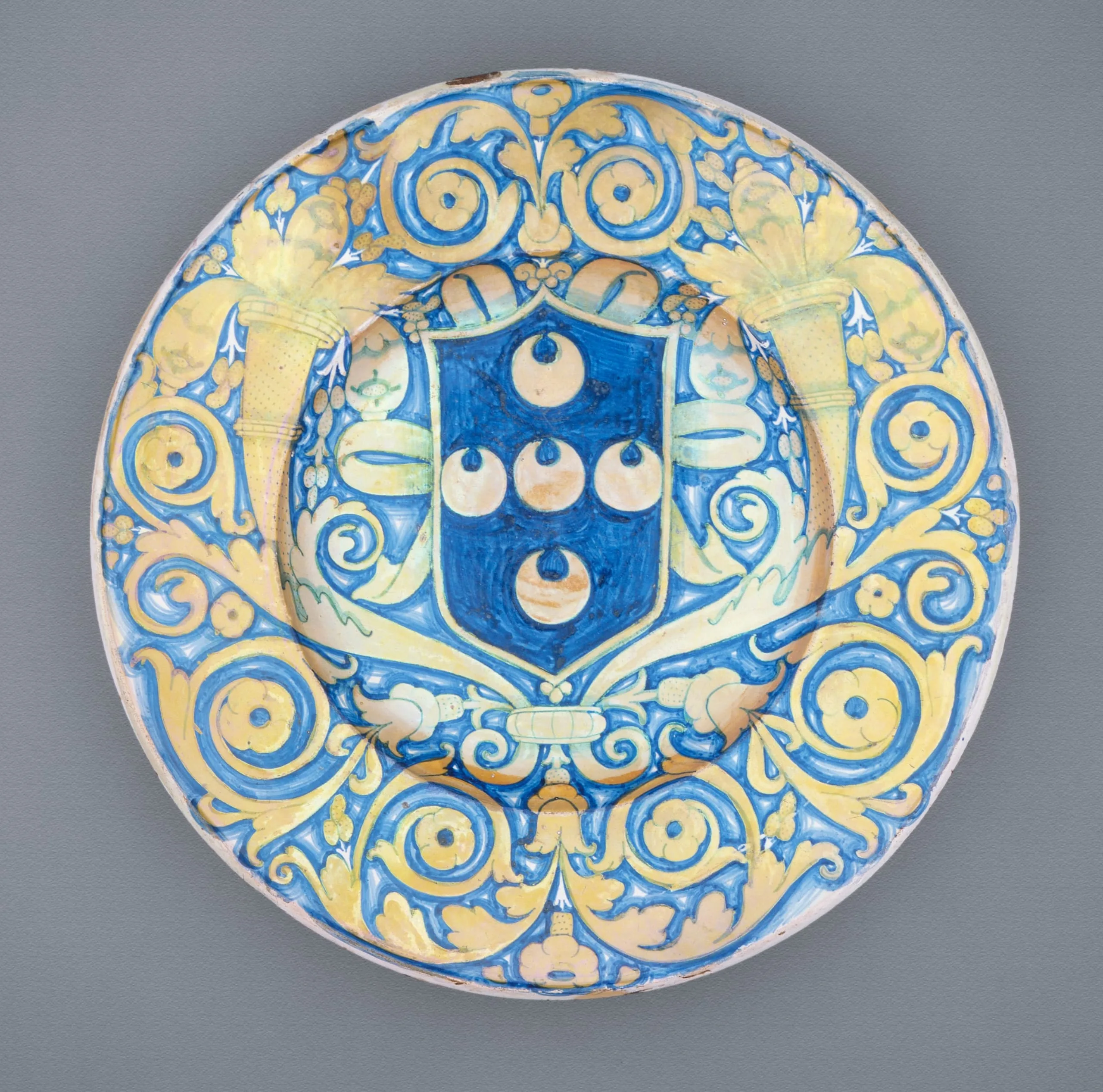
This charger prominently features the arms of the House of Piccolomini, an Italian noble family based in Siena. The Piccolomini family grew wealthy through trading and establishing merchant banks across Italy, France, and Germany. Such chargers were typically part of a larger service of ornamental plates, meant to be displayed or to be placed under a smaller plate in an elaborate table setting. In the fifteenth to early sixteenth century, Deruta became a center for producing maiolica, a type of earthenware ceramic covered with tin-opacified glaze and painted with bright colors. Influenced by ceramics from the Islamic world, craftspeople in Deruta became the first in Italy to use metallic compounds, usually silver or copper, in a final glaze, which resulted in an iridescent effect. Such ceramics became known as lusterware.
William Randolph Hearst populated his California estates with medieval and early modern decorative arts. This is one of more than twenty Deruta display plates that Hearst acquired between 1912 and 1935. He purchased the majority of them in the 1920s from Arnold Seligmann, Rey & Company in New York and others from various dealers and at auction in Munich, London, and New York. Hearst displayed them in the Gothic Study at San Simeon.
Cynthia Kok
2025