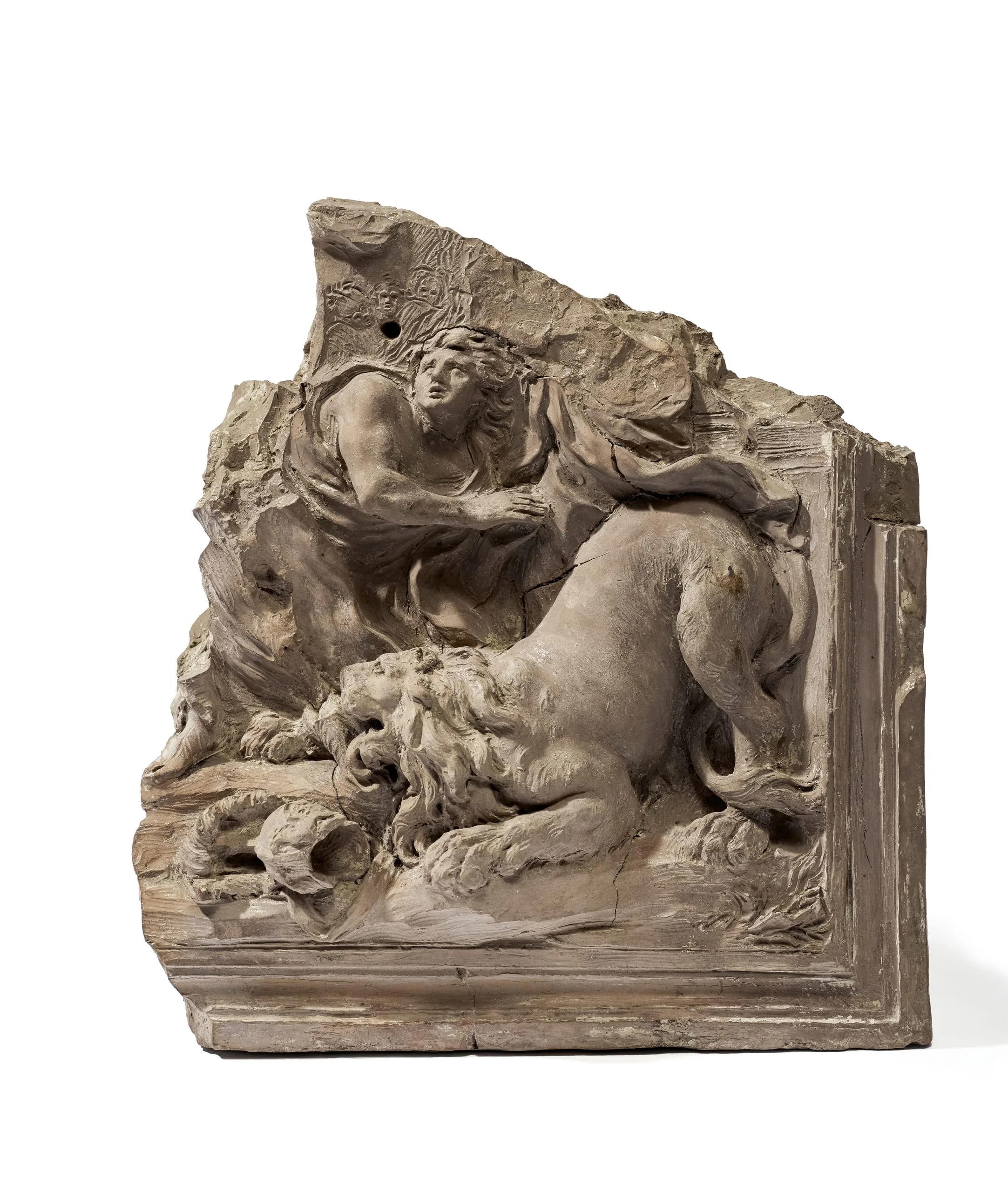
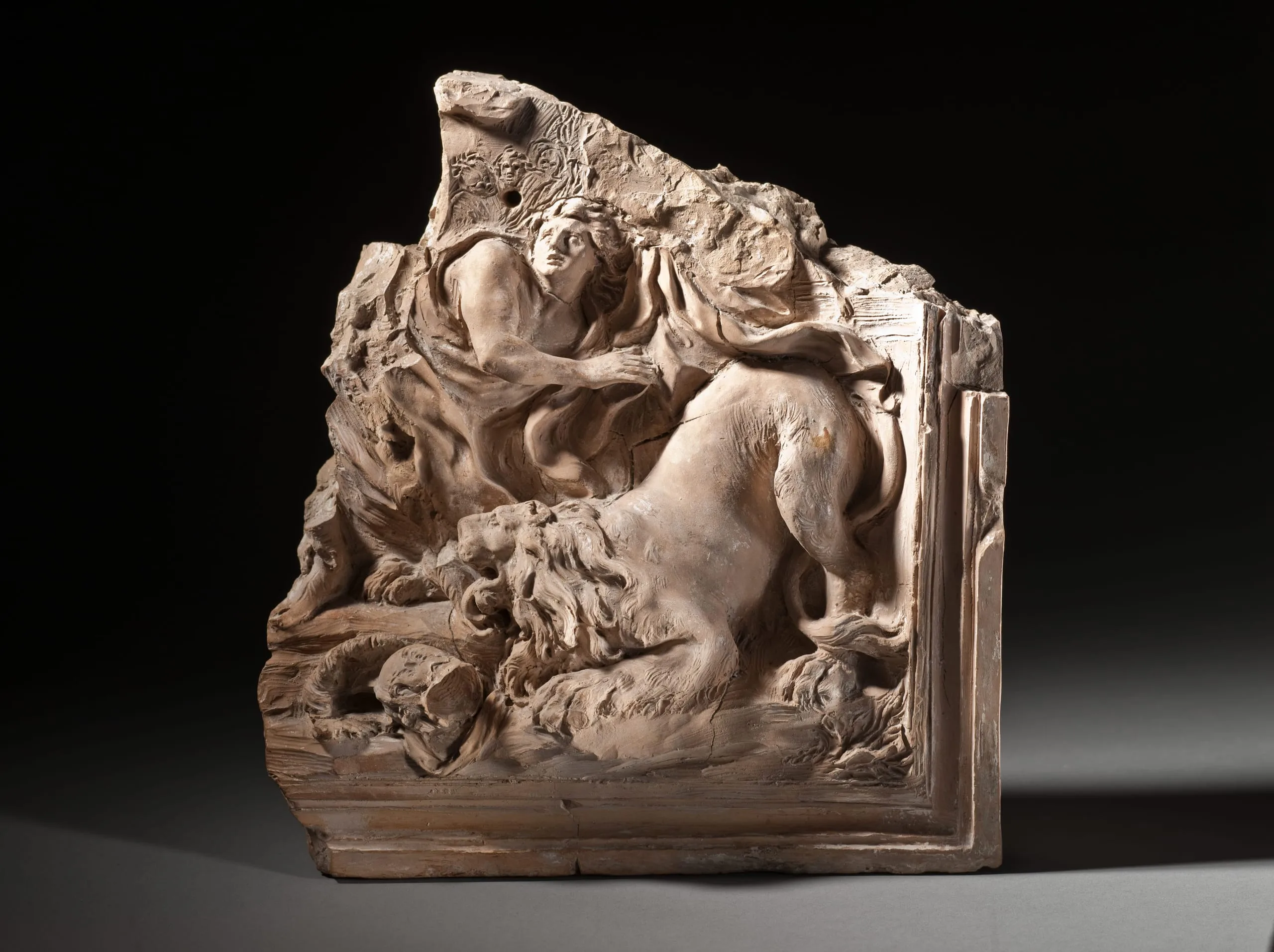
Melchiorre Cafà, described in a recent article as the "Maltese Genius of the Roman Baroque" was a sculptor of great renown, respected even by Bernini who feared his rising fame and considered him the only virtual challenger to his glory. Born in Malta in 1636, he rapidly moved to Rome where he was apprenticed to Ercole Ferrata, a prolific if somewhat uninspired artist. His earliest commissions are wood sculptures for Maltese churches, rapidly followed by more prestigious commissions from some of the leading Roman patrons of the time. In 1660, Camillo Pamphilj, nephew of Pope Innocent X, asked the artist to carve a large altarpiece for the Church of S. Agnese in Agone on the Piazza Navona. This work relates to that major commission.
Cafà executed only two marble sculptures in his short life, a relief of St. Catherine of Siena and a sculpture of St. Rose of Lima for the church of St. Domingo in Lima, Peru. In 1667, while working on yet another sculpture for Malta, he was hit by a block of marble and died shortly afterwards. Because of the many commissions he was considering at the time of his death, and his impatience with the actual carving of marble, most of his surviving work is in form of studies and fragments related to the projects he was considering.
Cafà's sculptures are very rare and the rediscovery of this previously unknown terracotta study has been hailed as a major rediscovery by Jennifer Montagu, the leading scholar in Roman Baroque sculpture. She wrote "...drawings and bozzetti provide a rare insight into [an artist's] mind. These rapid sketches manifest his approach to his art, his style. For Cafà, who left so few autograph marbles, they are of particular importance for an understanding of the sculptor."
The Church of S. Agnese was the family church of the Pamphilj whose nearby palazzo (now the Brazilian Embassy) was one of the major buildings on the Piazza Navona. Its distinctive feature is to have, instead of the more common painted altarpieces, five large sculpted ones, which are still a major attraction in Rome. Cafà's seldom represented subject was the Martyrdom of St. Eustace, a virtuous Roman soldier converted along with his family to Christianity. Having refused to sacrifice to the pagan gods, Eustace and his family were condemned to be devoured by lions, but the lions refused to eat them, after which they were roasted to death in a large bronze statue of a bull. The episode represented by Cafà does not in fact represent the martyrdom of the family but rather the moment when the lions are tamed by the vision of St. Eustace.
The sculptor began carving the altarpiece but only its central figure was completed by his death. Cafà executed also a terracotta model for the whole composition, now in the Museo di Roma, as well as a large plaster model, which by 1661, was in place on top of the altar — waiting, as it were, for its execution in marble. Furthermore six partial models, included this one, have survived. These show considerable differences with both the complete terracotta model and the finished composition. Jennifer Montagu argues that, while this is obviously a fragment, it is probably not part of a completed model. Cafà's unusual technique included working out details of his composition in sections of varying sizes. Above all, Montagu concludes her study of this terracotta stating that this "fragment... is remarkable as a rare work by an important artist, a fascinating document in the evolution of one of his most important works, but above all as a work of art, beautiful in its depiction of man and beast, and brilliant in the freedom of its sure and expressive modeling."