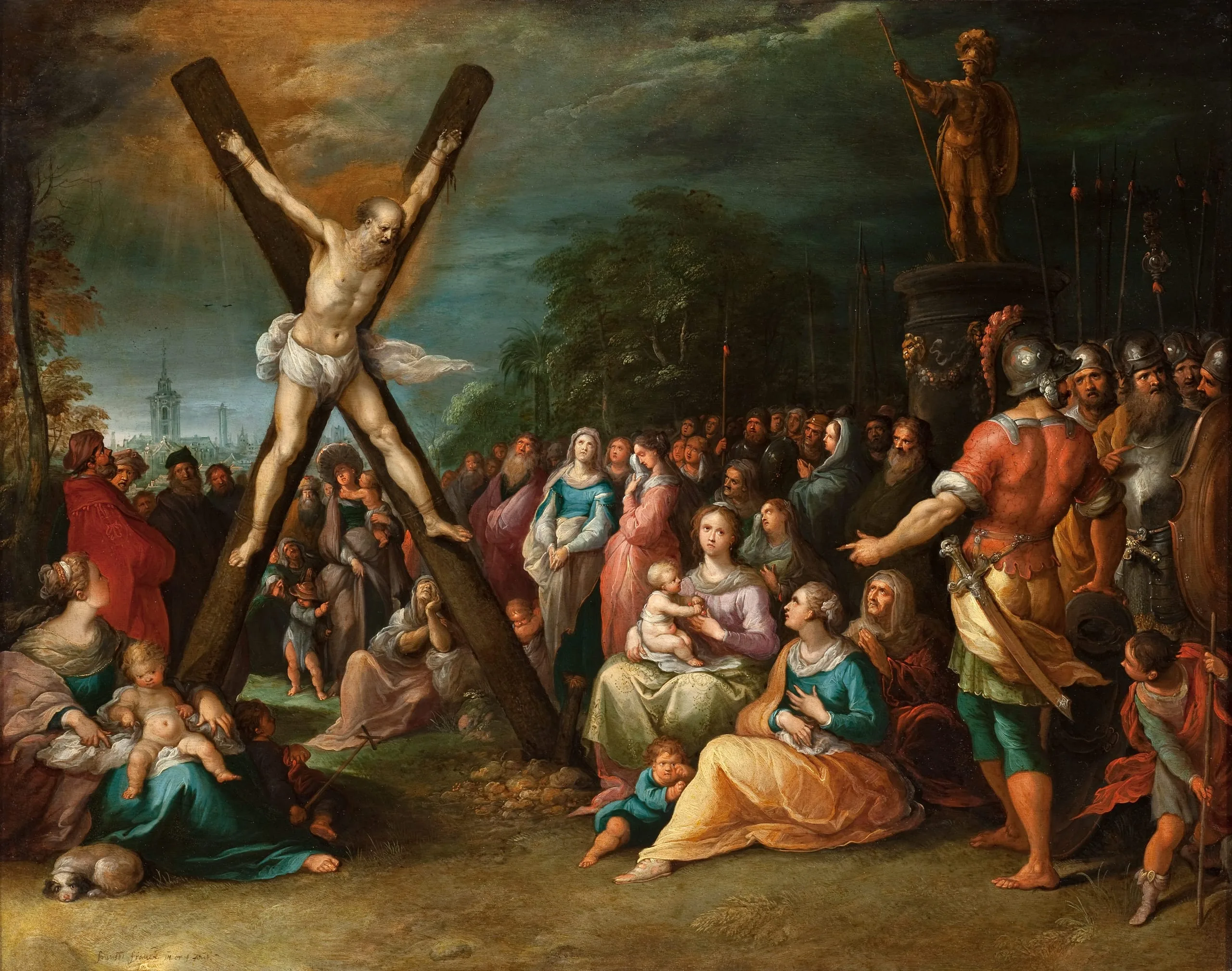
Golden light breaks through a dark, stormy sky to illuminate a crucified man as he looks defiantly at the crowd gathered below. The scene recalls the episode in Jacobus de Voragine’s compilation of saints’ lives, The Golden Legend, in which Andrew is martyred on an X-shaped cross. Andrew was one of Christ’s apostles, who, as part of his missionary activities, angered the Roman proconsul Aegeus. Not only had Andrew refused to pray to pagan idols (represented in the statue at upper right), but he had converted Aegeus’s wife. For this, he was condemned to die on the cross. Defying his physical torture, he lived for two days, preaching to and subsequently converting onlookers. Frans Francken’s delicately painted version on copper occupies a space between devotional and luxury object.
Francken was a master painter in Antwerp, a major European entrepôt with a flourishing art market. The city, which remained Catholic after the Reformation, was also a locus for Counter-Reformation visual culture and saw an increase in patronage for church altarpieces and other religious arts. Flemish artists, like Francken and his family of painters, completed commissions for clients both local and abroad in Spain and France. Extant records show a lively export market of artworks from Antwerp to Spain, in part because tensions with the Protestant Northern Netherlands (which had broken away from Spanish control in the late sixteenth century) led to prohibitions on imports from that region. While Francken’s painting of Saint Andrew reflects this demand for religious themes, he also found success painting mythological, historical, and other secular subjects.