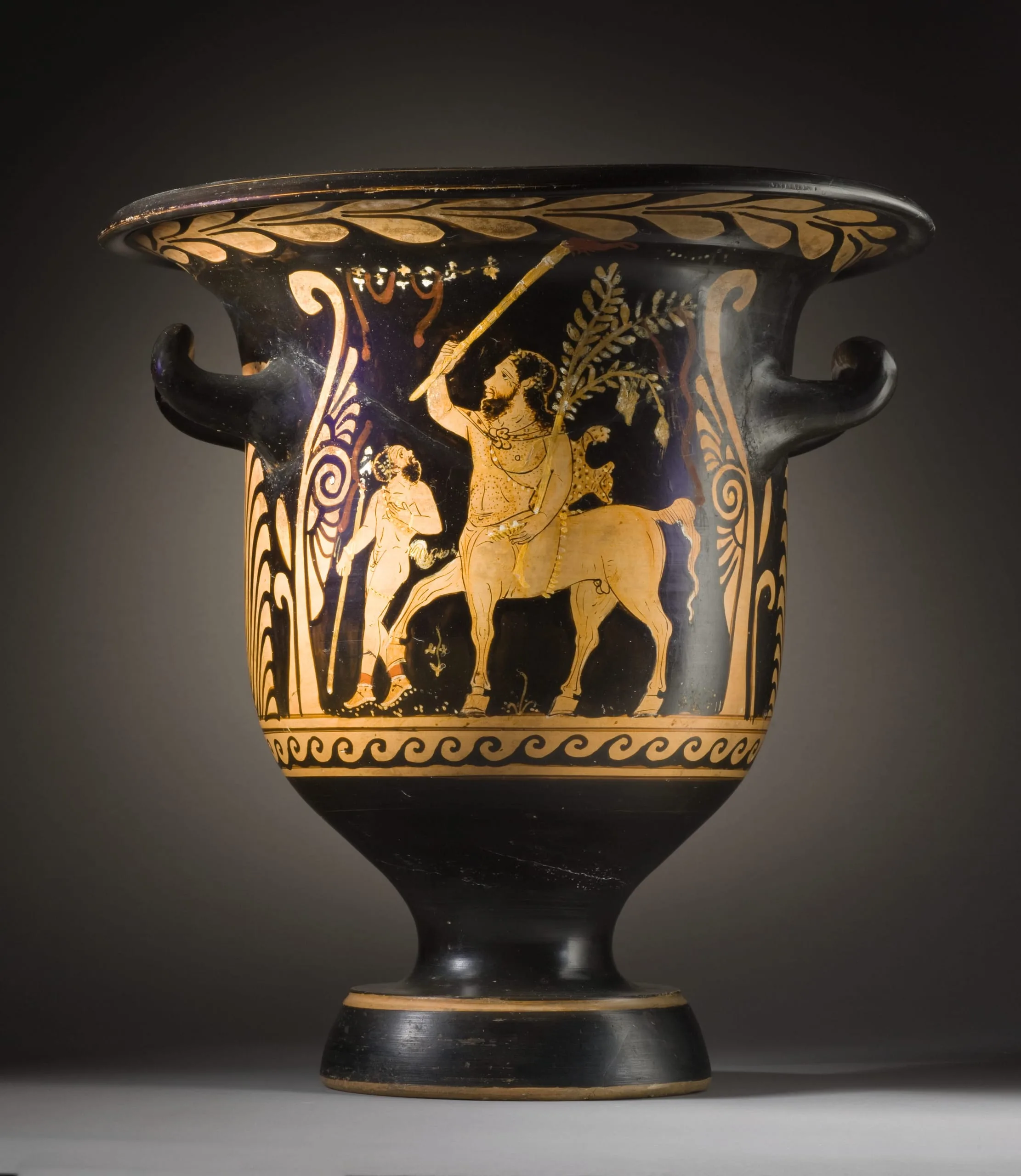
With its wide mouth and rounded body, this ceramic bell-krater from southern Italy (Paestum) was designed to mix and serve diluted wine. A laurel wreath encircles the krater just below the mouth. The front of the vessel depicts Chiron the centaur (a horse-man hybrid), with a satyr (a goat-man hybrid) to the left. Chiron wears a leopard skin around his shoulders and walks with a torch in one hand and a phiale (offering dish for libations) in the other. He cradles a branch draped with votive offerings, including a fillet, a tablet, and small vessels. The satyr, carrying a thyrsos (a giant fennel stalk usually topped by a large pinecone or ivy, typically associated with the god Dionysos) and laden with strings of beads, turns back to look at Chiron. A long fillet curls around a spray of ivy in the top left field.
Typically, centaurs were bestial and uncultured creatures—wild, prone to drunkenness and violence, and lusty. Chiron was unique among them for his wise and civilized character, and he served as a teacher to many heroes of Greek mythology, including Achilles and Jason (of the Argonauts).
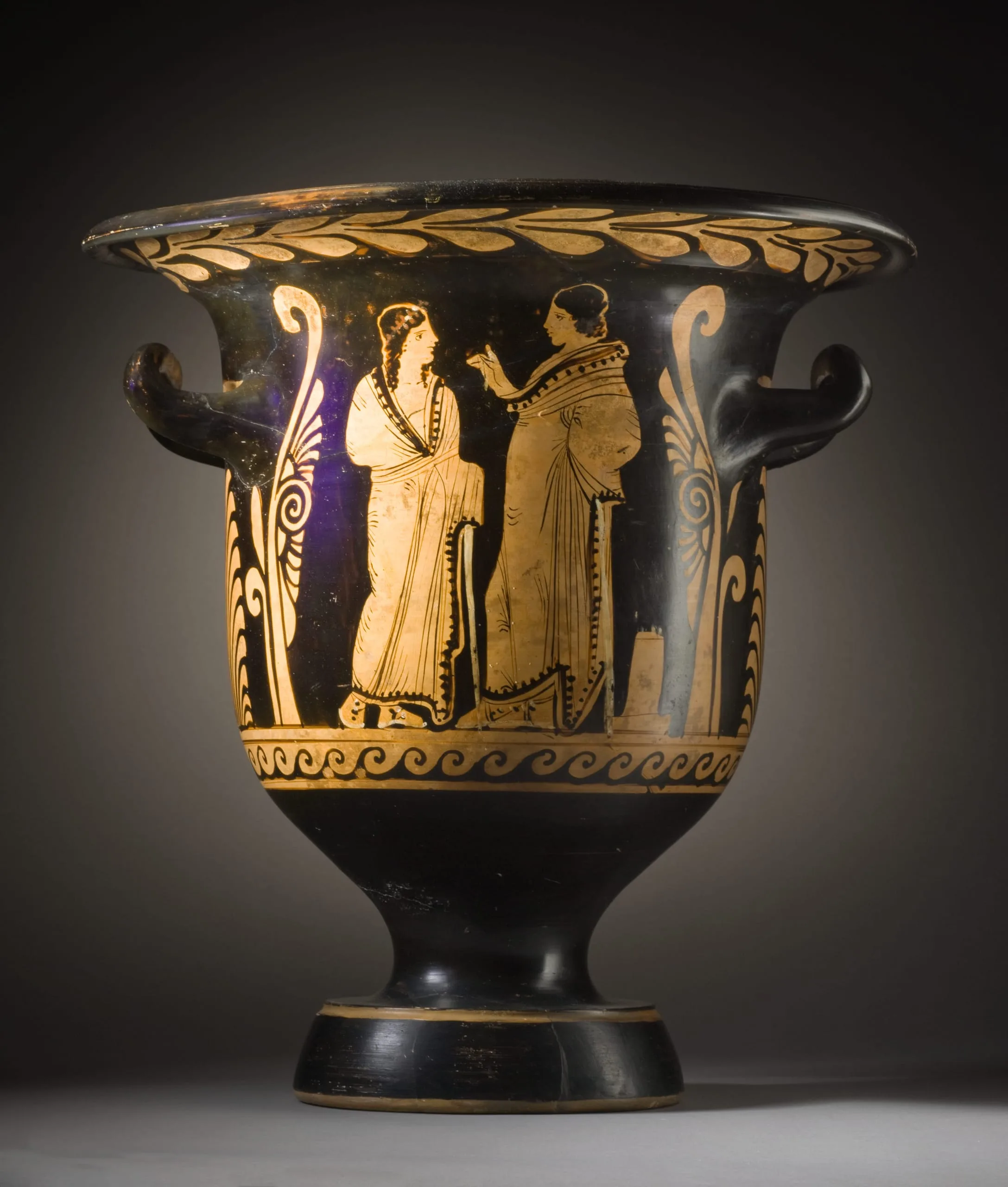
The back side of the krater depicts two young men facing each other, each wearing cloaks (himation), shoes, and wreaths. The taller youth holds up a berry spray, now preserved only as a stain. A low stela stands at right, while a dot-fillet hangs at the upper left of the scene.
Under each handle, tall volutes with partial palmettes flank a large, central palmette. The center of the left palmette is painted white, while the center of the right is painted yellow. In addition to these pigments, there is evidence of shading on Chiron’s rump, hoof, and leopard skin rendered with a dilute brown wash, all suggesting the skill of the painter.