- Artist or Maker
- Andy Warhol
United States, Pennsylvania, Pittsburgh, 1928–1987, active New York City - Title
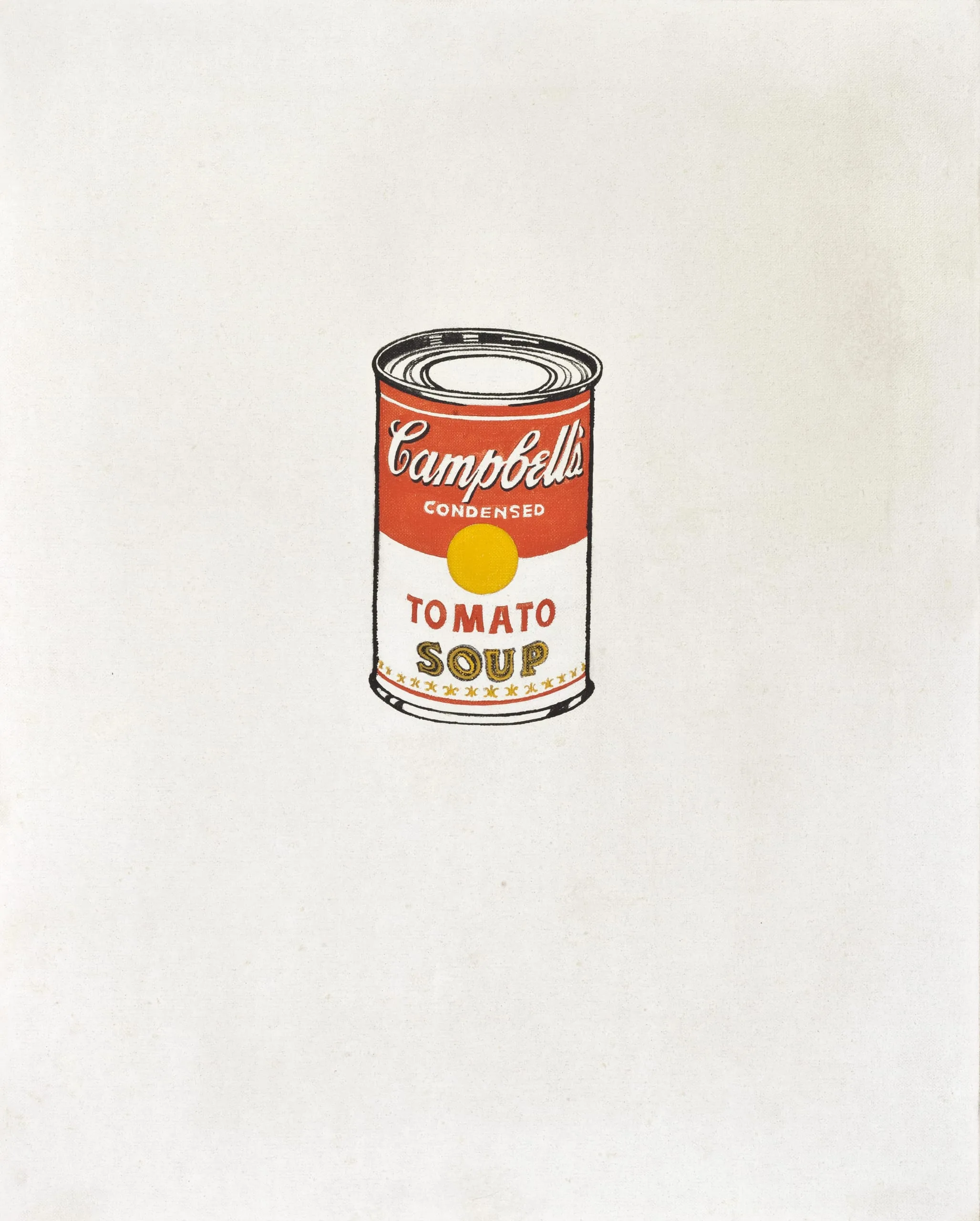
- Small Campbell's Soup Can (Tomato)
- Date Made
- 1962
- Medium
- Oil and graphite on linen
- Dimensions
- 20 x 16 in. (50.8 x 40.64 cm); Framed: 20 1/4 x 16 1/2 x 1 in. (51.44 x 41.91 x 2.54 cm)
- Accession Number
- M.2008.236
- Curatorial Notes
Andy Warhol already had a successful career as a commercial designer when he made his artistic debut at Ferus Gallery in Los Angeles in 1962. For his first gallery exhibition, Warhol presented thirty-two larger-than-life, almost identical paintings of individual Campbell’s Soup cans. These paintings were not hung on the wall but arranged single-file on shallow shelves, mimicking the immediacy of product displays at supermarkets. Warhol took painstaking care to standardize the already-flattened image of the soup can across his canvases, but each “can” was labeled with a different, existing Campbell’s Soup flavor. Much like the artist’s celebrity portraits and disaster-themed paintings, his “soup cans” have an iconic status today as concise and forward-thinking reflections on key issues that have propelled Pop art as a movement: materialism, standardization of everyday life, ubiquity of visual mediation, the oppressive banality of mass production, and the illusion of having a choice in a capitalist world order.
Small Campbell’s Soup Can (Tomato) and the paintings shown at Ferus Gallery are based on the same corporate Campbell’s Soup Company logo. All of them were created in early 1962 by carefully tracing the logo’s outlines with the help of a projector and by subsequently filling in the colors by hand. Unlike the Ferus Gallery works or the 1964 Campbell’s Soup Can at LACMA, a vast expanse of negative space surrounds the titular object in Small Campbell’s Soup Can (Tomato), which brings the image closer in size to an actual soup can, and simultaneously creates an air of mystery and reverence. Here, Warhol’s compositional choices have an effect similar to that of advertisements, both elevating the image and rendering it banal or approachable at the same time. When asked about the subject of his soup can paintings, Warhol replied with his characteristically wry but insightful humor: “I think they are portraits, don’t you?”
- Selected Bibliography
- Goldman, Judith. Robert & Ethel Scull: Portrait of a Collection. New York: Acquavella Galleries, 2010.
- Copyright
- © The Andy Warhol Foundation for the Visual Arts, Inc. / Artists Rights Society (ARS), New York