LACMA

ShopMembershipMyLACMATickets
LACMA
Los Angeles County Museum of Art
5905 Wilshire Blvd.
Los Angeles, CA 90036
info@lacma.org
(323) 857-6000
Sign up to receive emails
Subscribe
© Museum Associates 2026
  • About LACMA
  • Jobs
  • Building LACMA
  • Host An Event
  • Unframed
  • Press
  • FAQs
  • Log in to MyLACMA
  • Privacy Policy
© Museum Associates 2026
Collections

William Henry Fox Talbot
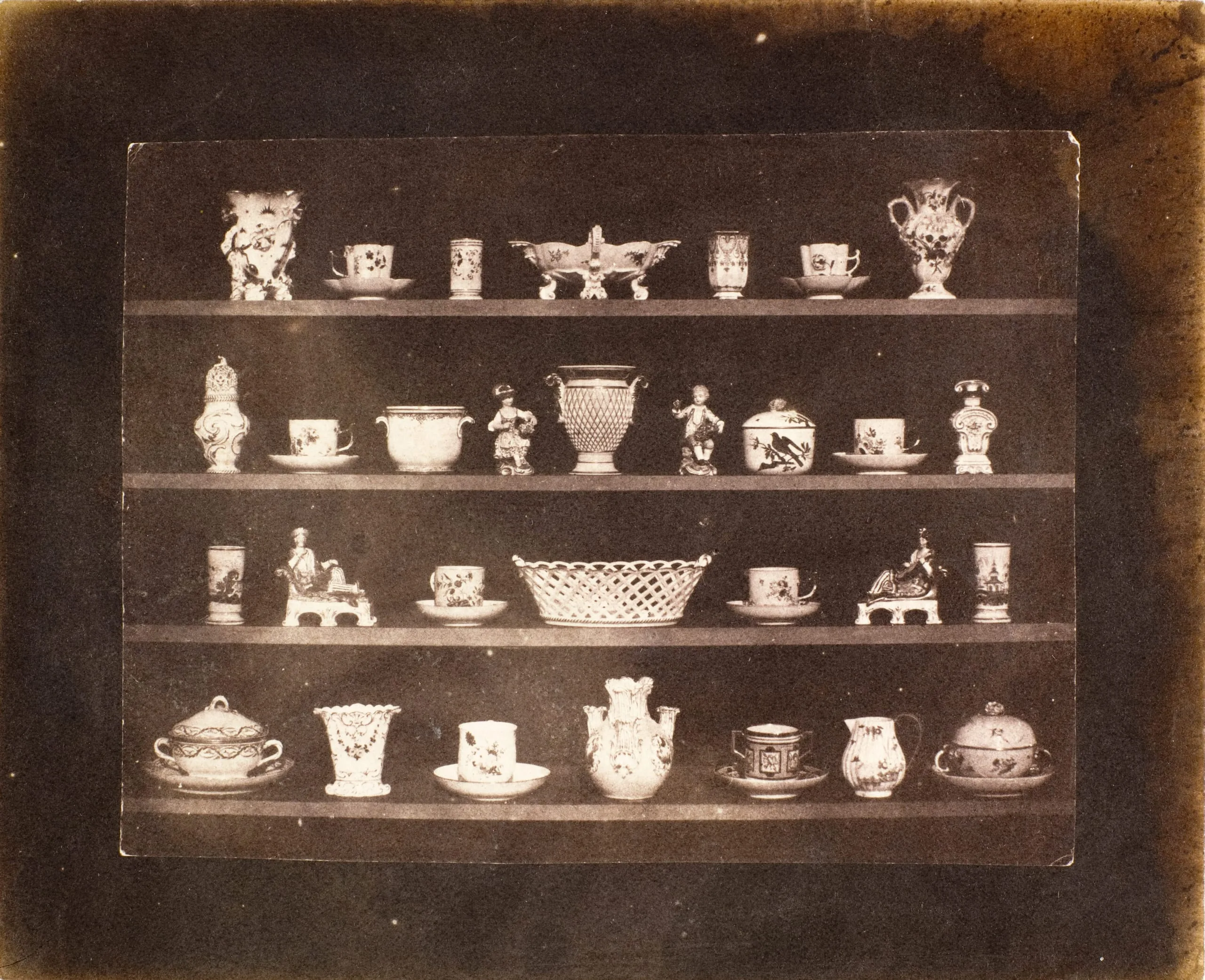
Articles of Chinacirca 1844

Not on view
Sepia-toned photograph of four wooden shelves displaying approximately twenty-five white ceramic vessels, figurines, and tablewares against a dark background
Artist or Maker
William Henry Fox Talbot
Title
Articles of China
Place Made
England
Date Made
circa 1844
Medium
Salt print
Dimensions
Image: 5 1/2 × 7 1/8 in. (13.97 × 18.1 cm) Primary support: 7 7/16 × 9 1/16 in. (18.89 × 23.02 cm) Mat: 14 × 17 in. (35.56 × 43.18 cm)
Credit Line
The Marjorie and Leonard Vernon Collection, gift of The Annenberg Foundation, acquired from Carol Vernon and Robert Turbin
Accession Number
M.2008.40.909
Classification
Photographs
Collecting Area
Photography
Curatorial Notes

In Victorian Britain, collecting china was a popular trend, known as “Chinamania.” Large collections of imported ceramics signaled taste, wealth, and status, and a desire to emulate Chinese originals drove innovation in Europe. A typical domestic collection is on view in this photograph by William Henry Fox Talbot, a British scientist, inventor, and photography pioneer. In 1841, Talbot developed the calotype process, an early photographic technique using paper negatives, enabling multiple prints. He also produced the first commercially published book to feature photographic illustrations. The Pencil of Nature, issued in six volumes between 1844 and 1846, included Articles of China as plate 3 of the first volume. Talbot used this image to extol the practical virtues of the new art, claiming that “the whole cabinet of a Virtuoso and collector of old China might be depicted on paper in little more time than it would take him to make a written inventory describing it in the usual way.” Because the calotype process required long exposures under natural sunlight, immobile objects were ideal for experimenting with contrast and composition. Here, Talbot arranged thirty decorative vessels, vases, and figurines on temporary shelves built outside his Lacock Abbey residence and backed with a drape of black velvet.

Britt Salvesen

2025
Selected Bibliography
  • Salvesen, Britt. See the Light: Photography, Perception, Cognition: the Marjorie and Leonard Vernon Collection. Los Angeles: Los Angeles County Museum of Art; New York: DelMonico Books/Prestel, 2013.

Related Unframed

Talbot and the Possibilities of Photography
  • February 25, 2014