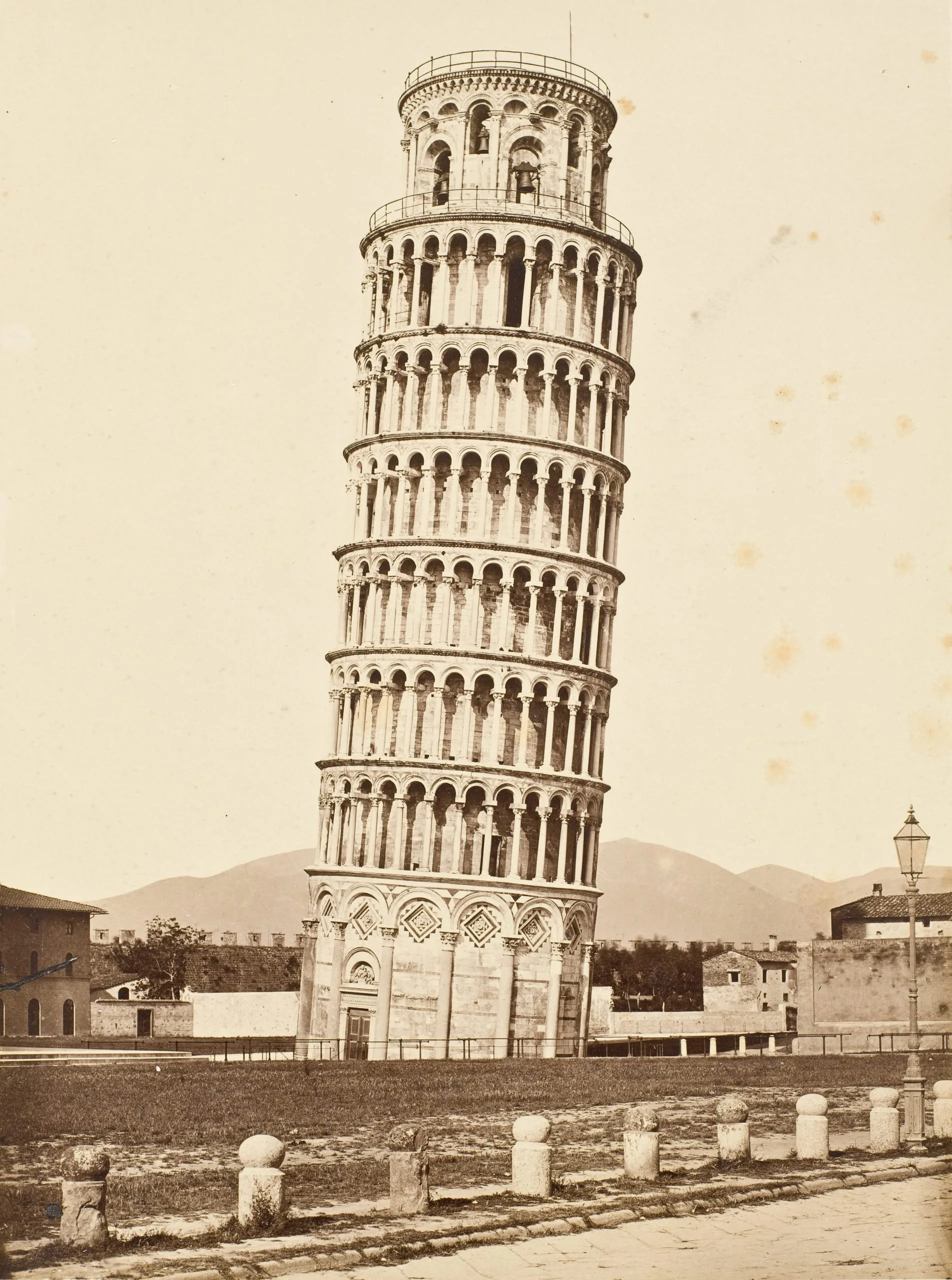
The Alinari Brothers documented the Leaning Tower of Pisa in its entirety, presenting architectural detail, the strange tilt, and the context of the city and landscape. The glass negative captured fine detail and, combined with the flattened tonality of the albumen paper, created almost an outline of the tower. No people can be seen, suggesting that the photograph was taken in the early morning before Pisa's pedestrian traffic began.
Technique
By 1855, the first generation of professional photographers used collodion on glass (wet plates) and it would remain the most popular process until the 1880s. The wealth of visual information available via a glass plate, coupled with its consistent tonal range and density, offered a seemingly direct representation of reality. The fine surface of the albumen paper furthered the three-dimensional illusion of the photograph, as images were no longer sunk into the physicality of the paper. (For more on albumen paper, see Alfred Capel-Cure's St. Ouen, Rouen.) With the ease of printing consistently from glass negatives, larger editions were possible.
The collodion on glass process was complicated. A glass plate was first coated with collodion and other chemicals and then dipped in silver nitrate before it was exposed in a large wooden folding camera while the plate was still wet, avoiding evaporation. Immediately after exposure, the plate had to be developed in pyrogallic acid and fixed with hyposulphite. Then it was contact-printed onto albumen silver paper, which had recently been invented. Although complex, the process was popular for a number of reasons: it was inexpensive; it produced more consistent results than paper negatives, especially with the advent of standardized printing paper; and it drastically reduced exposure and printing time. Small portraits with fine detail could be made in two seconds.
Context
The Alinari brothers entered commercial photography early. In 1852, Leopoldo Alinari set up a photography laboratory in Florence; two years later, he founded the firm known as Fratelli Alinari with his brothers, Giuseppe and Romualdo. They specialized in photographs of art, architecture, and historical monuments, gathering them into sales catalogues for reproduction and also exhibiting their prints. These tourist views were destined for albums as souvenirs of visits to Italy. With increasing fame and commissions, the brothers continued to publish catalogues and enlarge their image archive. By the 1880s, Alinari Brothers had more than a hundred employees and their catalogues had tens of thousands of available photographs.