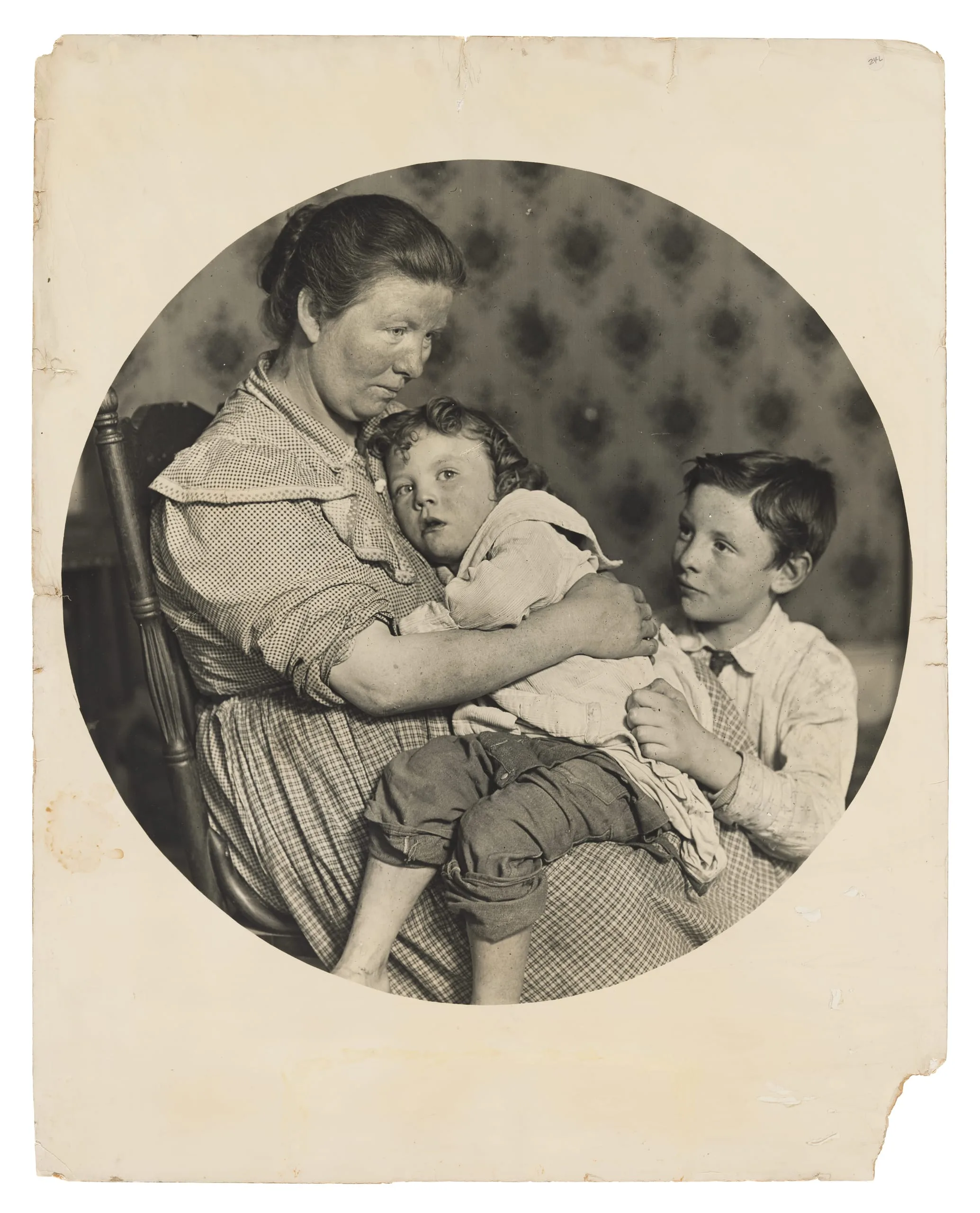
Among the most influential artist-activists in photographic history, Lewis Hine deployed the camera as an instrument of social change. He described this photograph as “a study . . . to represent maternity among the poor, following the conception used by Raphael in his ‘Madonna of the Chair.’” The image draws on the visual language of the Renaissance to imbue urban modernity with a sense of the sacred. Roughly five years earlier, in 1905, Hine had produced two photographs using a similar composition: Italian Madonna, Ellis Island, New York and Polish Mother and Child. He understood that while photography was indeed a new visual language, it could be evocatively translated with a shared cultural vocabulary such as a tradition of devotional images. Where an old master painter like Raphael presented his Madonna and Child as holy figures to be venerated, Hine’s Tenement Madonna and her children are meant to instill pathos.
As in Raphael’s painting (and Christian iconography as a whole), here the gaze of each figure is conspicuous: the mother looks down in thought, the daughter to the right of the camera, and the son toward his mother. But economics, not theology, provide the clues to deciphering this tableau: the mother’s arms and hands have experienced hard work; the son, wearing a dirty shirt, looks mature beyond his years; the daughter’s clothes are loose and ill-fitting, probably hand-me-downs. The background is out of focus. In Hine’s photographs of child labor, he ensured that the spaces where such labor occurred were as legible as the children themselves. But in Tenement Madonna, he opted for the compositional mode of portraiture over a more documentary view of the family’s living conditions. This artistic decision hints at his foundational approach to documentary photography that insists pathos can be generated without exploitive imagery. For Hine, the photograph had ethical power, and the ethical by its very nature was aesthetic.
2024