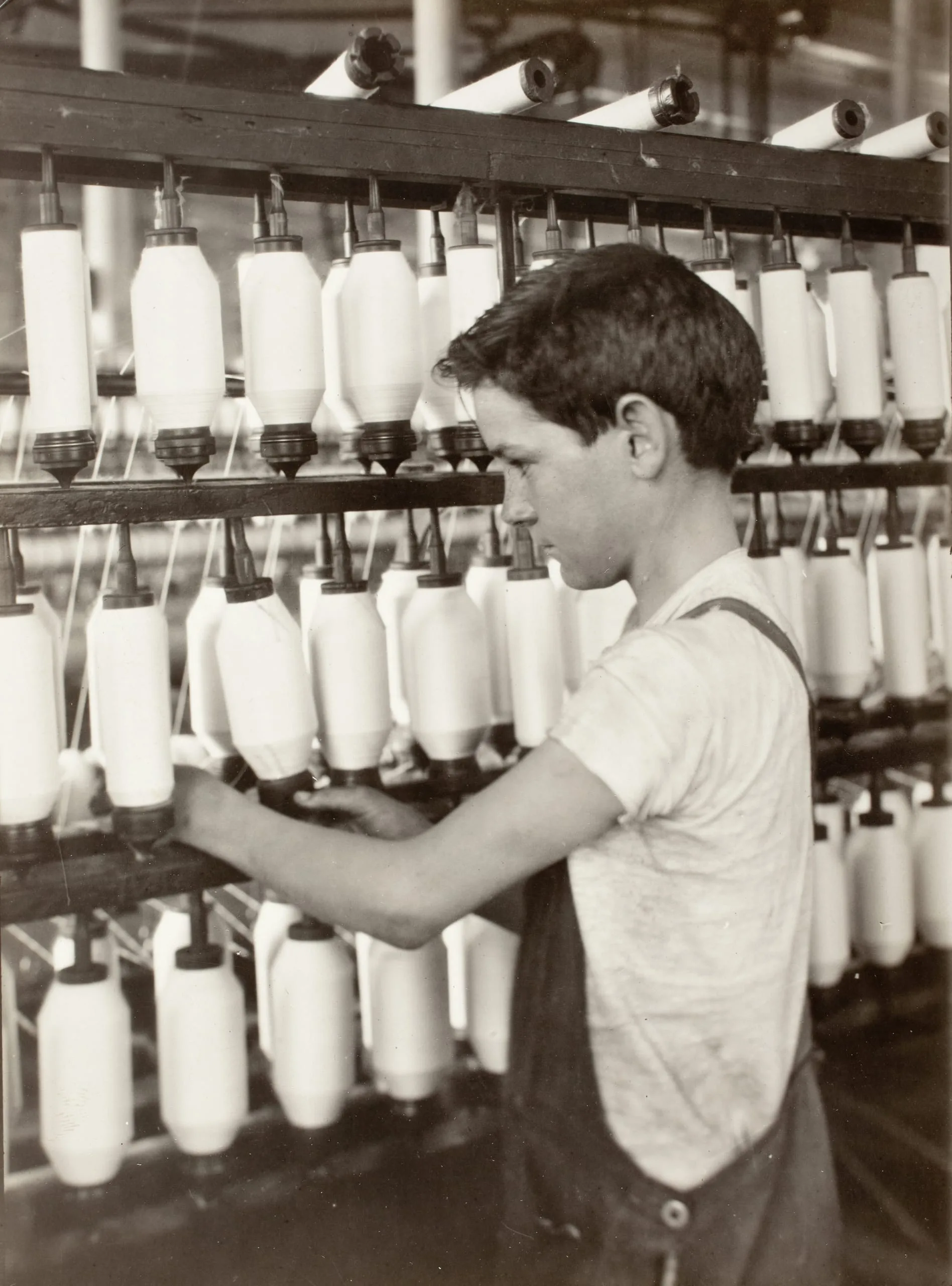
Among the most influential artist-activists in photographic history, Lewis Hine deployed the camera as an instrument of social change. Commissioned by social welfare agencies, he traveled the country to record the harsh conditions under which immigrants and children lived and labored. From 1908 to 1913, he worked as an investigative photographer for the National Child Labor Committee, documenting children working in mills, factories, canneries, mines, and agricultural fields across America.
Hine coined the term “photo-story,” precursor of the photo-essay, to describe his work as an investigative photographer, in which he combined image and text. A keen observer, he captioned his images with detailed information about the subject’s context. “The average person believes implicitly that the photograph cannot falsify,” Hine explained. “Of course, you and I know that this unbounded faith in the integrity of the photograph is often rudely shaken, for, while photographs may not lie, liars may photograph.” Here, we see a “child minder” monitoring cotton spinners. Hine effectively evokes the vulnerability of this young worker by simply placing his back to the camera.
In truth, photographer may have been forced to work quickly and not engage with the children. His work for the NCLC was often dangerous: he was frequently threatened with violence or even death by factory police and foremen. At the time, the exploitation of child laborers was purposefully hidden from the public. Photography posed a serious threat to the industry, thus it was prohibited. To gain entry to the mills and factories, Hine was forced to assume many guises—a fire inspector, a postcard vendor, a Bible salesman, even an industrial photographer making a record of factory machinery.
Eve Schillo
2024