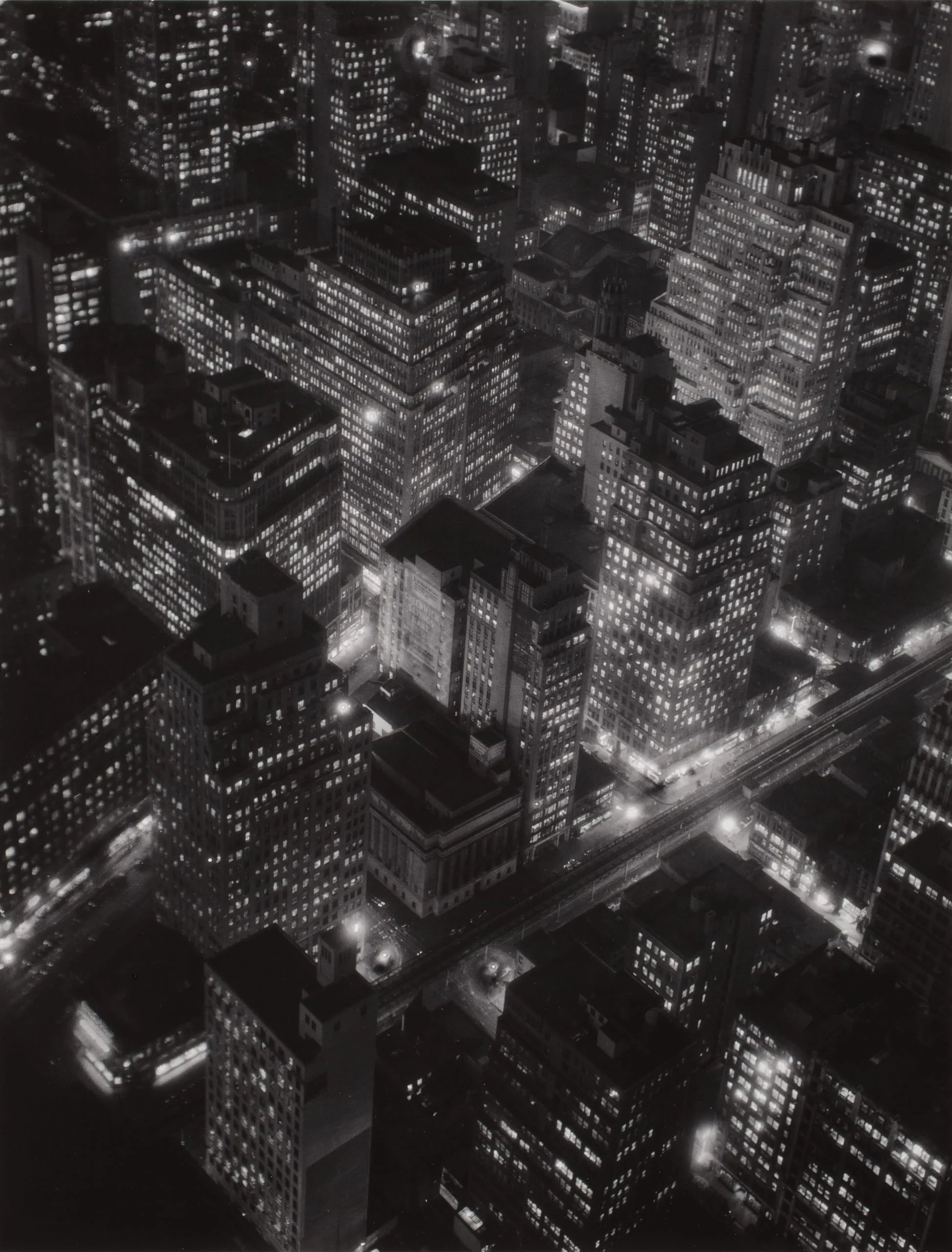
In 1929, after eight years in Paris, Berenice Abbott returned to New York with a passion to photograph the city as it underwent a major architectural transformation. This was New York’s second great skyscraper boom as nineteenth-century wood structures were rapidly replaced with steel highrises, and the boroughs were connected to Manhattan by newly built bridges. New York at Night, perhaps Abbott’s most well known photograph, is a celebration of the city as a connected metropolis glistening in the dark.
The image was made from the top of the Empire State Building looking north using an 8 x 10 view camera and a fifteen-minute exposure. Shot in the winter when the days are short, Abbott captured workers still in their offices just before their 5:00 departure when they would switch off the light. Typical of Abbott, architecture rather than people dominates the image, although their presence is implied by the thousands of lit-up windows. This photograph was first published in This Is New York, a guidebook described as the “first modern photographic book of New York,” alongside images by Margaret Bourke-White, Anton Bruehl, Walker Evans, and Ralph Steiner, among others, with the claim that these artists would teach the public how to see the city.
Born in 1897 in Springfield, Ohio, Abbott briefly studied sculpture, then moved to New York. There she met Man Ray, who hired her as his portrait studio assistant when she began living in Paris in 1923. A quick study, she was soon photographing her own clients in a section of his studio. Her style was casual and spontaneous, and she made memorable portraits of the city’s creative class, including James Joyce, Jean Cocteau, and Eugène Atget. Atget’s photographs of Paris became a passion project for Abbott, who, after he died in 1927, purchased his 400 glass-plate negatives and 7,800 prints, which she diligently archived, preserved, and promoted.
Upon returning to New York, she took assignments for Fortune magazine and photographed the construction of Rockefeller Center. Her time in Europe gave her a fresh view of New York City, and she began note-taking with a small camera, producing about 200 images. She switched to an 8 x 10 view camera and, in 1933, received WPA funding for her project Changing New York, published in book form in 1939. New York at Night is among the works included in this seminal documentation of New York’s radically transformed skyline.
Rebecca Morse, Curator, Wallis Annenberg Photography Department
2024
Bibliography
Yochelson, Bonnie. Berenice Abbott: Changing New York. New York: The Museum of the City of New York, 1997.
Exh. cat. Berenice Abbott Photographer: A Modern Vision. New York: New York Public Library, 1989.