LACMA

ShopMembershipMyLACMATickets
LACMA
Los Angeles County Museum of Art
5905 Wilshire Blvd.
Los Angeles, CA 90036
info@lacma.org
(323) 857-6000
Sign up to receive emails
Subscribe
© Museum Associates 2025

Museum Hours

Monday

11 am–6 pm

Tuesday

11 am–6 pm

Wednesday

Closed

Thursday

11 am–6 pm

Friday

11 am–8 pm

Saturday

10 am–7 pm

Sunday

10 am–7 pm


  • About LACMA
  • Jobs
  • Building LACMA
  • Host An Event
  • Unframed
  • Press
  • FAQs
  • Log in to MyLACMA
  • Privacy Policy
© Museum Associates 2025
Collections

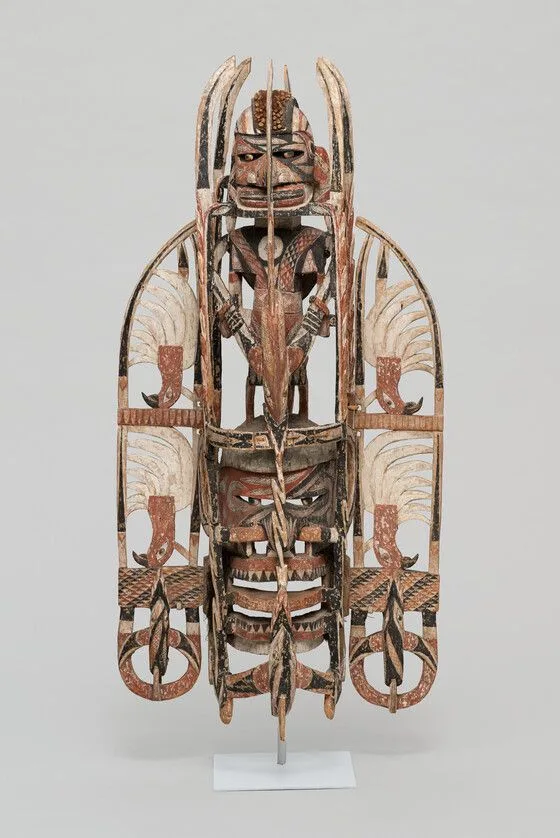
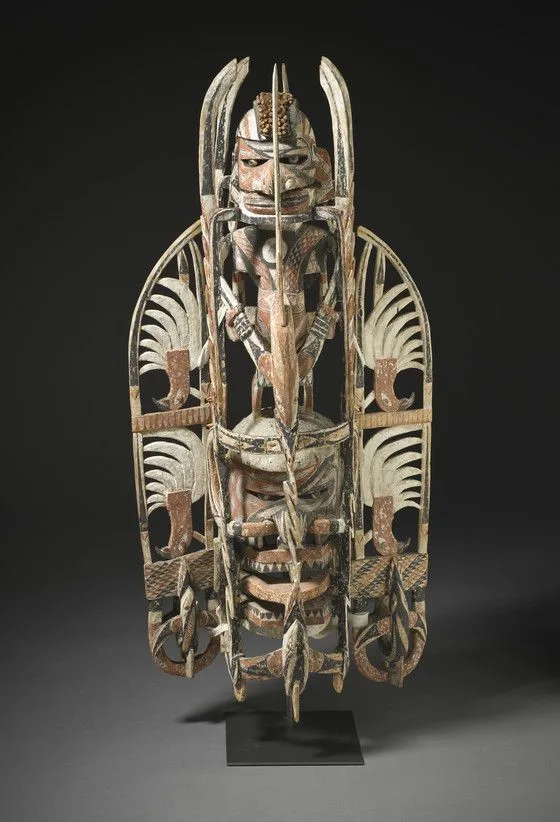
Mask (murua)circa 1890

On view:
Geffen Galleries, Navigating Pacific Asia
Tall carved wood sculpture with two stacked human faces, flanking lattice panels, and painted geometric patterns in rust red, white, and black, mounted on a display stand
Unknown, Mask (murua)
Title
Mask (murua)
Place Made
Papua New Guinea, New Ireland
Date Made
circa 1890
Medium
Wood, sea sponge, snail opercula, and pigment
Dimensions
37 x 18 1/2 x 10 in. (93.98 x 46.99 x 25.4 cm)
Credit Line
Purchased with funds provided by the Eli and Edythe Broad Foundation with additional funding by Jane and Terry Semel, the David Bohnett Foundation, Camilla Chandler Frost, Gayle and Edward P. Roski, and The Ahmanson Foundation
Accession Number
M.2008.66.39
Classification
Jewelry and Adornments
Collecting Area
Art of the Pacific
Curatorial Notes

Gallery Label
This murua, or mask, of human and animal figures consists of three sections joined together in a complex form. The intricately carved and painted figures represent characters in local legends and history, or possibly ancestors. The central head has a gaping mouth in the grimacing style common in such objects from New Ireland. The standing figure above it is designed with a fish and snake design winding down, with additional surrounding birds and fish. The entire murua is made of lightweight wood that is carved and then painted with red, black, and white pigments.

New Ireland’s unique social construction, known as malanggan, dictated most social procedures and art within the culture. Malanggan was an extended funerary and ceremonial gathering that took years of planning and preparation. The malanggan rites were primarily associated with funerals for multiple individuals that are often paired with the initiation ceremonies of young boys. Preparation began with individuals and families gathering pigs and other displays of wealth for the ceremonies’ feasts and dances. The production of the various types and styles of sculptures and masks for the malanggan also began in the months leading up to the rituals. The entire community was involved with the performances and feasts that were meant to complete the transition of the deceased into the spirit world. A performer wore the mask during the intricate and involved malanggan proceedings that govern society in New Ireland. Malanggan ceremonies also were places at which to solidify social relationships and gain social status through displays of wealth, including pigs and the quality of the malanggan carvings. This murua mask was worn at the end of the ceremony to clear the ceremonial grounds and village of taboos.

Another example of a malanggan mask is the tatanua which has been in LACMA’s collection since the early 1970s.


Selected Bibliography
  • Wardwell, Allen. Island Ancestors: Oceanic Art from the Masco Collection. [Seattle]: University of Washington Press, 1994.
  • Muchnic, Suzanne. LACMA So Far: Portrait of a Museum in the Making. San Marino, California: Huntington Library, Art Collections, and Botanical Gardens, 2015.