LACMA

ShopMembershipMyLACMATickets
LACMA
Los Angeles County Museum of Art
5905 Wilshire Blvd.
Los Angeles, CA 90036
info@lacma.org
(323) 857-6000
Sign up to receive emails
Subscribe
© Museum Associates 2025

Museum Hours

Monday

11 am–6 pm

Tuesday

11 am–6 pm

Wednesday

Closed

Thursday

11 am–6 pm

Friday

11 am–8 pm

Saturday

10 am–7 pm

Sunday

10 am–7 pm


  • About LACMA
  • Jobs
  • Building LACMA
  • Host An Event
  • Unframed
  • Press
  • FAQs
  • Log in to MyLACMA
  • Privacy Policy
© Museum Associates 2025
Collections

Ceremonial Figurecirca 1850

Not on view
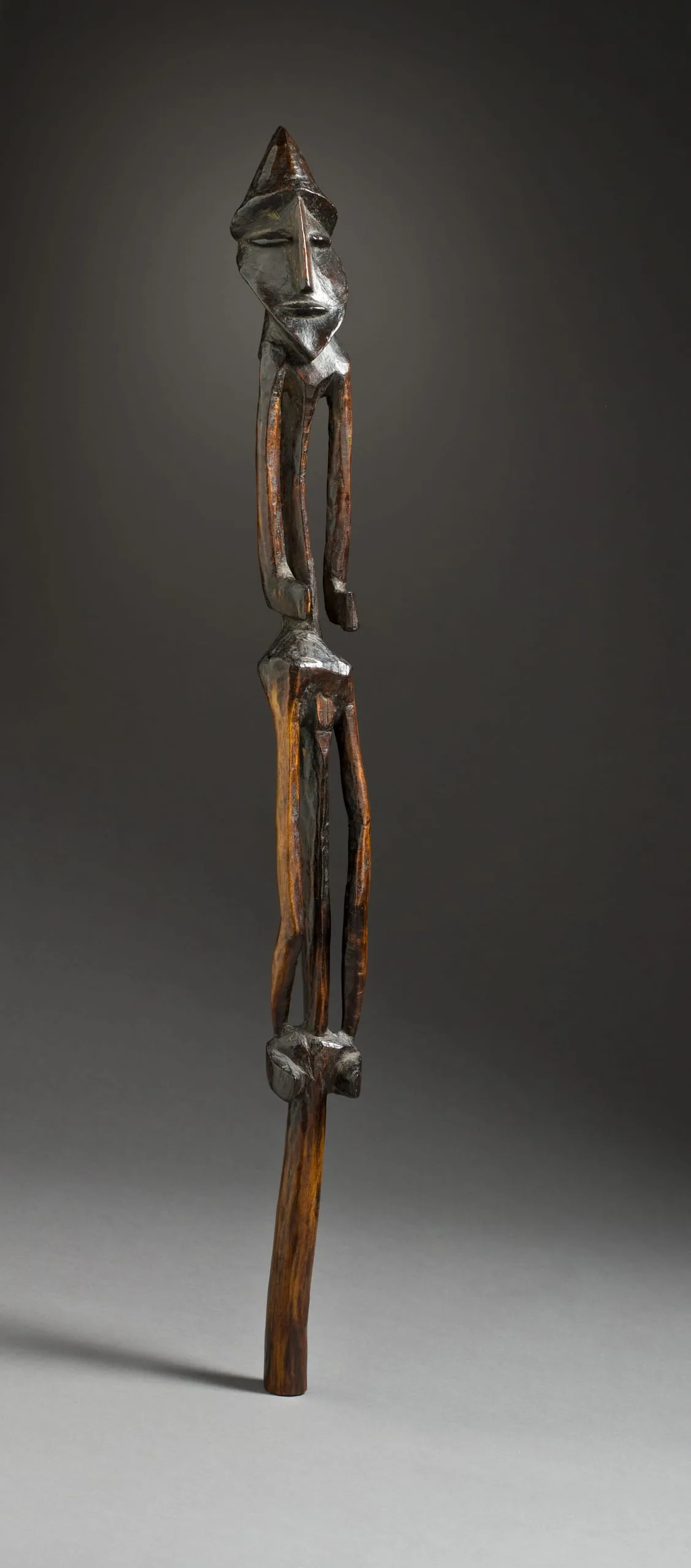
Carved wood staff sculpture with a highly stylized elongated human figure, featuring a pointed crown, angular face, and thin arms and legs gripping the shaft
Title
Ceremonial Figure
Place Made
Republic of Vanuatu, Banks Islands
Date Made
circa 1850
Medium
Fernwood
Dimensions
35 1/4 x 3 x 2 1/2 in. (89.54 x 7.62 x 6.35 cm)
Credit Line
Purchased with funds provided by the Eli and Edythe Broad Foundation with additional funding by Jane and Terry Semel, the David Bohnett Foundation, Camilla Chandler Frost, Gayle and Edward P. Roski, and The Ahmanson Foundation
Accession Number
M.2008.66.35
Classification
Sculpture
Collecting Area
Art of the Pacific
Curatorial Notes

Gallery Label
The islands of Vanuatu comprise many languages and cultures, whose artists have produced objects made with a wide diversity of materials and techniques. This figure has the typical features of a nineteenth-century Banks Island sculpture: elongated torso, serrated backbone, clearly defined arms and legs, and pointed cap and chin. Figures of this type often were made of a more fibrous fernwood; however, this example is made of a hardwood variety. These figures were commissioned for specific celebrations associated with the grade society initiations that dominated the social order in the Banks Islands.

The local society was broken down into a series of ranks, each requiring initiation. The Banks Islands area was under the single value system and code of conduct delineated by suque, the local term for the nonhereditary graded society. This system was based on complicated ritual practices associated with initiation into a succession of ranks based on displays of wealth and the learning of secret knowledge. Men moved through the initiation to higher levels, celebrating their increased knowledge with feasts, dances, the donation of pigs as symbols of wealth, and the commission of carved figures that were placed in specially built structures. These rituals were the primary means of increasing power and prestige in the community.

Most of the carved figures are believed to represent spirits or ancestors and were associated with specific ranks known to the initiates during the movement to their new rank. However, the particular grade of this sculpture is not known.


Selected Bibliography
  • Wardwell, Allen. Island Ancestors: Oceanic Art from the Masco Collection. [Seattle]: University of Washington Press, 1994.