LACMA

ShopMembershipMyLACMATickets
LACMA
Los Angeles County Museum of Art
5905 Wilshire Blvd.
Los Angeles, CA 90036
info@lacma.org
(323) 857-6000
Sign up to receive emails
Subscribe
© Museum Associates 2025

Museum Hours

Monday

11 am–6 pm

Tuesday

11 am–6 pm

Wednesday

Closed

Thursday

11 am–6 pm

Friday

11 am–8 pm

Saturday

10 am–7 pm

Sunday

10 am–7 pm


  • About LACMA
  • Jobs
  • Building LACMA
  • Host An Event
  • Unframed
  • Press
  • FAQs
  • Log in to MyLACMA
  • Privacy Policy
© Museum Associates 2025
Collections

Feast Bowlcirca 1800

Not on view
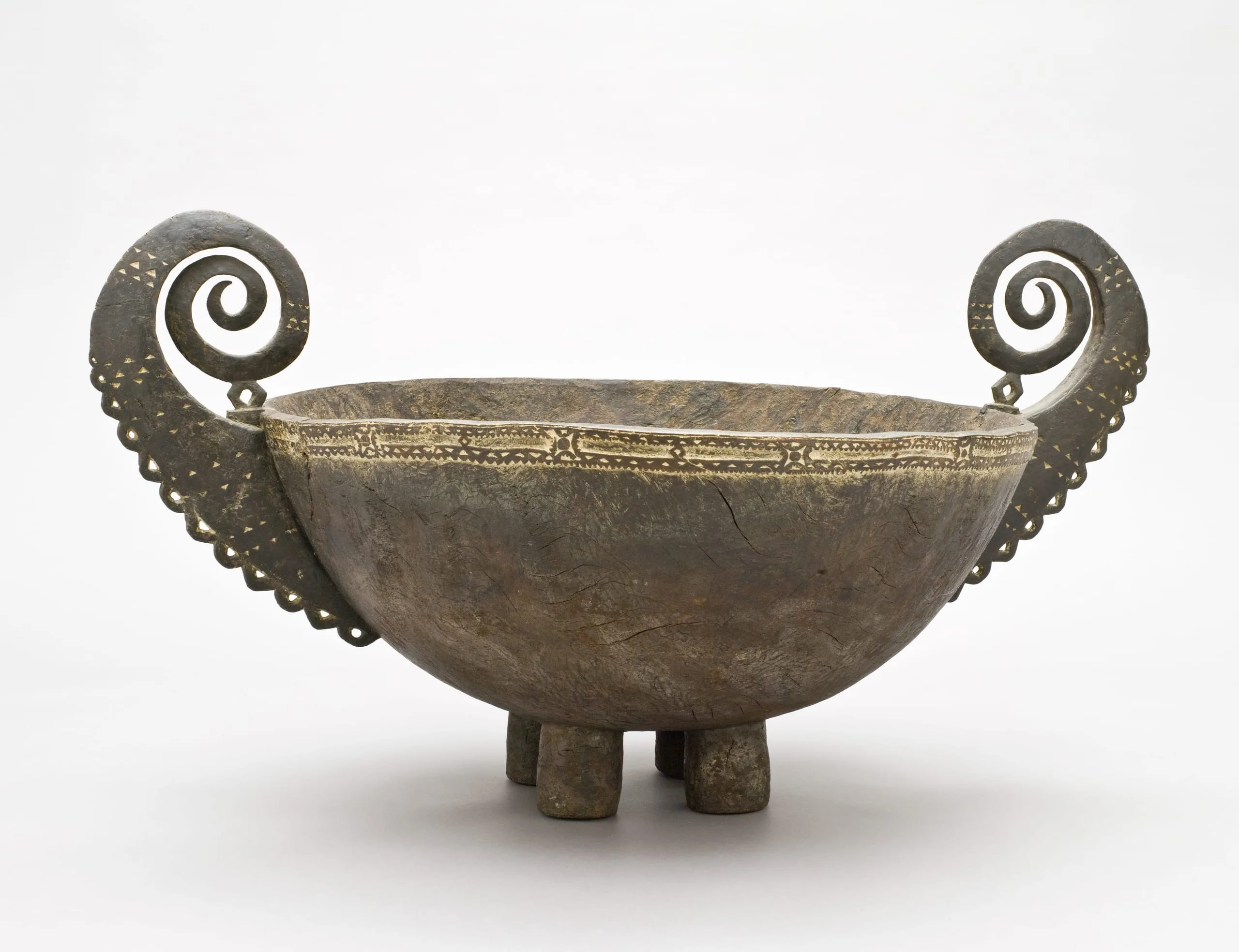
Ceramic or gourd bowl with four short legs, a gold-dotted geometric band at the rim, and two large metal handles curling into spirals with perforated scalloped edges
Title
Feast Bowl
Place Made
Papua New Guinea, Admiralty Islands, Lou Island
Date Made
circa 1800
Medium
Wood, parinarium nut paste, and traces of pigment
Dimensions
25 x 45 x 45 in. (63.5 x 114.3 x 114.3 cm)
Credit Line
Purchased with funds provided by the Eli and Edythe Broad Foundation with additional funding by Jane and Terry Semel, the David Bohnett Foundation, Camilla Chandler Frost, Gayle and Edward P. Roski, and The Ahmanson Foundation
Accession Number
M.2008.66.26
Classification
Furnishings
Collecting Area
Art of the Pacific
Curatorial Notes

Gallery Label
This bowl was carved from a single piece of wood, with its complexly carved handles formed independently and attached with parinarium nut paste. Unable to bear the weight of the vessel, these handles are purely decorative. The ornamental handles are carved in spiral designs, which add complexity to the more simply executed four-legged bowl. The bowl shows evidence of carving with obsidian tools and has a band of geometric relief carving around its rim.

Similar bowls were used in feasts to honor recently deceased ancestors on Lou Island, one of the Admiralty Islands. Feasts involved the entire community, and the bowls were used communally, which would explain the fairly large size. The use of such bowls waned after European contact, when missionary influence discouraged the traditional practices of ceremonial ancestor worship, and the bowls were discarded or destroyed.

Each of the Admiralty Islands, which are located to the north of the Papua New Guinea mainland, is known to have a different artistic specialty or style for its ceremonial objects. There is evidence that the inhabitants shared a seafaring culture almost five thousand years ago. Twenty or more languages are spoken in the region and the artistic diversity is reflected in the artfully rendered objects produced there.


Selected Bibliography
  • Wardwell, Allen. Island Ancestors: Oceanic Art from the Masco Collection. [Seattle]: University of Washington Press, 1994.