LACMA

ShopMembershipMyLACMATickets
LACMA
Los Angeles County Museum of Art
5905 Wilshire Blvd.
Los Angeles, CA 90036
info@lacma.org
(323) 857-6000
Sign up to receive emails
Subscribe
© Museum Associates 2025

Museum Hours

Monday

11 am–6 pm

Tuesday

11 am–6 pm

Wednesday

Closed

Thursday

11 am–6 pm

Friday

11 am–8 pm

Saturday

10 am–7 pm

Sunday

10 am–7 pm


  • About LACMA
  • Jobs
  • Building LACMA
  • Host An Event
  • Unframed
  • Press
  • FAQs
  • Log in to MyLACMA
  • Privacy Policy
© Museum Associates 2025
Collections

Fan Handlecirca 1900

Not on view
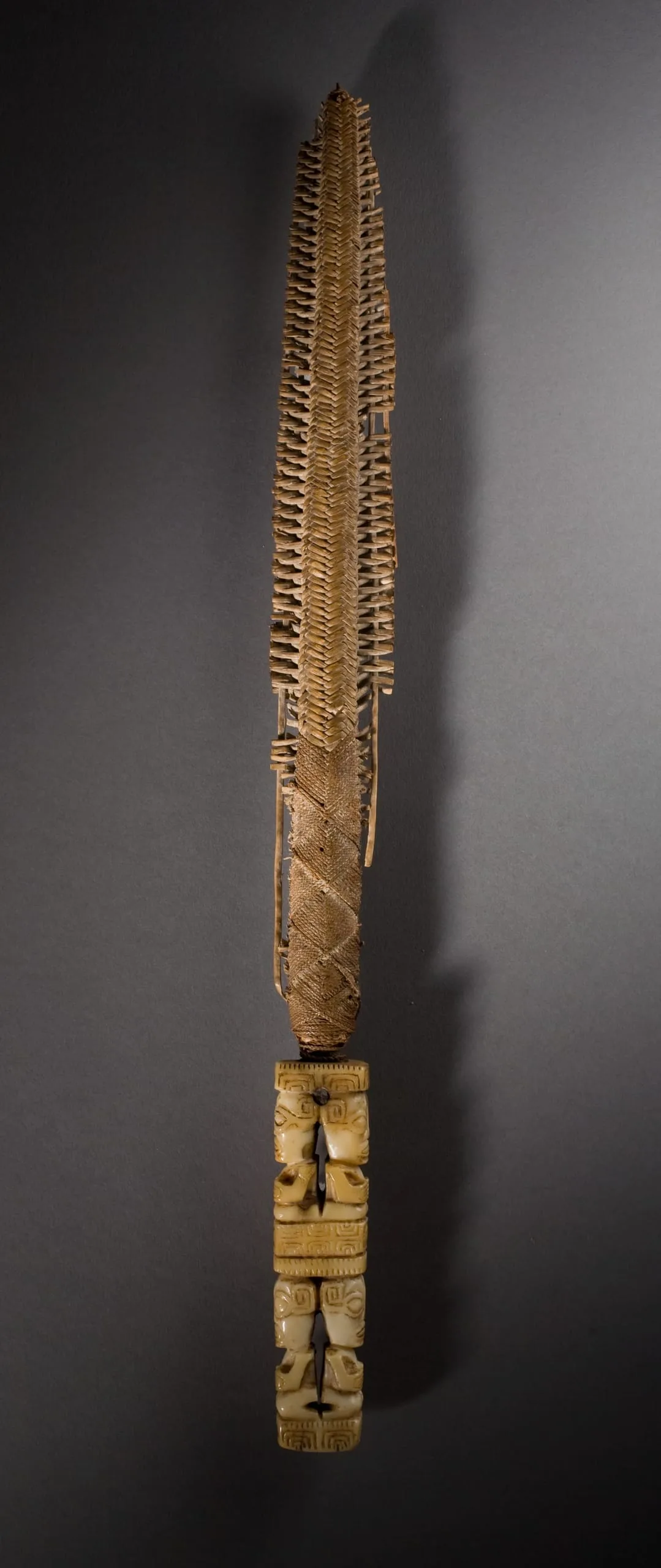
Tall ceremonial dagger with a serrated blade of bound organic teeth over a cord-wrapped spine, and a cream-colored carved bone or ivory handle with figural relief decoration
Title
Fan Handle
Place Made
Marquesas Islands (Te Henua 'Enana/Te Fenua 'Enata)
Date Made
circa 1900
Medium
Whale ivory and fiber
Dimensions
1 1/2 x 14 x 1/2 in. (3.81 x 35.56 x 1.27 cm)
Credit Line
Purchased with funds provided by the Eli and Edythe Broad Foundation with additional funding by Jane and Terry Semel, the David Bohnett Foundation, Camilla Chandler Frost, Gayle and Edward P. Roski, and The Ahmanson Foundation
Accession Number
M.2008.66.33
Classification
Tools and Equipment
Collecting Area
Art of the Pacific
Curatorial Notes

Gallery Label
This handle is carved with four tikis, images of a deity in human form, an important motif in Marquesan culture. It once had a fan of braided pandanus leaves woven over the handle and is made of whale ivory (others were made of wood or bone). The handles are often the only remaining parts of the fan, because the woven leaves wear or rot away, leaving the hardier handles.

The handle has pairs of tiki figures standing back to back and retains the complex weave of plaited sennit strands originally joining the fan and handle. The fans made in the Marquesas were woven in well-crafted patterns and were straight at the top, which varies from other Polynesian fans that have curved or pointed tops. This straight top was difficult to use in a utilitarian way because it did not move as smoothly through the air as the Polynesian curved-top fans. This nonutilitarian construction shows that Marquesan fans were used as decorative items, to display status through the fine craftsmanship involved in their creation.

This fan probably was owned by a chief or other noble person and displayed to symbolize rank. This is strange because Marquesan society differs from that of other Polynesian groups in that it was not a highly stratified social system based on chiefs and genealogy. Movement through social ranks was much more fluid and could pass outside of hereditary inheritance from father to son. The display of rank through objects did occur, but would not seem to be as strict as object display in other Polynesian hierarchies.


Selected Bibliography
  • Wardwell, Allen. Island Ancestors: Oceanic Art from the Masco Collection. [Seattle]: University of Washington Press, 1994.