LACMA

ShopMembershipMyLACMATickets
LACMA
Los Angeles County Museum of Art
5905 Wilshire Blvd.
Los Angeles, CA 90036
info@lacma.org
(323) 857-6000
Sign up to receive emails
Subscribe
© Museum Associates 2025

Museum Hours

Monday

11 am–6 pm

Tuesday

11 am–6 pm

Wednesday

Closed

Thursday

11 am–6 pm

Friday

11 am–8 pm

Saturday

10 am–7 pm

Sunday

10 am–7 pm


  • About LACMA
  • Jobs
  • Building LACMA
  • Host An Event
  • Unframed
  • Press
  • FAQs
  • Log in to MyLACMA
  • Privacy Policy
© Museum Associates 2025
Collections

Flute (putorino)18th century

Not on view
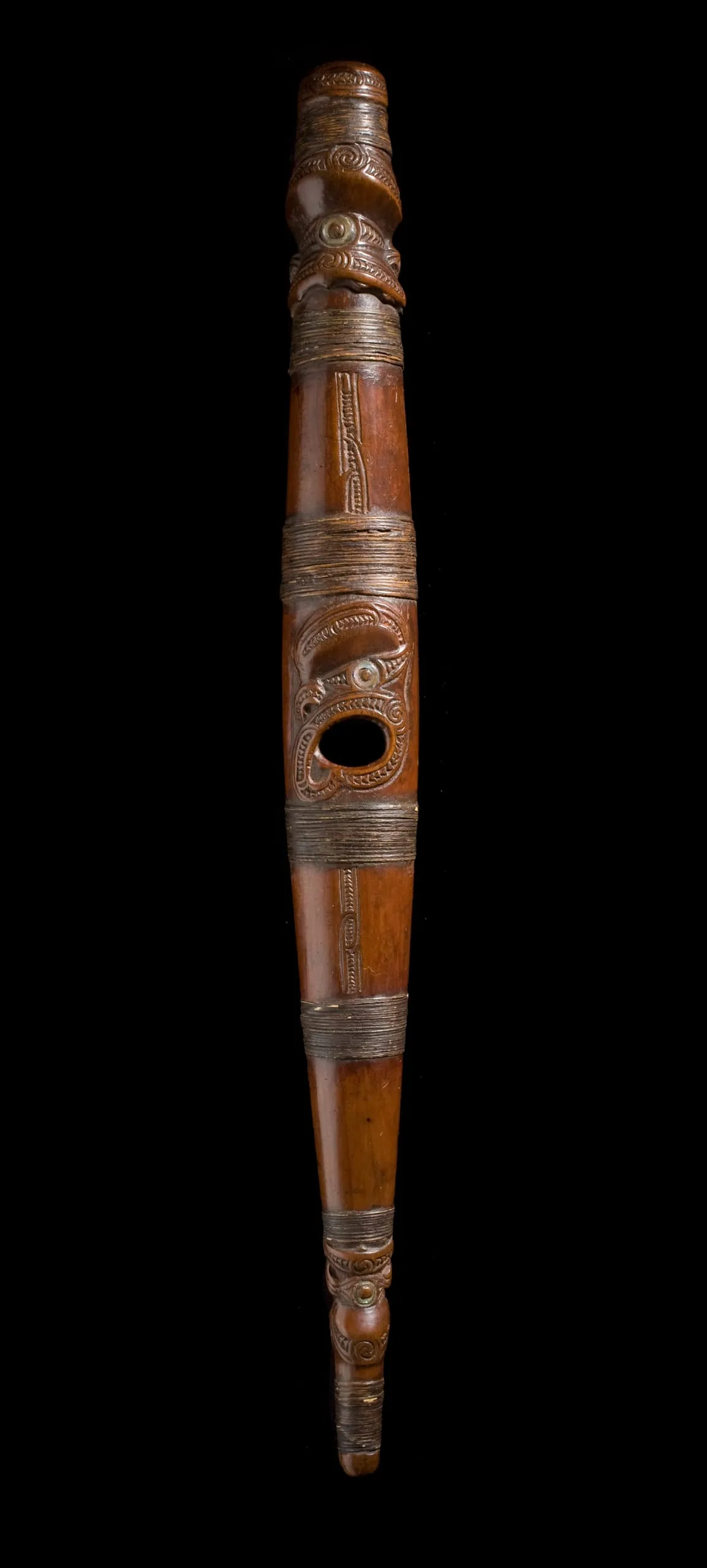
Carved wooden Māori weapon or implement with honey-brown wood, spiral relief carvings, three fiber cord bindings, a shell-inlaid figure at the top, and a central oval aperture
Title
Flute (putorino)
Culture
Maori, Te Arawa People, Tuhourangi tribe
Place Made
New Zealand (Aotearoa), Bay of Plenty Region, possibly Rotorua
Date Made
18th century
Medium
Wood, fiber, and Haliotis shell
Dimensions
1 1/4 x 15 1/2 x 1 3/4 in. (3.18 x 39.37 x 4.45 cm)
Credit Line
Purchased with funds provided by the Eli and Edythe Broad Foundation with additional funding by Jane and Terry Semel, the David Bohnett Foundation, Camilla Chandler Frost, Gayle and Edward P. Roski, and The Ahmanson Foundation
Accession Number
M.2008.66.36
Classification
Tools and Equipment
Collecting Area
Art of the Pacific
Curatorial Notes

Gallery Label
This long-form putorino flute is made of a cut and hollowed-out piece of wood carved very thin, with holes cut at each end and one into the side. The pieces of wood are then reattached with cord or resin to form a single-piece flute. A head or face is usually carved around the hole on the side, with the hole representing an open mouth. There are also additional carved tiki, or humanlike, figures above the hole near the top of the flute. This example is unique because the face around the hole is in profile.

Maori flutes did not provide a wide range of sound; they made no more than two notes. As such, flutes of this type were used as trumpets or bugles, not to make music but to gain the attention of the community for important events. The putorino is played from the larger end at the top, near the tiki carvings. Its signaling sound was a recognizable announcement typically heralding the return of chiefs and nobles from battle or long absence and for other ceremonial calls. Maori society was hierarchal based on the lineage of chiefs and their importance in the community. Because of their concentration of mana, or powerful life force, flutes like this were necessary in ritual contexts.


Selected Bibliography
  • Wardwell, Allen. Island Ancestors: Oceanic Art from the Masco Collection. [Seattle]: University of Washington Press, 1994.