LACMA

ShopMembershipMyLACMATickets
LACMA
Los Angeles County Museum of Art
5905 Wilshire Blvd.
Los Angeles, CA 90036
info@lacma.org
(323) 857-6000
Sign up to receive emails
Subscribe
© Museum Associates 2025

Museum Hours

Monday

11 am–6 pm

Tuesday

11 am–6 pm

Wednesday

Closed

Thursday

11 am–6 pm

Friday

11 am–8 pm

Saturday

10 am–7 pm

Sunday

10 am–7 pm


  • About LACMA
  • Jobs
  • Building LACMA
  • Host An Event
  • Unframed
  • Press
  • FAQs
  • Log in to MyLACMA
  • Privacy Policy
© Museum Associates 2025
Collections

Flywhisk Handlecirca 1818

Not on view
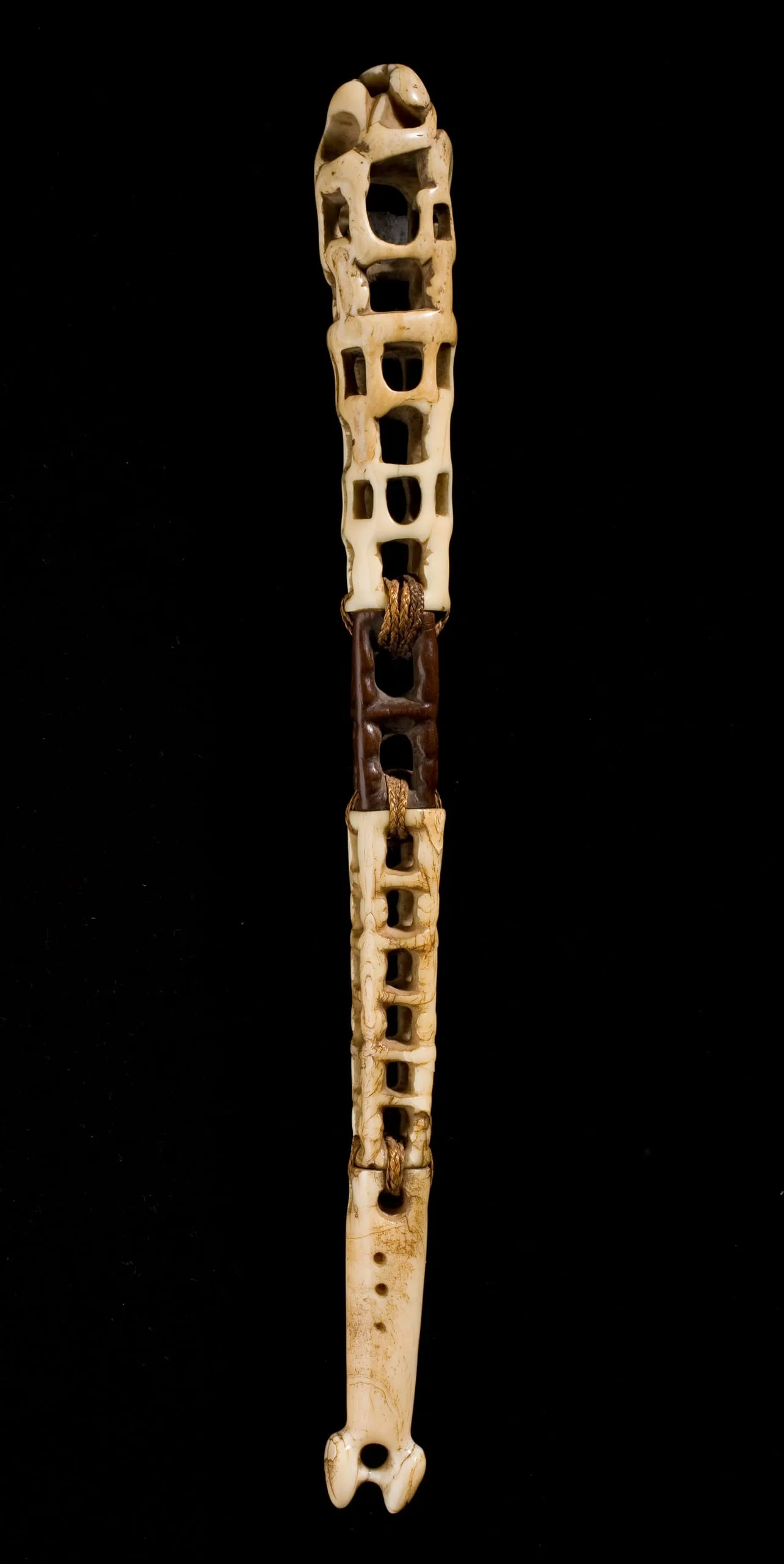
Carved bone or ivory object with lattice-like rectangular cutouts, in three joined segments — two cream-colored and one dark brown — against a black background
Title
Flywhisk Handle
Place Made
Society Islands
Date Made
circa 1818
Medium
Sperm whale ivory, wood, and fiber
Dimensions
1 1/4 x 13 x 1 1/2 in. (3.18 x 33.02 x 3.81 cm)
Credit Line
Purchased with funds provided by the Eli and Edythe Broad Foundation with additional funding by Jane and Terry Semel, the David Bohnett Foundation, Camilla Chandler Frost, Gayle and Edward P. Roski, and The Ahmanson Foundation
Accession Number
M.2008.66.32
Classification
Tools and Equipment
Collecting Area
Art of the Pacific
Curatorial Notes

Gallery Label
This flywhisk handle is an eighteenth-century example presented to the Rev. Haweis in 1818 by Pomare II, ruler of Tahiti. Tahiti is the best-known island in the Society Islands archipelago, which comprises nine larger islands, including fertile Tahiti, and four smaller atolls. Tahitian rank and status were highly stratified, and the power of the ruling class was linked to genealogy, kinship, and relation to the ancestors and gods, with individuals being born into their social positions. Ari’i, as the chiefs were known, carried signals of their royalty in their possessions. The symbolic authority in possessions such as a ceremonial flywhisk was demonstrated in craftsmanship and materials, such as fine wood and whale ivory. Utilitarian flywhisks were simpler, with less carving work and lower-quality wood, which denoted lower social ranks.

This example is an early variety of the ceremonial type and is noteworthy due to the use of sperm whale ivory. This flywhisk is rare, because it was made prior to contact with the West, and because it was made of whale ivory, which was difficult to obtain before Western whaling practices began. The appearance of rare materials brought added prestige to the owner. The openwork design is reminiscent of the well-known intricate carvings of the nearby Cook Islands. Here wood and ivory pieces are tied together with finely braided straw. The abstract forms have no definitive source or meaning, though hypotheses of the intertwined bending of human forms do exist.

Finely carved works such as these were done by tahu’a, or traditional craftsmen—who were in charge of creating and protecting objects used by the ari’i, or chiefs—to allow these objects to maintain their taboos that protected chiefs and their materials from citizens of lesser rank. These tahu’a were pushed out of their positions as important craftsmen/priests as European contact increased.


Selected Bibliography
  • Wardwell, Allen. Island Ancestors: Oceanic Art from the Masco Collection. [Seattle]: University of Washington Press, 1994.