LACMA

ShopMembershipMyLACMATickets
LACMA
Los Angeles County Museum of Art
5905 Wilshire Blvd.
Los Angeles, CA 90036
info@lacma.org
(323) 857-6000
Sign up to receive emails
Subscribe
© Museum Associates 2025

Museum Hours

Monday

11 am–6 pm

Tuesday

11 am–6 pm

Wednesday

Closed

Thursday

11 am–6 pm

Friday

11 am–8 pm

Saturday

10 am–7 pm

Sunday

10 am–7 pm


  • About LACMA
  • Jobs
  • Building LACMA
  • Host An Event
  • Unframed
  • Press
  • FAQs
  • Log in to MyLACMA
  • Privacy Policy
© Museum Associates 2025
Collections

Maskcirca 1820

Not on view
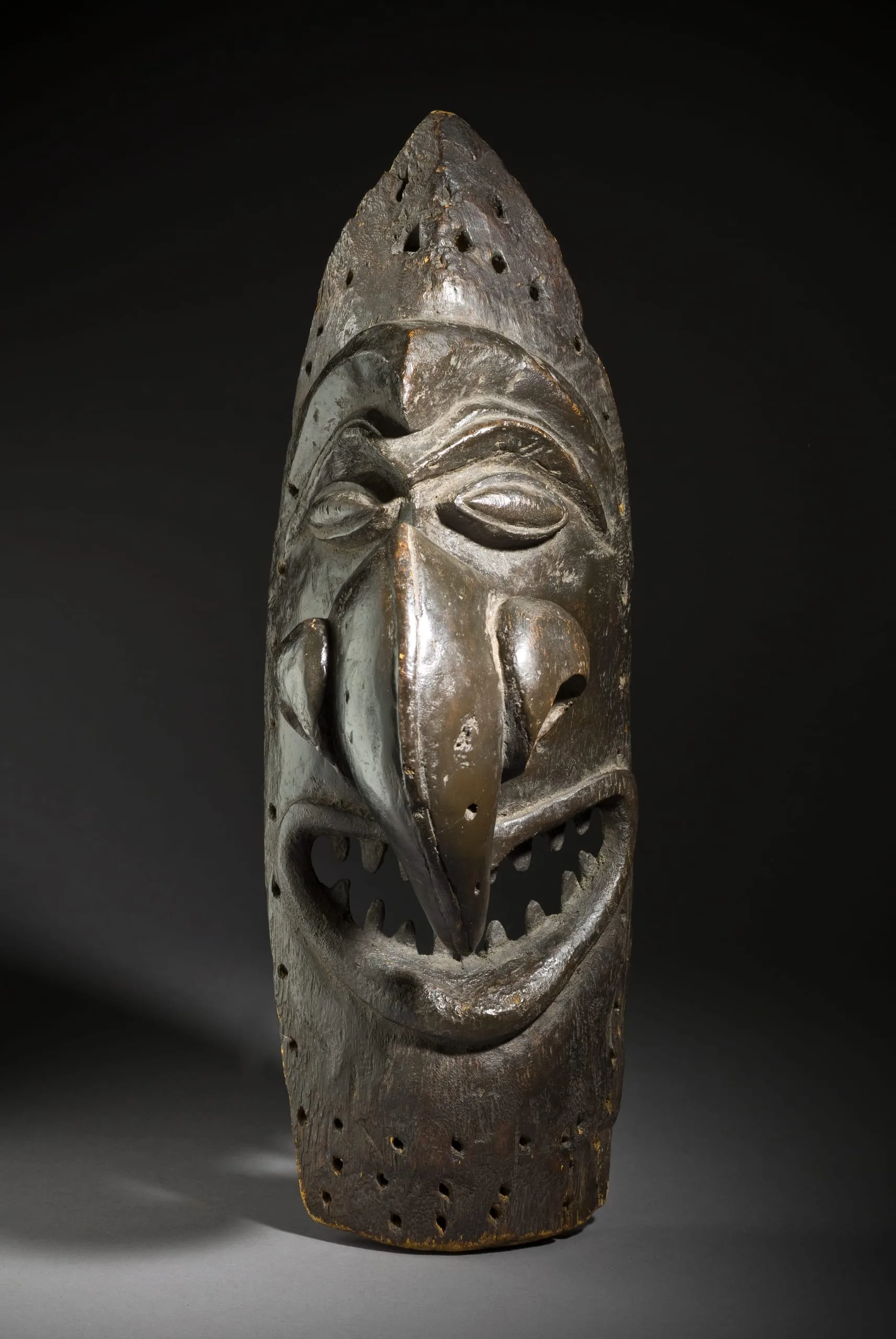
Carved wooden mask with a flame-shaped silhouette, dark pigmented surface, projecting hooked beak, open-mouthed teeth, and rows of drilled holes along the edges
Title
Mask
Place Made
New Caledonia
Date Made
circa 1820
Medium
Wood
Dimensions
21 x 8 x 6 1/2 in. (53.34 x 20.32 x 16.51 cm)
Credit Line
Purchased with funds provided by the Eli and Edythe Broad Foundation with additional funding by Jane and Terry Semel, the David Bohnett Foundation, Camilla Chandler Frost, Gayle and Edward P. Roski, and The Ahmanson Foundation
Accession Number
M.2008.66.25
Classification
Jewelry and Adornments
Collecting Area
Art of the Pacific
Curatorial Notes

Gallery Label
This heavy wood mask has a prominent and exaggerated hooked nose, full cheeks, angular mouth, and almond eyes. Carved holes at the edge were used to attach fiber or hair to construct a realistic beard. The hair was human and occasionally grown specifically for use on a ceremonial mask.

The striking shape of this mask has a few possible origins. It could be a representation of a myth story, in which a cultural hero lost his nose, causing him great shame, the mask therefore representing the nose he lost. The other possibility is that the shape reflects a stylistic influence from the neighboring islands of Vanuatu.

The mask is marked from the adze (a cutting tool used chiefly for shaping wood) that carved it, and although its exact function is unknown, it would have been paired with a full body costume. This costume may have been used in the mourning process and made of a cloak of dark feathers. The style of the mask, with its strong nose and facial features, indicates that it comes from the northern area of New Caledonia.


Selected Bibliography
  • Wardwell, Allen. Island Ancestors: Oceanic Art from the Masco Collection. [Seattle]: University of Washington Press, 1994.