LACMA

ShopMembershipMyLACMATickets
LACMA
Los Angeles County Museum of Art
5905 Wilshire Blvd.
Los Angeles, CA 90036
info@lacma.org
(323) 857-6000
Sign up to receive emails
Subscribe
© Museum Associates 2025

Museum Hours

Monday

11 am–6 pm

Tuesday

11 am–6 pm

Wednesday

Closed

Thursday

11 am–6 pm

Friday

11 am–8 pm

Saturday

10 am–7 pm

Sunday

10 am–7 pm


  • About LACMA
  • Jobs
  • Building LACMA
  • Host An Event
  • Unframed
  • Press
  • FAQs
  • Log in to MyLACMA
  • Privacy Policy
© Museum Associates 2025
Collections

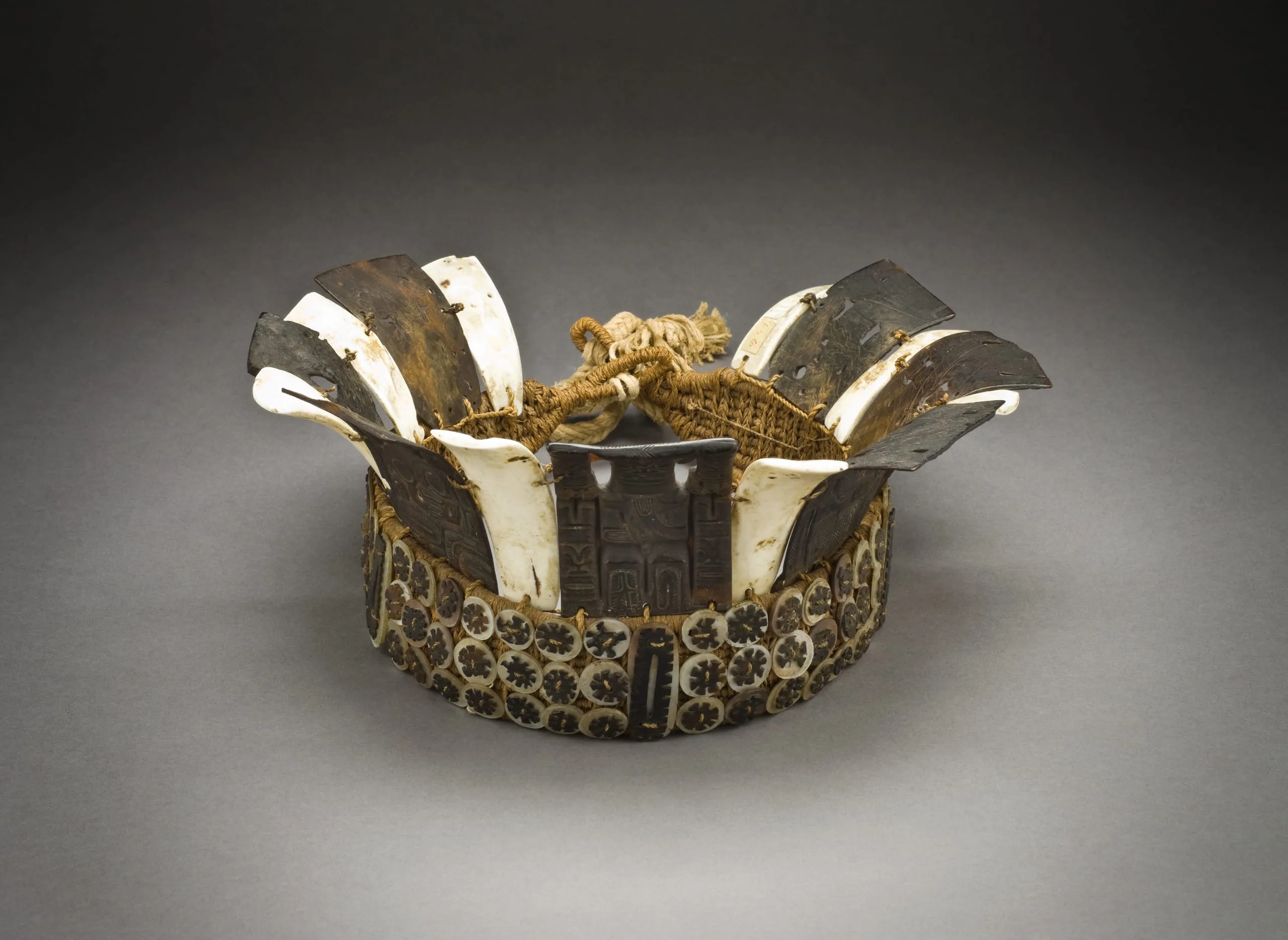
Headdress (paekaha)circa 1850

Not on view
Crown-shaped ceremonial object with ivory-white curved elements rising from a cylindrical band covered in dark rosette discs, with woven fiber construction and a carved central plaque
Title
Headdress (paekaha)
Place Made
Marquesas Islands (Te Henua 'Enana/Te Fenua 'Enata)
Date Made
circa 1850
Medium
Tortoise-shell, conch shell, and fiber
Dimensions
Height: 3 1/2 in. (8.89 cm); Diameter: 8 5/8 in. (21.91 cm)
Credit Line
Purchased with funds provided by the Eli and Edythe Broad Foundation with additional funding by Jane and Terry Semel, the David Bohnett Foundation, Camilla Chandler Frost, Gayle and Edward P. Roski, and The Ahmanson Foundation
Accession Number
M.2008.66.34
Classification
Jewelry and Adornments
Collecting Area
Art of the Pacific
Curatorial Notes

Gallery Label
The Marquesan chiefs employed the tuhuna, or craftsmen, to carve each of the unique tortoise and conch shell plaques that make up this headdress. The tortoise shell plaques were formed to match the curve of the conch shell pieces and both were attached to a woven band of coconut fiber. This band, which also had rows of thin pearl disks and tortoise shell elements attached to the fiber, was tied around the top of the head. The tortoiseshell plaques were carved with tiki figures set frontally alternating with smaller tiki figures at each side.

This meticulously constructed headdress was worn by the high-status men and women in Marquesan society. Marquesan social ranks were unique in Polynesia because the upper ranks had no connection to divine powers as they did elsewhere in the region, and status was hereditary but flexible. The majority of Polynesian cultures had strict hierarchies that did not allow for flexible movement among the ranks.

Controversy exists among scholars concerning the way the paekaha was worn. After contact with foreign travelers, the headdress was recorded as being worn with the plaques sloping down and outward, creating a rim where objects could be hung. Yet, if the headdress was in fact worn this way, the carved images and designs on the plaques would be upside-down. Many scholars conclude that it was worn the other way, keeping the figures upright, and that postcontact, the Marquesans switched styles to mimic the hats of visiting sailors.


Selected Bibliography
  • Wardwell, Allen. Island Ancestors: Oceanic Art from the Masco Collection. [Seattle]: University of Washington Press, 1994.