LACMA

ShopMembershipMyLACMATickets
LACMA
Los Angeles County Museum of Art
5905 Wilshire Blvd.
Los Angeles, CA 90036
info@lacma.org
(323) 857-6000
Sign up to receive emails
Subscribe
© Museum Associates 2025

Museum Hours

Monday

11 am–6 pm

Tuesday

11 am–6 pm

Wednesday

Closed

Thursday

11 am–6 pm

Friday

11 am–8 pm

Saturday

10 am–7 pm

Sunday

10 am–7 pm


  • About LACMA
  • Jobs
  • Building LACMA
  • Host An Event
  • Unframed
  • Press
  • FAQs
  • Log in to MyLACMA
  • Privacy Policy
© Museum Associates 2025
Collections

Female Figurecirca 1850

Not on view
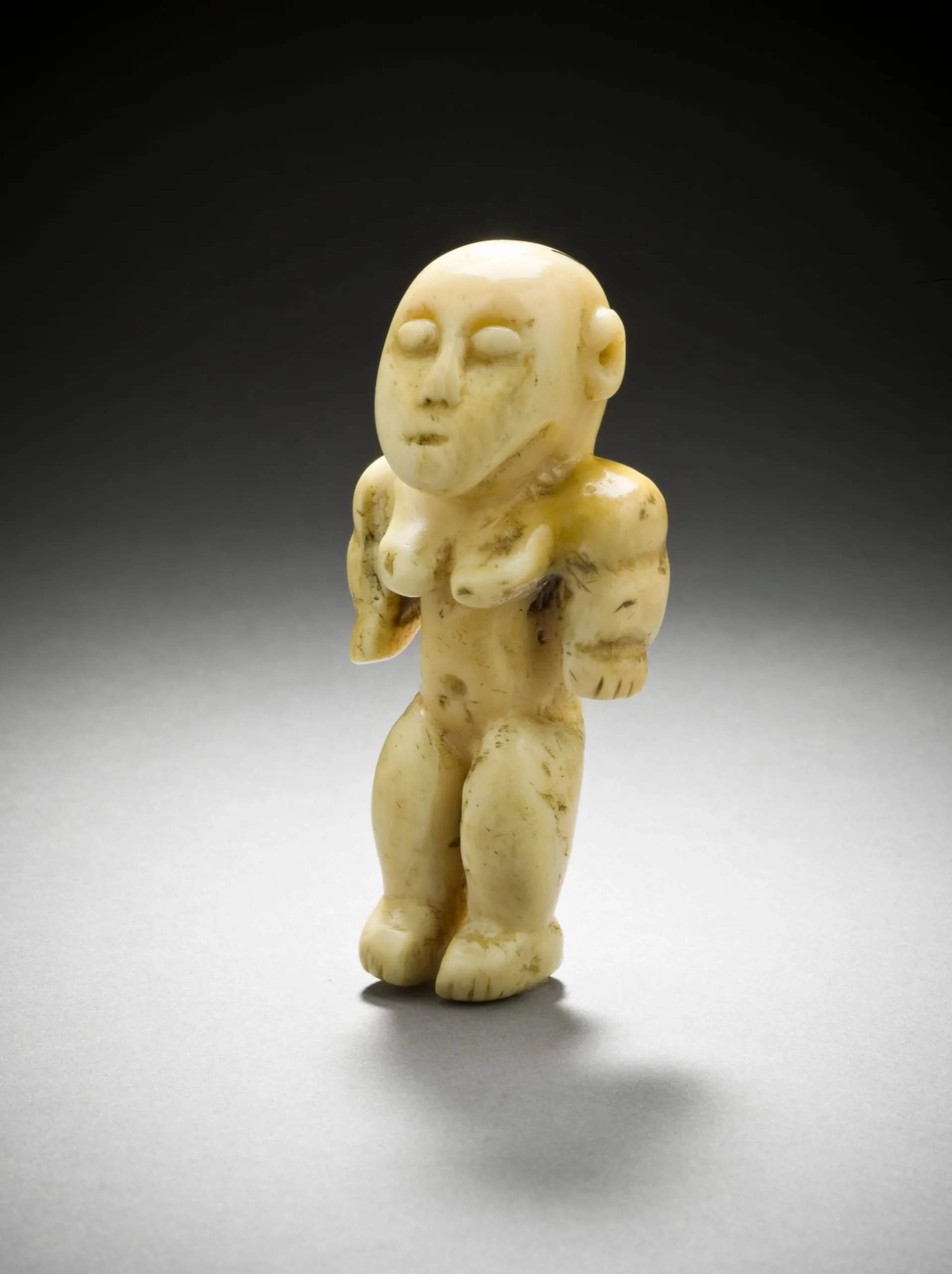
Small carved bone or ivory figurine of a seated human form with a large rounded head, raised arms, and dark streaks across the pale surface
Title
Female Figure
Place Made
Tonga
Date Made
circa 1850
Medium
Sperm whale ivory
Dimensions
3 x 1 1/2 x 1 1/2 in. (7.62 x 3.81 x 3.81 cm)
Credit Line
Purchased with funds provided by the Eli and Edythe Broad Foundation with additional funding by Jane and Terry Semel, the David Bohnett Foundation, Camilla Chandler Frost, Gayle and Edward P. Roski, and The Ahmanson Foundation
Accession Number
M.2008.66.31
Classification
Sculpture
Collecting Area
Art of the Pacific
Curatorial Notes

Gallery Label
This pendant is one of only nineteen small Tongan figural sculptures in existence. Most are made of ivory, some larger examples are wooden, and all have the same general interpretation of the female form. It is likely that they are representations of female ancestors, which were important in the Tongan bloodline. The female figure also could be seen as the originator of the leading hereditary descent line. The figures were worn by high-ranking females and could have been strung together on a necklace. All of the figures share a similar stance and specific stylistic features, including short powerful bodies with bent, flexed legs, pointed breasts, strong trunks, and flat triangular faces and facial features. Some examples found in Fiji have carved areas at the back of the head that may have been used as suspension areas for a necklace, and are more than likely Tongan in origin. The use of rare whale ivory indicates that the figure was a highly treasured object.


Selected Bibliography
  • Wardwell, Allen. Island Ancestors: Oceanic Art from the Masco Collection. [Seattle]: University of Washington Press, 1994.
  • Harding, Julian. "Pacific Treasures: the Masco Collection Goes to Los Angeles." Tribal Art no.50 (2008): 68-73.