LACMA

ShopMembershipMyLACMATickets
LACMA
Los Angeles County Museum of Art
5905 Wilshire Blvd.
Los Angeles, CA 90036
info@lacma.org
(323) 857-6000
Sign up to receive emails
Subscribe
© Museum Associates 2025

Museum Hours

Monday

11 am–6 pm

Tuesday

11 am–6 pm

Wednesday

Closed

Thursday

11 am–6 pm

Friday

11 am–8 pm

Saturday

10 am–7 pm

Sunday

10 am–7 pm


  • About LACMA
  • Jobs
  • Building LACMA
  • Host An Event
  • Unframed
  • Press
  • FAQs
  • Log in to MyLACMA
  • Privacy Policy
© Museum Associates 2025
Collections

Maskcirca 1909

Not on view
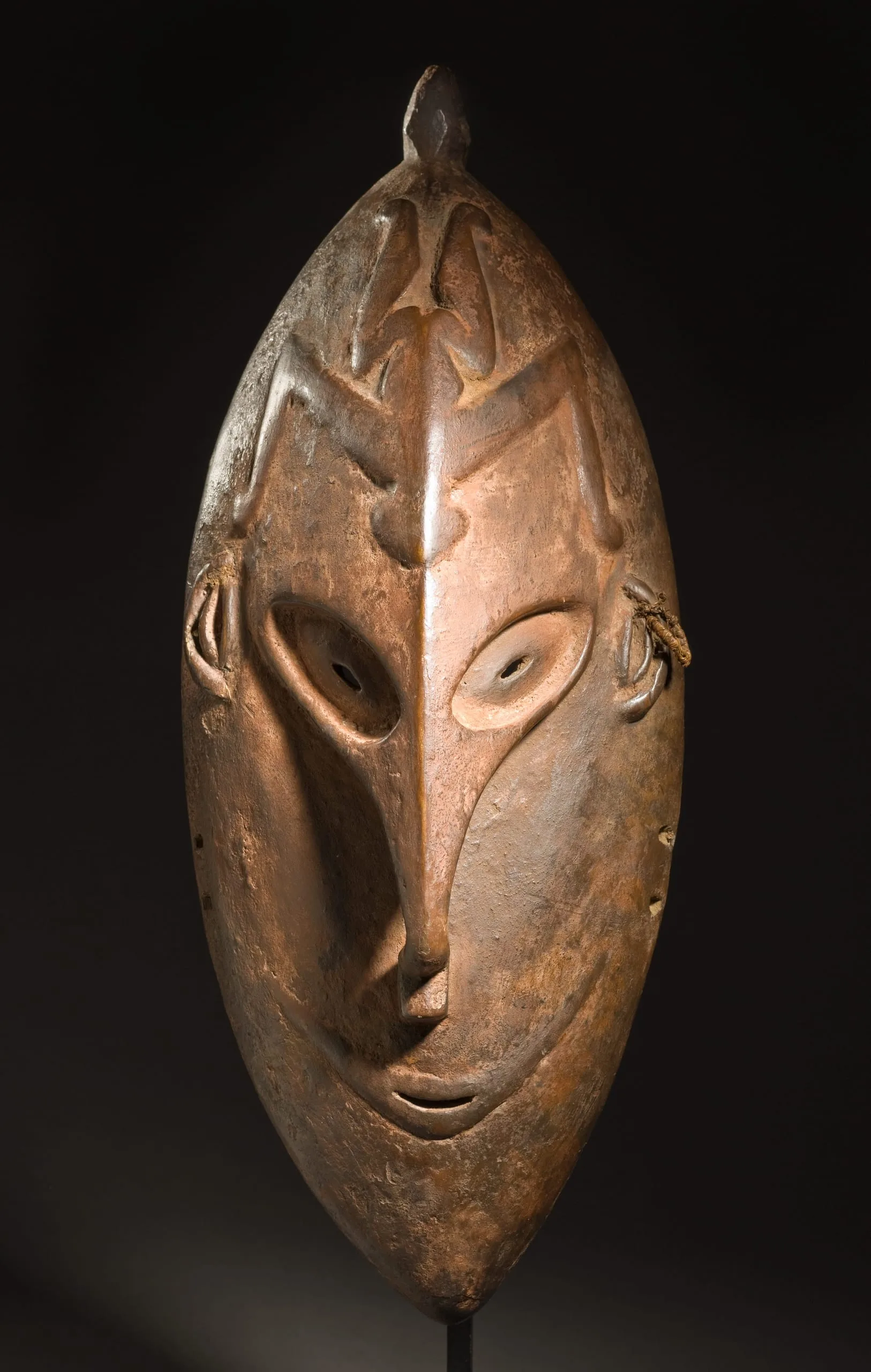
Carved wooden face mask with an elongated oval form, warm brown patina, almond-shaped eye sockets, and relief-carved geometric designs on the upper surface, mounted on a thin rod
Title
Mask
Place Made
Papua New Guinea, East Sepik Province, Lower Sepik River, Coastal Zone
Date Made
circa 1909
Medium
Wood and traces of pigment
Dimensions
15 1/2 x 6 1/4 x 4 in. (39.37 x 15.88 x 10.16 cm)
Credit Line
Purchased with funds provided by the Eli and Edythe Broad Foundation with additional funding by Jane and Terry Semel, the David Bohnett Foundation, Camilla Chandler Frost, Gayle and Edward P. Roski, and The Ahmanson Foundation
Accession Number
M.2008.66.28
Classification
Jewelry and Adornments
Collecting Area
Art of the Pacific
Curatorial Notes

Gallery Label
This mask has the typical features of a coastal Sepik River–area mask, which combines human and avian designs. The birdlike combination includes an elongated beaked nose on an oval face with a pointed chin and slanted eyes. The mask was made of wood with few surface details other than paint and a totemic relief meant to represent an ancestor.

Masks such as this one were kept in ceremonial houses and used in song and dance rituals. Other masks of varying sizes were placed on the gables of ceremonial houses, attached to canoes, or kept as personal amulets.

This mask was used in a number of different ceremonies: events celebrating and honoring marriage, birth, death, and fertility, among them. There were songs and dances to honor the specific ancestor the mask personified and such a mask was used with a costume. The masks and costumes were painted and adorned for the ceremonial use. Following completion of the festivities, the masks were kept, while the costumes were destroyed.


Selected Bibliography
  • Wardwell, Allen. Island Ancestors: Oceanic Art from the Masco Collection. [Seattle]: University of Washington Press, 1994.