LACMA

ShopMembershipMyLACMATickets
LACMA
Los Angeles County Museum of Art
5905 Wilshire Blvd.
Los Angeles, CA 90036
info@lacma.org
(323) 857-6000
Sign up to receive emails
Subscribe
© Museum Associates 2025

Museum Hours

Monday

11 am–6 pm

Tuesday

11 am–6 pm

Wednesday

Closed

Thursday

11 am–6 pm

Friday

11 am–8 pm

Saturday

10 am–7 pm

Sunday

10 am–7 pm


  • About LACMA
  • Jobs
  • Building LACMA
  • Host An Event
  • Unframed
  • Press
  • FAQs
  • Log in to MyLACMA
  • Privacy Policy
© Museum Associates 2025
Collections

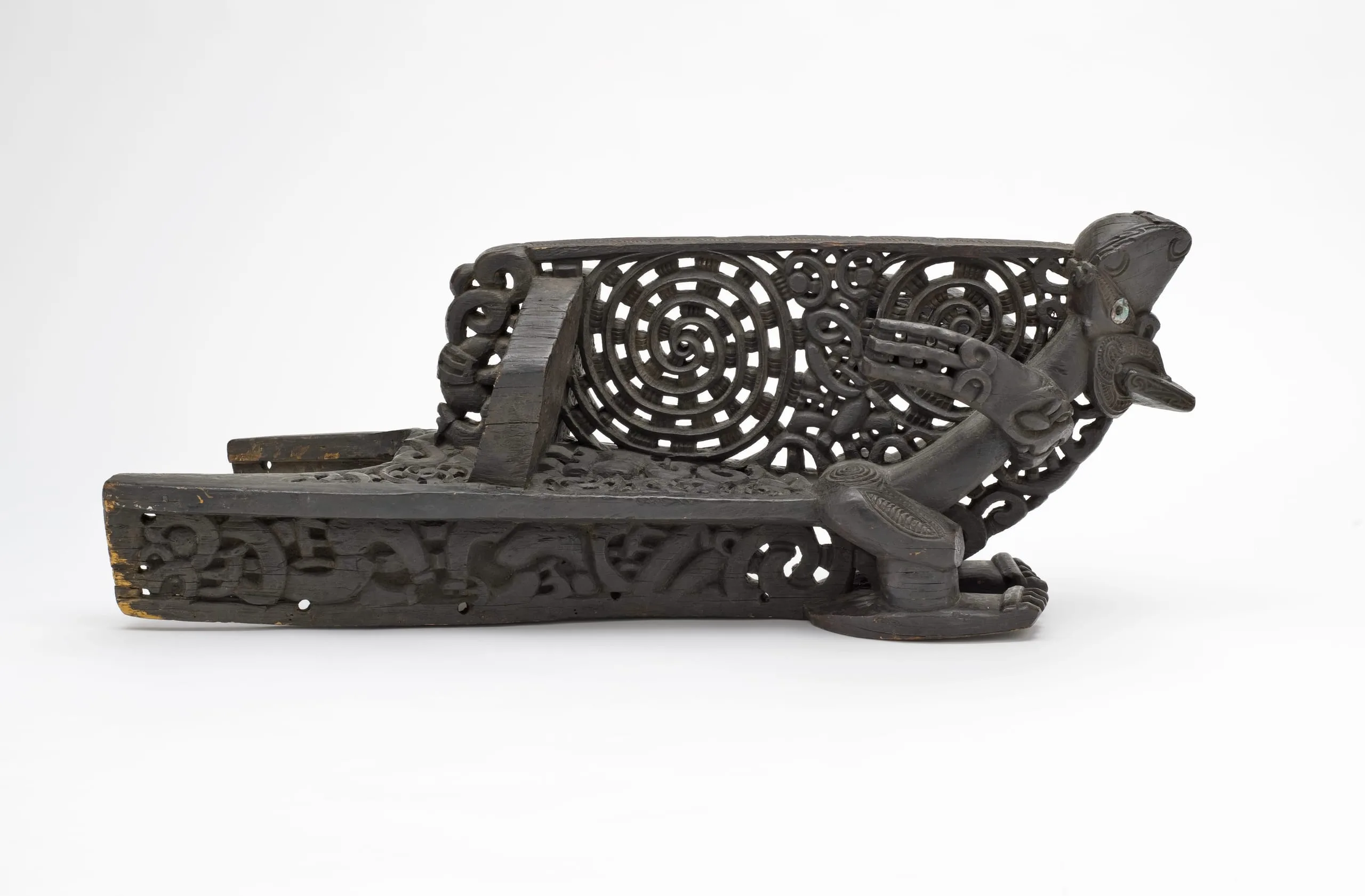
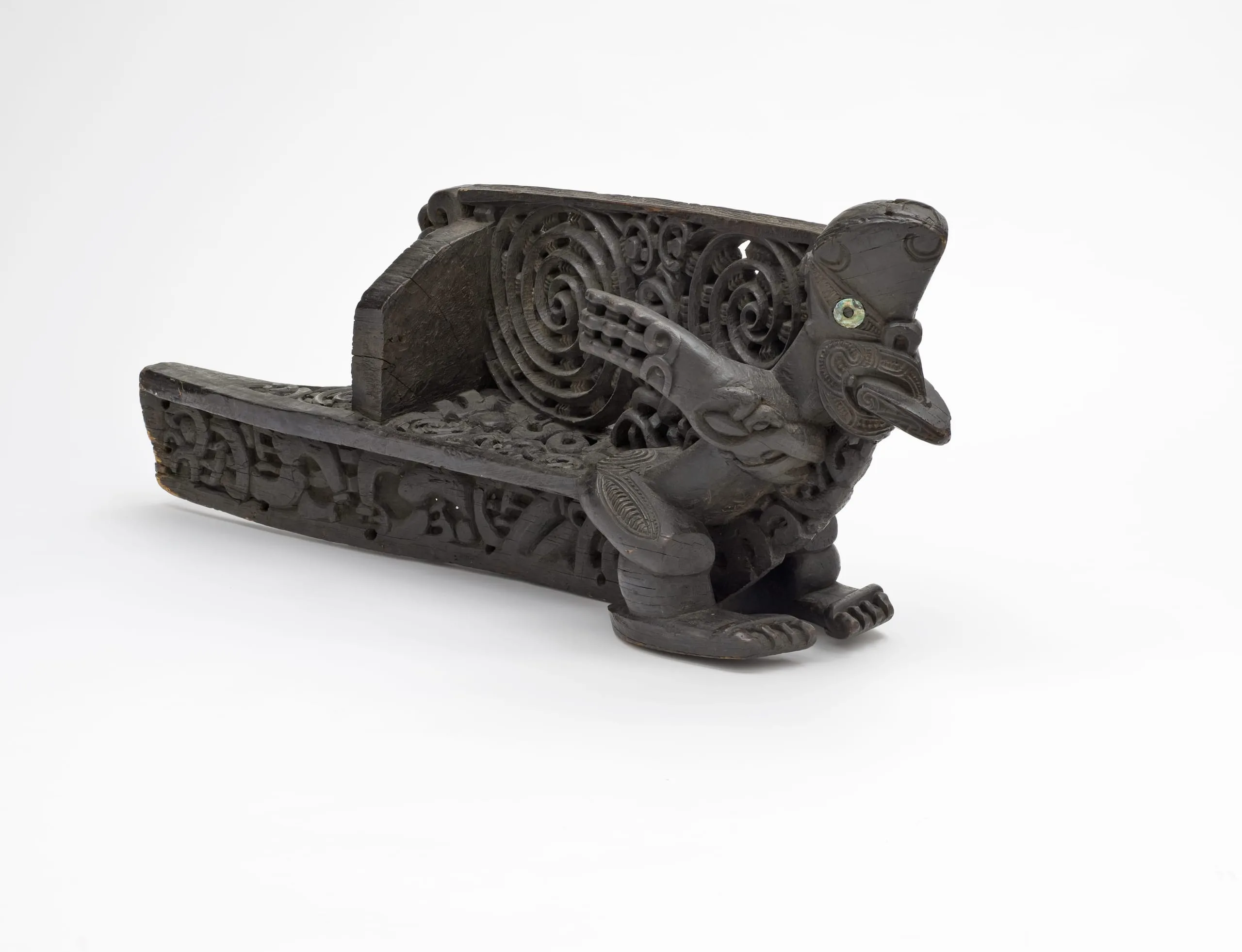
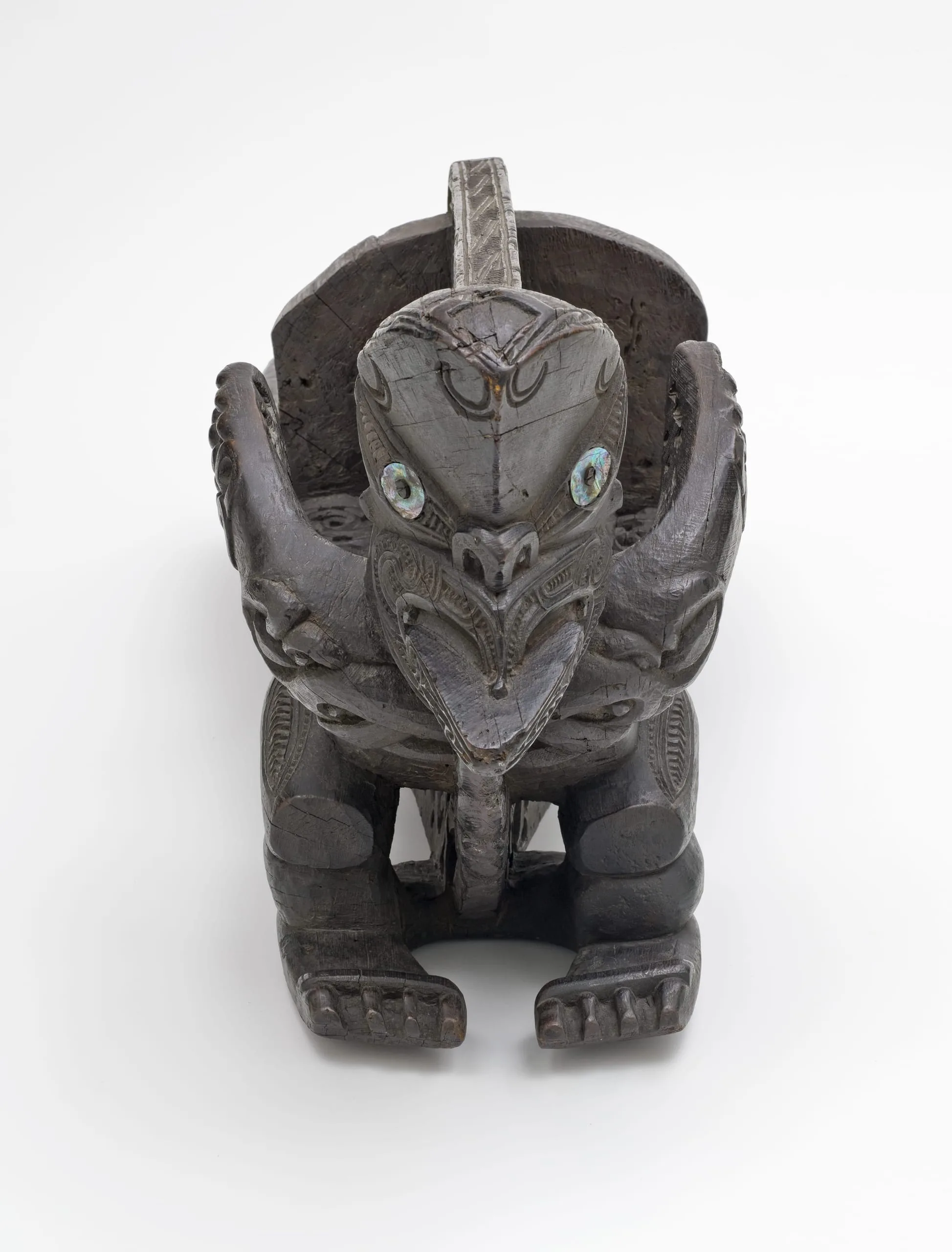
Canoe Prow (tauihu)circa 1860

On view:
Geffen Galleries, Polynesia: "Our Sea of Islands"
Dark carved wooden object with pierced spiral panel, interlocking curvilinear relief carving, and a three-dimensional crouching figure with shell-inlaid eyes at one end
Carved wooden Māori object with a crouching figure at one end featuring inlaid pāua shell eyes and an open mouth with protruding tongue; the elongated base is densely covered in koru and kowhaiwhai relief carving, dark brown-black patina throughout.
Carved wooden figure in a crouching posture with a hollowed vessel on its back, dense surface carving throughout, and inlaid pāua shell eyes with blue-green iridescence.
Title
Canoe Prow (tauihu)
Culture
Maori
Place Made
New Zealand (Aotearoa), Hawkes Bay Region, Wairoa District
Date Made
circa 1860
Medium
Wood and Haliotis shell
Dimensions
20 x 57 x 17 1/2 in. (50.8 x 144.78 x 44.45 cm)
Credit Line
Purchased with funds provided by the Eli and Edythe Broad Foundation with additional funding by Jane and Terry Semel, the David Bohnett Foundation, Camilla Chandler Frost, Gayle and Edward P. Roski, and The Ahmanson Foundation
Accession Number
M.2008.66.21
Classification
Tools and Equipment
Collecting Area
Art of the Pacific
Curatorial Notes

Gallery Label
The large canoes that had attached a prow such as this were carved from one large totara tree trunk. The additional prow and stern ornaments were attached later, creating an extremely skillfully carved whole. The soft totara wood made for good carving, and the more skilled the carving, the higher the status of the owner and the vessel’s occupants. The canoe ornaments have the curvilinear style of classic Maori carving, with spiral frets and abstract figural patterns. There is no specific meaning known for the double-spiral design on this nonrectangular prow. The carved seated figure added to the end of the prow was meant to protect and watch over the canoe’s occupants and would gain mana, or power, as more successful expeditions were completed. The figure could represent an ancestor, and with this ancestral power, also mana, that could provide courage, endurance, and enterprise on the canoe’s voyage—both for the canoe and its occupants.

Canoes played an incredibly important part of Maori culture and myth. They were said to have carried the first ancestors to the islands, and were highly decorated and intricately carved to show their significance. This was because the high-status craftsmen (tohunga) were able to control and harness mana in important objects such as canoes, for which a well-carved prow held the mana. This was seen as integral during the war expeditions for which the canoe with this prow was used. There are few complete surviving examples of classic Maori war canoes (one such vessel is in the Auckland Museum in New Zealand).


Selected Bibliography
  • Wardwell, Allen. Island Ancestors: Oceanic Art from the Masco Collection. [Seattle]: University of Washington Press, 1994.