LACMA

ShopMembershipMyLACMATickets
LACMA
Los Angeles County Museum of Art
5905 Wilshire Blvd.
Los Angeles, CA 90036
info@lacma.org
(323) 857-6000
Sign up to receive emails
Subscribe
© Museum Associates 2025

Museum Hours

Monday

11 am–6 pm

Tuesday

11 am–6 pm

Wednesday

Closed

Thursday

11 am–6 pm

Friday

11 am–8 pm

Saturday

10 am–7 pm

Sunday

10 am–7 pm


  • About LACMA
  • Jobs
  • Building LACMA
  • Host An Event
  • Unframed
  • Press
  • FAQs
  • Log in to MyLACMA
  • Privacy Policy
© Museum Associates 2025
Collections

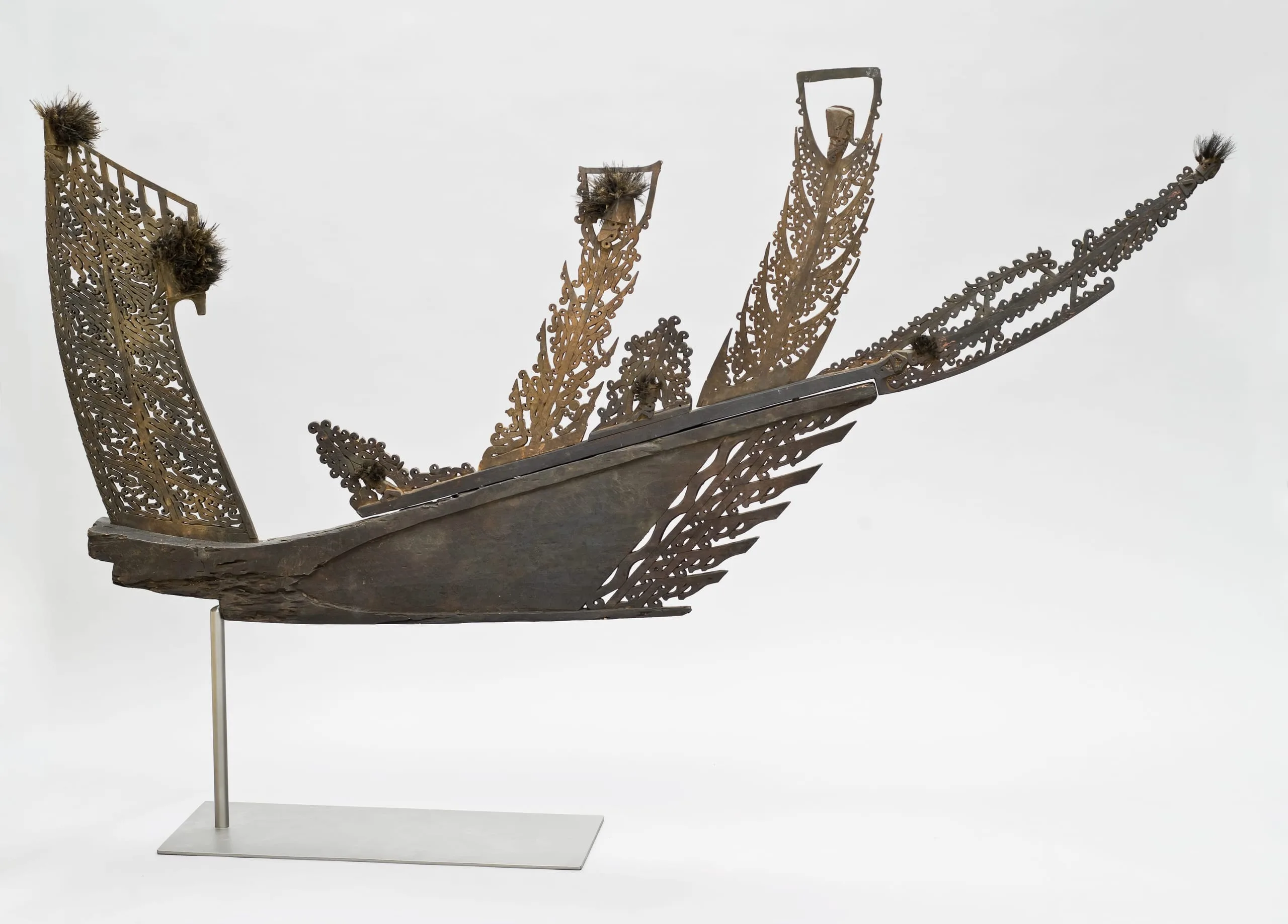
Canoe Prow (haluan perahu)circa 1890

On view:
Geffen Galleries, Navigating Pacific Asia
Decorative metal vessel form with pierced scrollwork panels and gilded accents, displayed on a museum stand, with small fur or feather tufts at the tips
Title
Canoe Prow (haluan perahu)
Place Made
Western New Guinea, West Papua, Cenderawasih Bay
Date Made
circa 1890
Medium
Wood and cassowary feathers
Dimensions
35 x 82 3/8 x 3 1/2 in. (88.9 x 209.23 x 8.89 cm)
Credit Line
Purchased with funds provided by the Eli and Edythe Broad Foundation with additional funding by Jane and Terry Semel, the David Bohnett Foundation, Camilla Chandler Frost, Gayle and Edward P. Roski, and The Ahmanson Foundation
Accession Number
M.2008.66.40
Classification
Tools and Equipment
Collecting Area
Art of the Pacific
Curatorial Notes

Gallery Label
This canoe prow, with its intricately carved interlaced scrollwork, is from the Cenderawasih, formerly Geelvinck, Bay area of the western half of the island of New Guinea. The area now known as West Papua had diverse cultural ties to other regions, including Indonesia, through trade contact, and the interlaced carved artwork of the region reflects this. The Indonesian influence is visible in the scroll motifs, which also appear in Indonesian textiles and wood reliefs.

Figures attached to the tops of the prow are ancestor effigies known as korwar, literally translated as “soul of the dead,” which are topped with cassowary feathers. These korwar protected those riding in the canoe.

Male carvers designed this exquisite prow with inherited knowledge from their fathers. The prow was attached to an outrigger canoe with bamboo strips, and painted red, white, and black. These canoes were used in war expeditions or as transportation to special ceremonies.


Selected Bibliography
  • Wardwell, Allen. Island Ancestors: Oceanic Art from the Masco Collection. [Seattle]: University of Washington Press, 1994.