LACMA

ShopMembershipMyLACMATickets
LACMA
Los Angeles County Museum of Art
5905 Wilshire Blvd.
Los Angeles, CA 90036
info@lacma.org
(323) 857-6000
Sign up to receive emails
Subscribe
© Museum Associates 2025

Museum Hours

Monday

11 am–6 pm

Tuesday

11 am–6 pm

Wednesday

Closed

Thursday

11 am–6 pm

Friday

11 am–8 pm

Saturday

10 am–7 pm

Sunday

10 am–7 pm


  • About LACMA
  • Jobs
  • Building LACMA
  • Host An Event
  • Unframed
  • Press
  • FAQs
  • Log in to MyLACMA
  • Privacy Policy
© Museum Associates 2025
Collections

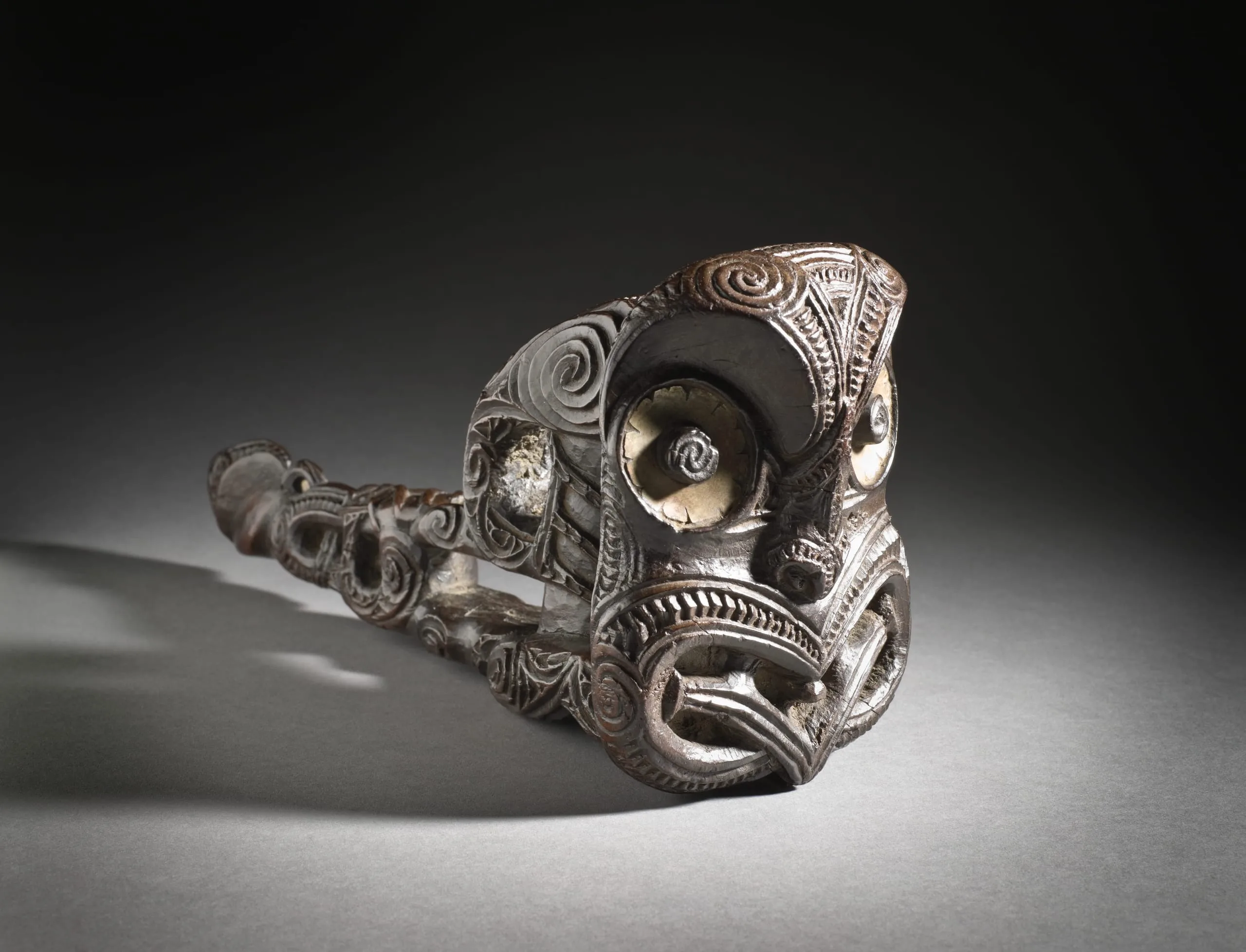
Carved Bar (paepae)circa 1850

Not on view
Carved wooden object covered in dense spiral and scroll motifs, with a stylized creature head featuring a large inlaid shell eye, viewed from slightly above
Title
Carved Bar (paepae)
Culture
Maori, Rukupo school of carvers
Place Made
New Zealand (Aotearoa), Gisborne Region
Date Made
circa 1850
Medium
Wood and Haliotis shell
Dimensions
6 x 11 1/2 x 4 1/2 in. (15.24 x 29.21 x 11.43 cm)
Credit Line
Purchased with funds provided by the Eli and Edythe Broad Foundation with additional funding by Jane and Terry Semel, the David Bohnett Foundation, Camilla Chandler Frost, Gayle and Edward P. Roski, and The Ahmanson Foundation
Accession Number
M.2008.66.38
Classification
Sculpture
Collecting Area
Art of the Pacific
Curatorial Notes

Gallery Label
Very little is known about the exact use of this carved bar or the meaning of its motifs. It may have been used as a bird perch or snare, fishing rod, or an element at the end of a latrine seat. The bar is covered in intricate curvilinear designs and features a humanlike face with facial tattoo carvings and inlaid eyes. There are slots carved for the possible attachment of other objects. If the bar was used as a perch-style snare, decoys would have been attached at these slots. Snares were placed in a tree to attract birds, while the trapper waited, eventually pulling a cord that would trap a bird on the bar.


Selected Bibliography
  • Wardwell, Allen. Island Ancestors: Oceanic Art from the Masco Collection. [Seattle]: University of Washington Press, 1994.