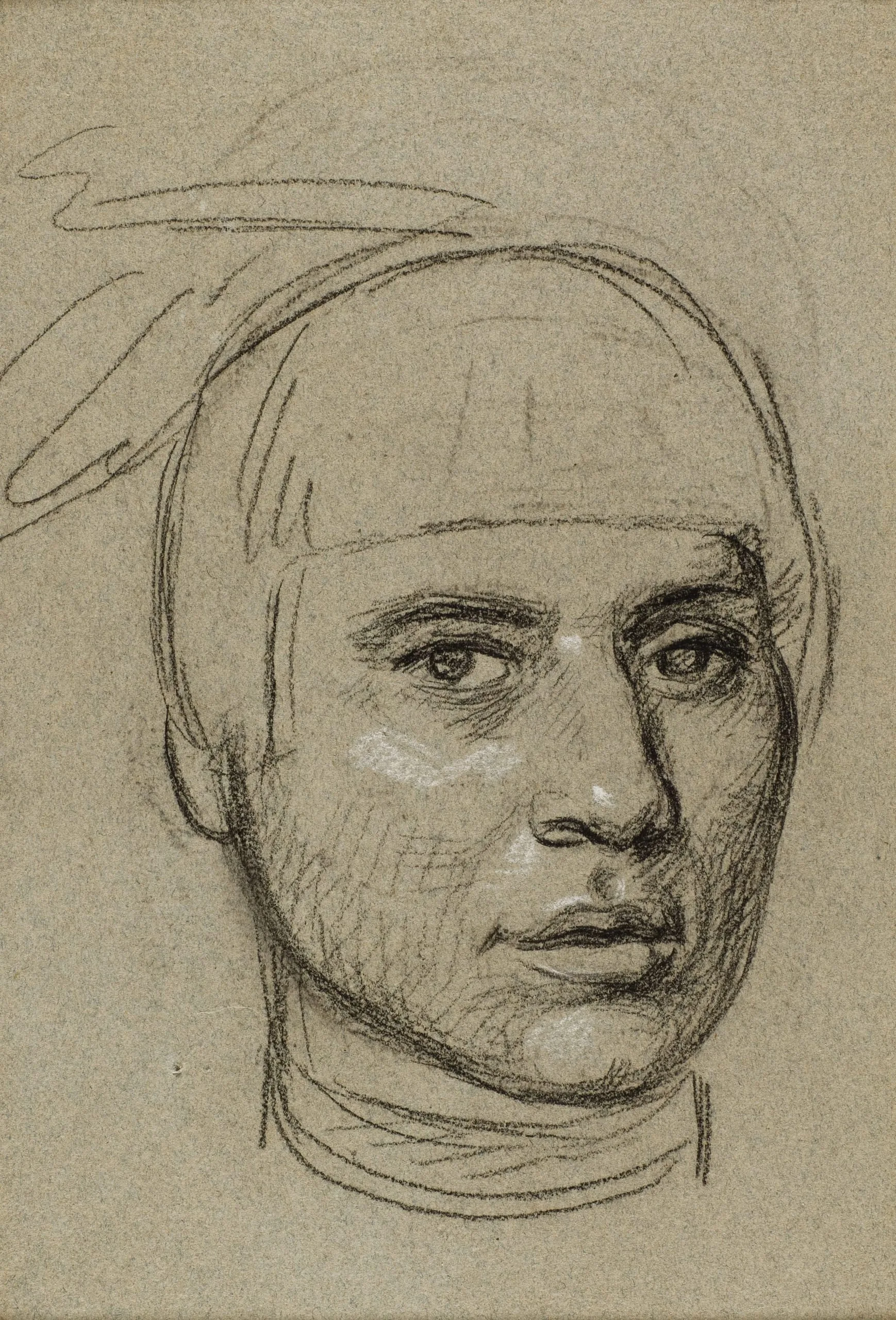
This delicately rendered charcoal portrait of No-Tin (also spelled as Nodin, Noodin, Naudin, or Nadin) was likely drawn from life when the Ojibwe leader visited Washington, D.C., in 1824. No-Tin (or Wind) was part of a delegation of Indigenous leaders that traveled from their homelands to the U.S. capital in order to fight for their political sovereignty, for the rights of their people, and for the protection of their homelands in the face of violent settler colonialism. During delegation visits, which typically lasted several weeks, even months, Native leaders met with U.S. government officials and politicians, including the president, toured attractions, attended events, and often sat for painted (and later photographic) portraits.
Beginning in 1821, U.S. Superintendent of Indian Trade Thomas McKenney codified the practice of delegation portraiture, regularly commissioning local artist Charles Bird King to paint visiting leaders. Over the next two decades, King produced 143 portraits depicting members of twenty different Native Nations, creating a so-called pantheon of Indigenous leaders in Washington. Although almost all of King’s original painted portraits were lost in a fire at the Smithsonian in 1865, many—including LACMA’s portrait of No-Tin (M.2008.58)—are known today through copies made by the artist Henry Inman for reproduction in McKenney’s three-volume publication The History of the Indian Tribes of North America (1836–44).
While Inman’s copy provides further information about the appearance of King’s original painted portrait, this drawing is a more direct and intimate depiction of No-Tin. Here, King carefully delineated the sitter’s features, with heavy lines defining the shape of his nose, lips, eyelids, eyebrows, and jaw, and short daubs of white chalk adding depth along the curves of his face. The artist’s original oil paintings were only 18 × 14 inches, and it appears that he used the drawing of No-Tin on its 10¼ × 6¼−inch sheet as a direct guide for his finished composition. Moreover, a large swath of charcoal on the back of the paper may have been applied to help transfer the drawing’s contours to another surface, possibly a canvas.
There are, however, considerable differences between King’s drawing and Inman’s portrait. For example, the eagle and peacock feathers and the ostrich plume, which are clearly identifiable in the painted portrait, are only hinted at in the drawing. Most notably, No-Tin’s striated face paint is not indicated in the drawing, suggesting that these markings were added only to the final portrait(s) or, perhaps, are instances of artistic license. Such alterations were not uncommon in depictions of Native peoples by non-Native artists, who often took liberties to create images that reinforced preconceived expectations and harmful stereotypes of what Native peoples should look like. Nevertheless, King and Inman’s portraits play an important role in expanding our understanding of these complex histories of intercultural exchange, while also highlighting stories of Indigenous agency and resiliency—past, present, and future.
Selected Bibliography
Cosentino, Andrew J. The Paintings of Charles Bird King (1785−1862), no. 638. Smithsonian Institution Press, 1977.
Horan, James D. The McKenney-Hall Portrait Gallery of American Indians. Crown Publishers, 1972.
Hutchinson, Elizabeth. “From Pantheon to Indian Gallery: Art and Sovereignty on the Early Nineteenth-Century Cultural Frontier.” Journal of American Studies 47, no. 2 (2013): 313–37. http://www.jstor.org/stable/24485523.
Morilla, Cristina. “Conservation as Cultural Practice: The Portrait Collection of Indigenous Delegates by Henry Inman.” Studies in Conservation 69, no. 8 (2024): 756–68. https://doi.org/10.1080/00393630.2024.2328383.
Viola, Herman J. Diplomats in Buckskins : A History of Indian Delegations in Washington City. Bluffton, S.C.: Rivilo Books, 1981.