LACMA

ShopMembershipMyLACMATickets
LACMA
Los Angeles County Museum of Art
5905 Wilshire Blvd.
Los Angeles, CA 90036
info@lacma.org
(323) 857-6000
Sign up to receive emails
Subscribe
© Museum Associates 2025

Museum Hours

Monday

11 am–6 pm

Tuesday

11 am–6 pm

Wednesday

Closed

Thursday

11 am–6 pm

Friday

11 am–8 pm

Saturday

10 am–7 pm

Sunday

10 am–7 pm


  • About LACMA
  • Jobs
  • Building LACMA
  • Host An Event
  • Unframed
  • Press
  • FAQs
  • Log in to MyLACMA
  • Privacy Policy
© Museum Associates 2025
Collections

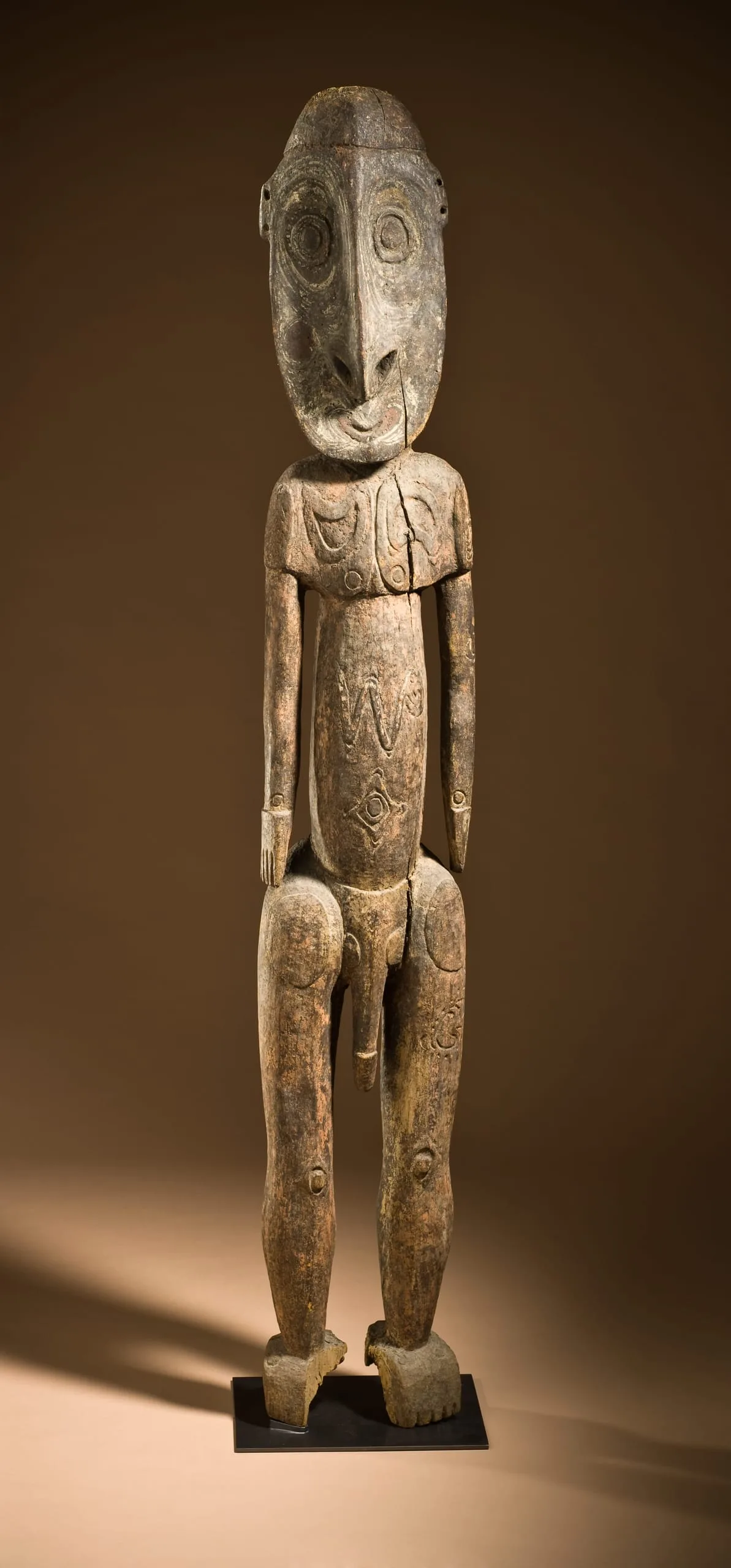
Ancestor Figure (mian’gandu)circa 1950

On view:
Geffen Galleries, Navigating Pacific Asia
Full-length carved wooden standing figure with elongated oval head, large circular eye sockets, hooked nose, and relief-carved geometric motifs on the torso, mounted on a black base
Title
Ancestor Figure (mian’gandu)
Culture
Sawos People
Place Made
Papua New Guinea, East Sepik Province, Wolembi Village
Date Made
circa 1950
Medium
Wood and pigment
Dimensions
83 x 11 1/4 x 7 1/2 in. (210.82 x 28.58 x 19.05 cm)
Credit Line
Purchased with funds provided by the Eli and Edythe Broad Foundation with additional funding by Jane and Terry Semel, the David Bohnett Foundation, Camilla Chandler Frost, Gayle and Edward P. Roski, and The Ahmanson Foundation
Accession Number
M.2008.66.1
Classification
Sculpture
Collecting Area
Art of the Pacific
Curatorial Notes

Gallery Label
This wood sculpture is thought to represent a founding ancestor. Larger than life-size, the figure has a long torso, long arms and legs, a prominent phallus, and a large head, all of which imply its sacred nature in the art of the Sawos People of the Middle Sepik River region. Their art primarily depicts human figures, and patterns carved and painted on the body mimic the Sawos People’s practiced patterns in body art. Elements of the facial paint are in the patterns of a successful headhunter, while the carvings on the torso match the patterns of scarification on initiates.

This figure was kept indoors and for ceremonial use attached to the central post in a clan’s cult house. The ancestral figure was given offerings of food before the men departed on hunting or war expeditions. It was believed that if the ancestor was not honored, great misfortune would befall the expedition.

The Sawos are closely related to the neighboring Iatmul People of the Middle Sepik River region. The Sawos are a more agricultural people, while the Iatmul are more bound to the river and its resources. The Sepik floods in this area, and the Iatmul live on the flood plain, while the Sawos inhabit the fertile soils at the edge of the plain. This has led to agreeable trade between the groups, due to their different specialties, and facilitated cultural similarity, though art objects remain distinct.


Selected Bibliography
  • Wardwell, Allen. Island Ancestors: Oceanic Art from the Masco Collection. [Seattle]: University of Washington Press, 1994.