LACMA

ShopMembershipMyLACMATickets
LACMA
Los Angeles County Museum of Art
5905 Wilshire Blvd.
Los Angeles, CA 90036
info@lacma.org
(323) 857-6000
Sign up to receive emails
Subscribe
© Museum Associates 2025

Museum Hours

Monday

11 am–6 pm

Tuesday

11 am–6 pm

Wednesday

Closed

Thursday

11 am–6 pm

Friday

11 am–8 pm

Saturday

10 am–7 pm

Sunday

10 am–7 pm


  • About LACMA
  • Jobs
  • Building LACMA
  • Host An Event
  • Unframed
  • Press
  • FAQs
  • Log in to MyLACMA
  • Privacy Policy
© Museum Associates 2025
Collections

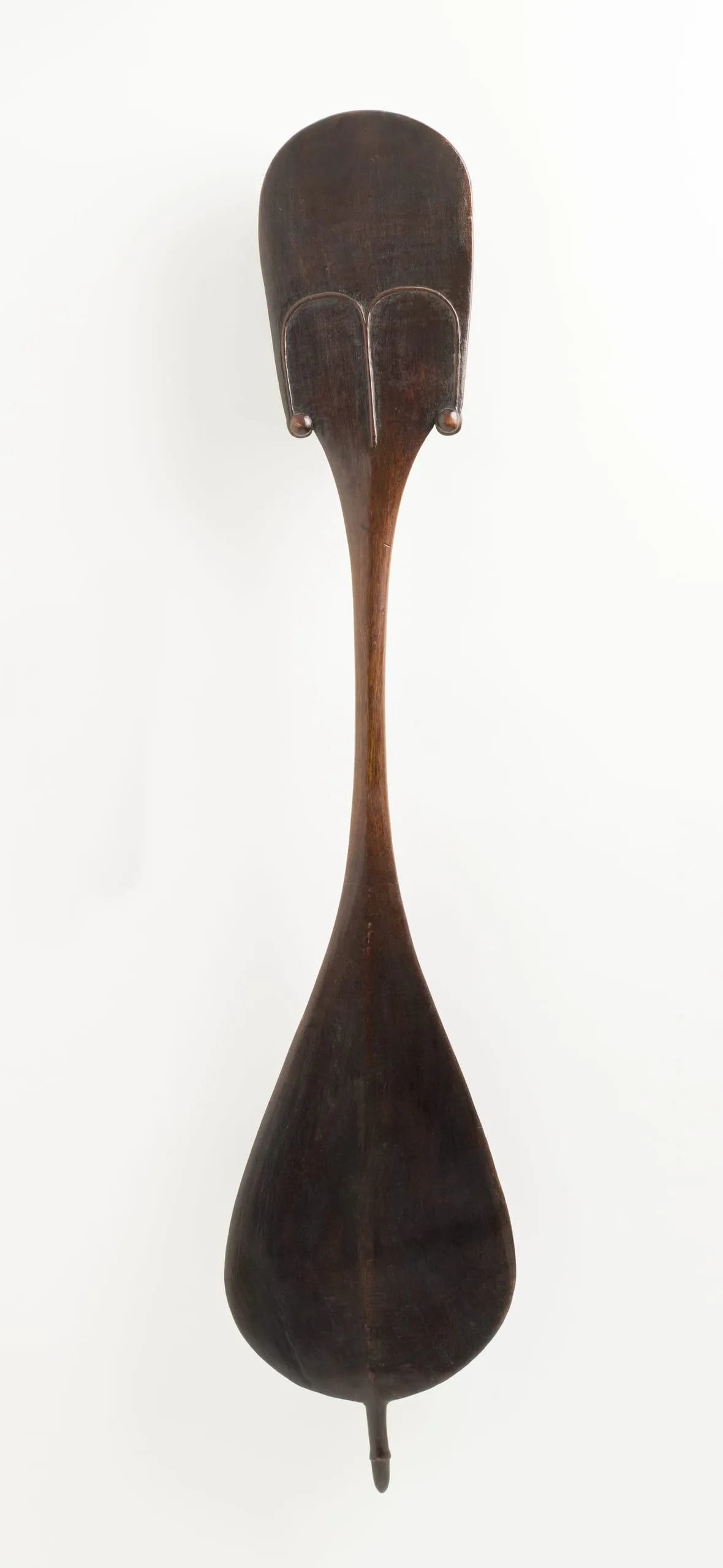
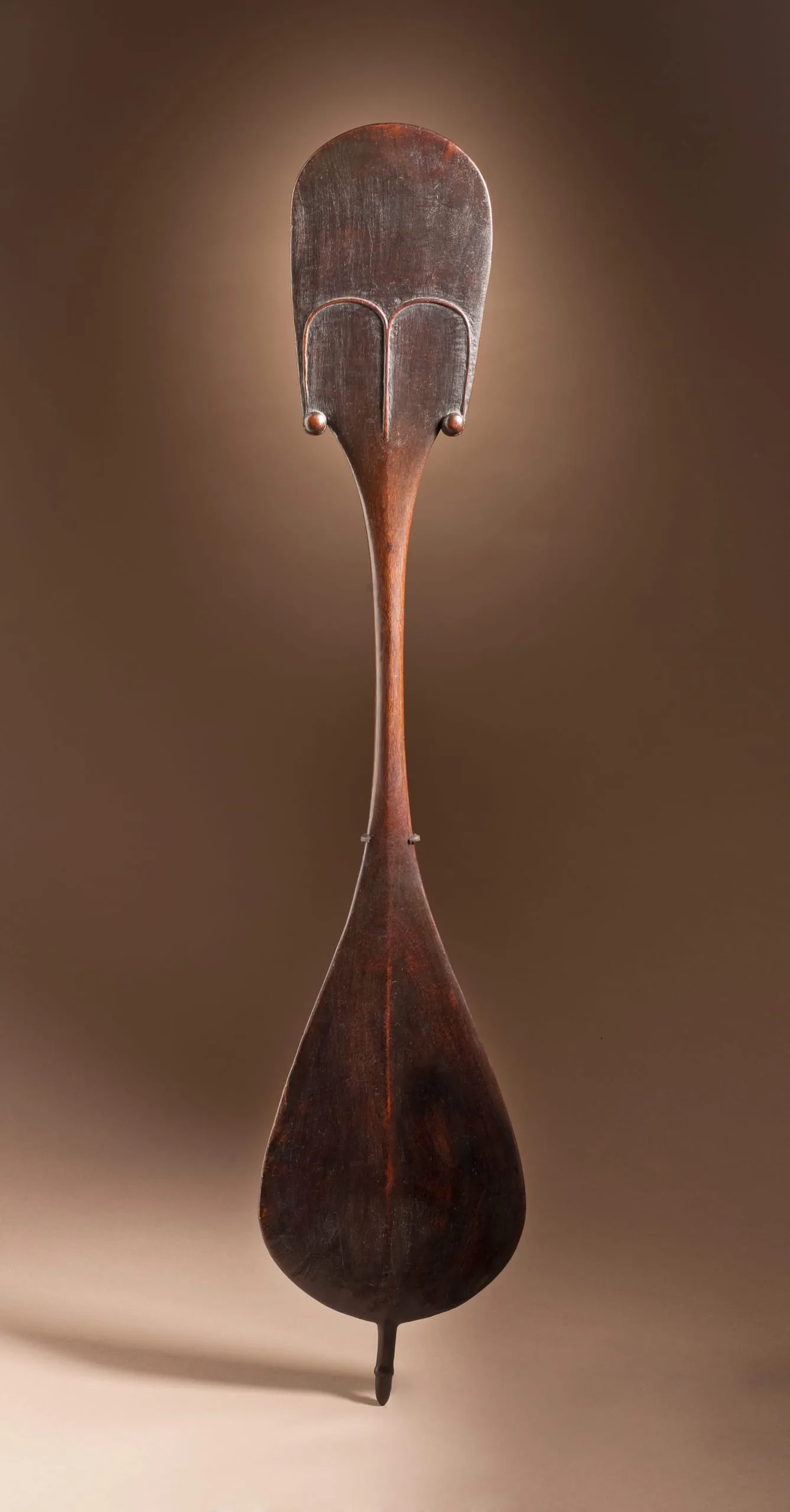
Dance Paddle (rapa)circa 1800

On view:
Geffen Galleries, Polynesia: "Our Sea of Islands"
Carved wooden object, dark chestnut brown, vertical symmetrical form with oval head, slender neck, and wide teardrop-shaped lower bowl, smooth worn surface
Carved wooden instrument with a broad, flat paddle-shaped head, narrow waisted neck, and rounded teardrop body, shown from the back; dark reddish-brown patinated surface with two small peg-like tuning knobs near the upper end.
Title
Dance Paddle (rapa)
Place Made
Easter Island (Rapa Nui)
Date Made
circa 1800
Medium
Wood
Dimensions
33 1/2 x 7 x 3/4 in. (85.09 x 17.78 x 1.91 cm)
Credit Line
Purchased with funds provided by the Eli and Edythe Broad Foundation with additional funding by Jane and Terry Semel, the David Bohnett Foundation, Camilla Chandler Frost, Gayle and Edward P. Roski, and The Ahmanson Foundation
Accession Number
M.2008.66.4
Classification
Sculpture
Collecting Area
Art of the Pacific
Curatorial Notes

Gallery Label
Located in the eastern most area of Polynesia, Easter Island (Rapa Nui) lacks the natural resources of many of its Polynesian cultural counterparts. This makes the exquisite quality of the woodwork produced there, such as this rapa, or dance paddle, interesting, because there was very little indigenous wood on which to hone carving skills. Carvings were made from either this minimal amount of natural wood or found pieces, such as driftwood.

The form of this two-sided paddle is unique in Polynesia as all others have only one blade. Paddles of this type were used in pairs during seated ritual dances. Such paddles have a thin handle connecting the blades to facilitate the spinning and twisting motion of the dance. One end has an abstract human face made up of a long, thin, nasal ridge that curves up and out into a curved brow ridge that continues on to decorated ears at the outer edges. The opposite end has a blunt spike similar to utilitarian paddles, which use the spike as a pushing tool. Many scholars believe that this end of the paddle represents the abdomen of the figure, with the thin handle representing the neck, and the spike, a phallus. This paddle and many of the other surviving examples were made prior to 18th century contact with seafaring travelers, without the aid of modern metal-tool-carving techniques.

The abstract designs on the paddles are believed to be associated with the birdman cult that was centered around the sooty tern colony at the island’s northern area. This differed from the other potential ritual usages, which were performed on the ahu ritual platforms with the large stone moai heads, prolific symbols of the island.


Selected Bibliography
  • Wardwell, Allen. Island Ancestors: Oceanic Art from the Masco Collection. [Seattle]: University of Washington Press, 1994.