Gallery Label
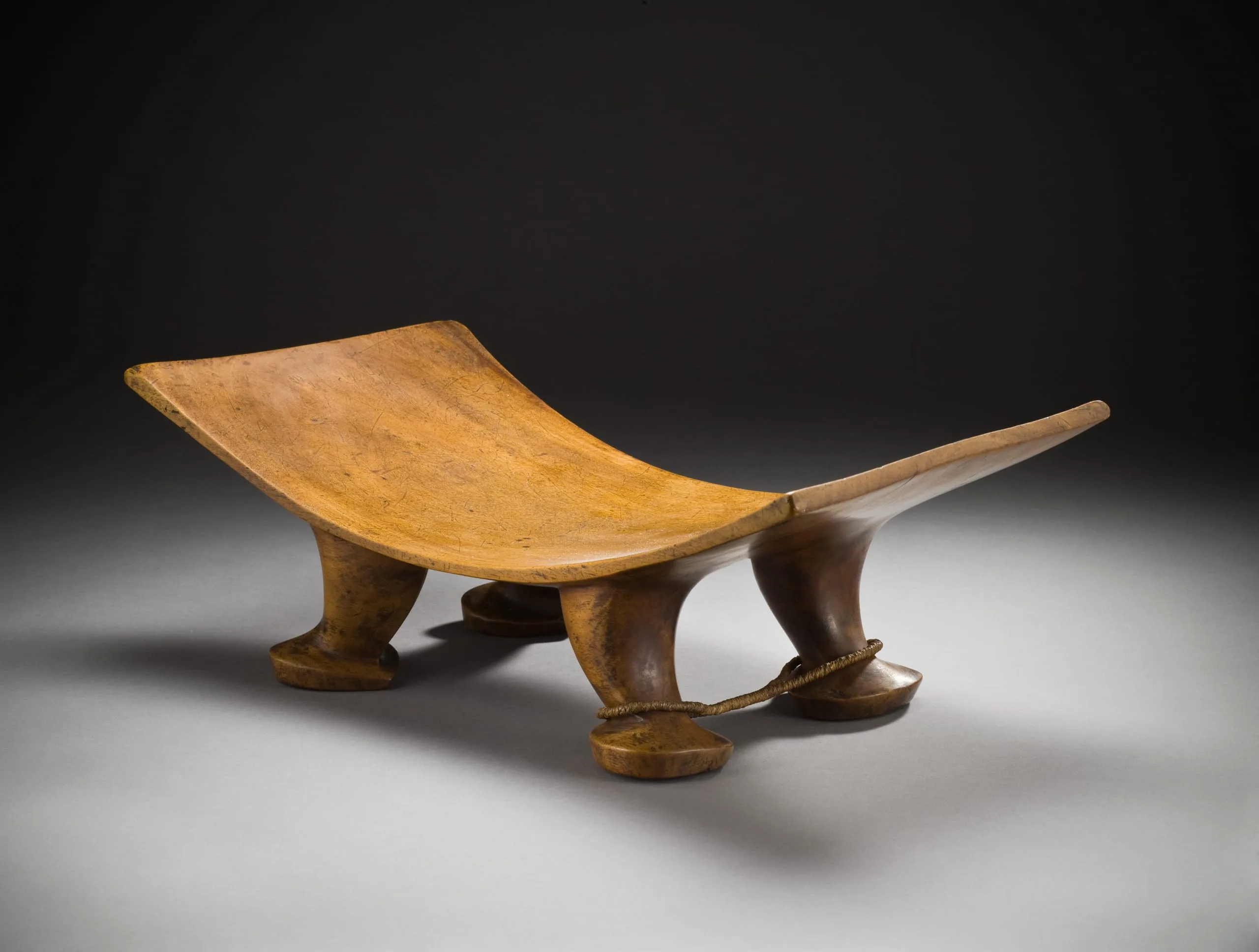
This beautifully crafted stool was carved from a single block of wood. The shallow curved seat is thin, and the legs gently taper, focusing their angles toward the stool’s center. The blend of curved and linear forms is smoothly articulated, with the seat held by short legs that end in teardrop-shaped feet, with the cord still in place around two legs.
This no’oanga stool, created by carvers of the Cook Islands, is an exquisite example of an object crafted specifically for ceremonial use, and its craftsmanship acted as a status signifier for the chief who owned it. A stool of this kind often was outfitted with a braided cord that was used to hang the stool when not in use. This variety is one of three types made in the Cook Islands and is the most popular and standardized in size and shape. This design was made well into the twentieth century and presumably was made on the island of Atiu and traded throughout the other islands.
The Cook Islands are made up of fifteen main islands separated into northern and southern groups. The northern islands are low-lying coral atolls, while the southern islands are volcanic, support more natural resources, and their inhabitants produce more highly developed art forms than their northern neighbors. The Cook Islands are situated between Samoa and the Society Islands and are culturally related to the surrounding Central Polynesian societies who settled the area. This cultural similarity extends into the hierarchal social strata common in Polynesia that strictly ranks the various powers of each social group, culminating in the ariki, or chief, group. The chiefly class held a certain degree of mana, or powerful life force, within the physical person, and this mana was imbued in the objects touched and used in daily life, particularly ceremonial objects. The tu’hunga, or craftsmen, who were under the patronage of the chiefs to make their ceremonial objects, were trusted with using and creating objects with powerful mana.