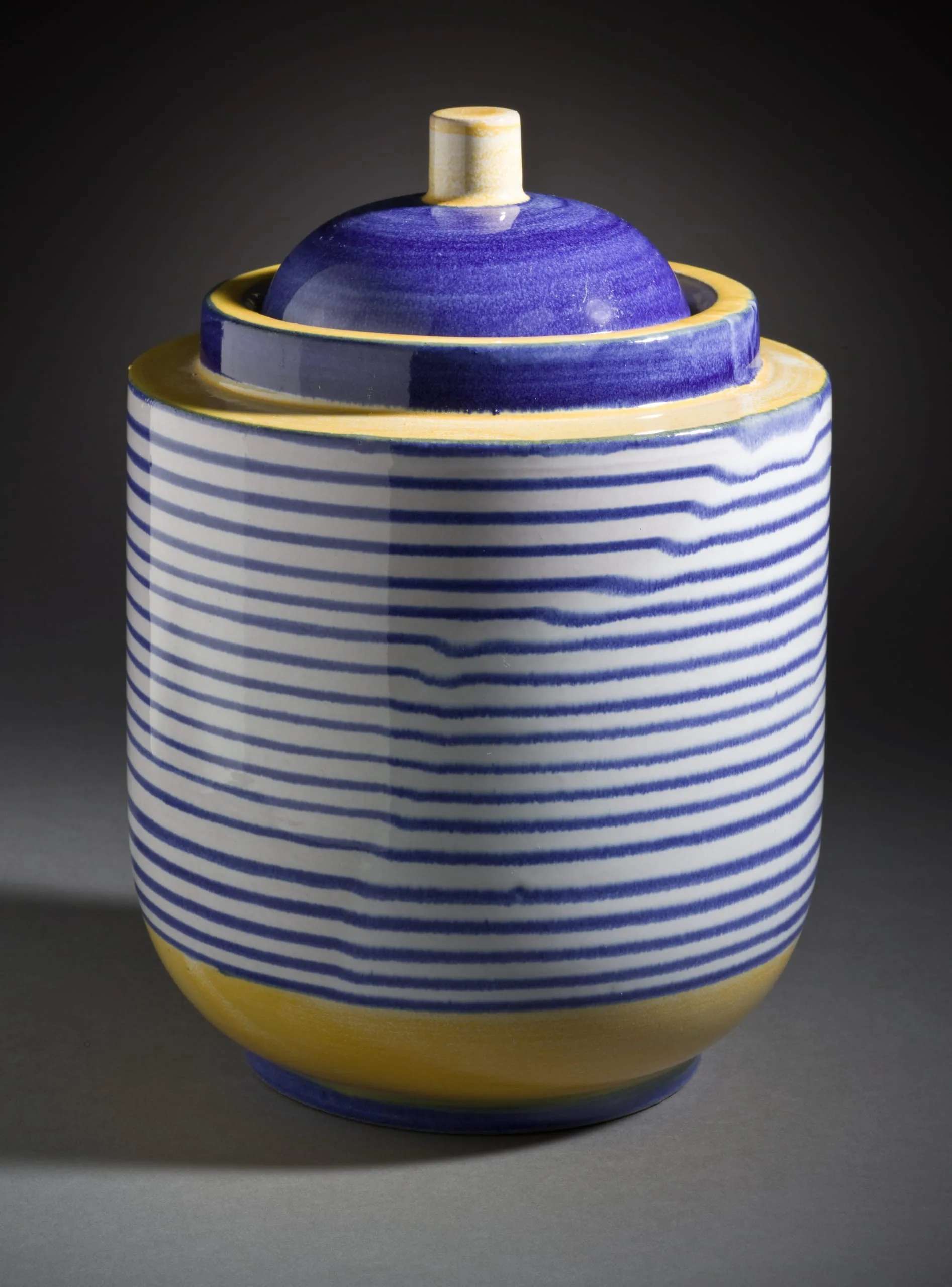
This large covered jar was produced during Werner Burri’s tenure at the Velten-Vordamm stoneware factory, one of the few German manufacturers willing to produce the experimental wares developed by Bauhaus potters. Its cylindrical body and low, domed lid are well suited to industrial replication (an important goal of Bauhaus training), and yet the irregularity of the hand-painted decoration clearly reveals the artist’s hand. Its bright palette of yellow, blue, and white is also strikingly modern and complements the jar’s clean lines.
Burri began his studies at the Bauhaus in 1921 under Johannes Itten, who developed the revolutionary “preliminary course” at the school in Weimar. The next year, Burri moved to study ceramics at the Bauhaus workshops in nearby Dornburg under sculptor Gerhard Marcks and master potter Max Krehan. The ceramics program was a remarkable, short-lived experiment in communal living. Only five students committed to the two-year program, during which they lived in the stables of Dornburg Castle, dug their own clay, grew their own vegetables, and harvested wood from local forests to fire their kilns. Burri was one of the four Bauhaus students who successfully completed the apprenticeship final examination (the others were Marguerite Wildenhain, Otto Lindig, and Theodor Bogler).
As at many art colonies, tensions arose between idealists who prioritized handcraft (Krehan) and pragmatists who sought to align Bauhaus training with commercial production (Walter Gropius, who had founded the school). In 1923, the pragmatists prevailed and converted Krehan’s workshop to production, with Otto Lindig and Theodor Bogler in charge. Two years later, the program ended when the Bauhaus at Weimar closed for political and financial reasons. Ceramics were no longer taught when the school reopened at Dessau in 1925. Thanks in part to the commercial training they had received, each of the Dornburg graduates found work in the ceramics industry. In 1928, Burri succeeded Bogler as head of the modeling and design workshops at the Velten-Vordamm stoneware factory. After the factory closed in 1931, Burri returned to his native Switzerland. He continued to produce ceramics for various workshops and, beginning in 1941, spent the rest of his career teaching and making pottery at the school for ceramics (Keramischen Fachschule) in Bern.
Wendy Kaplan, Department Head and Curator, Decorative Arts and Design
Adapted from the 2008 text