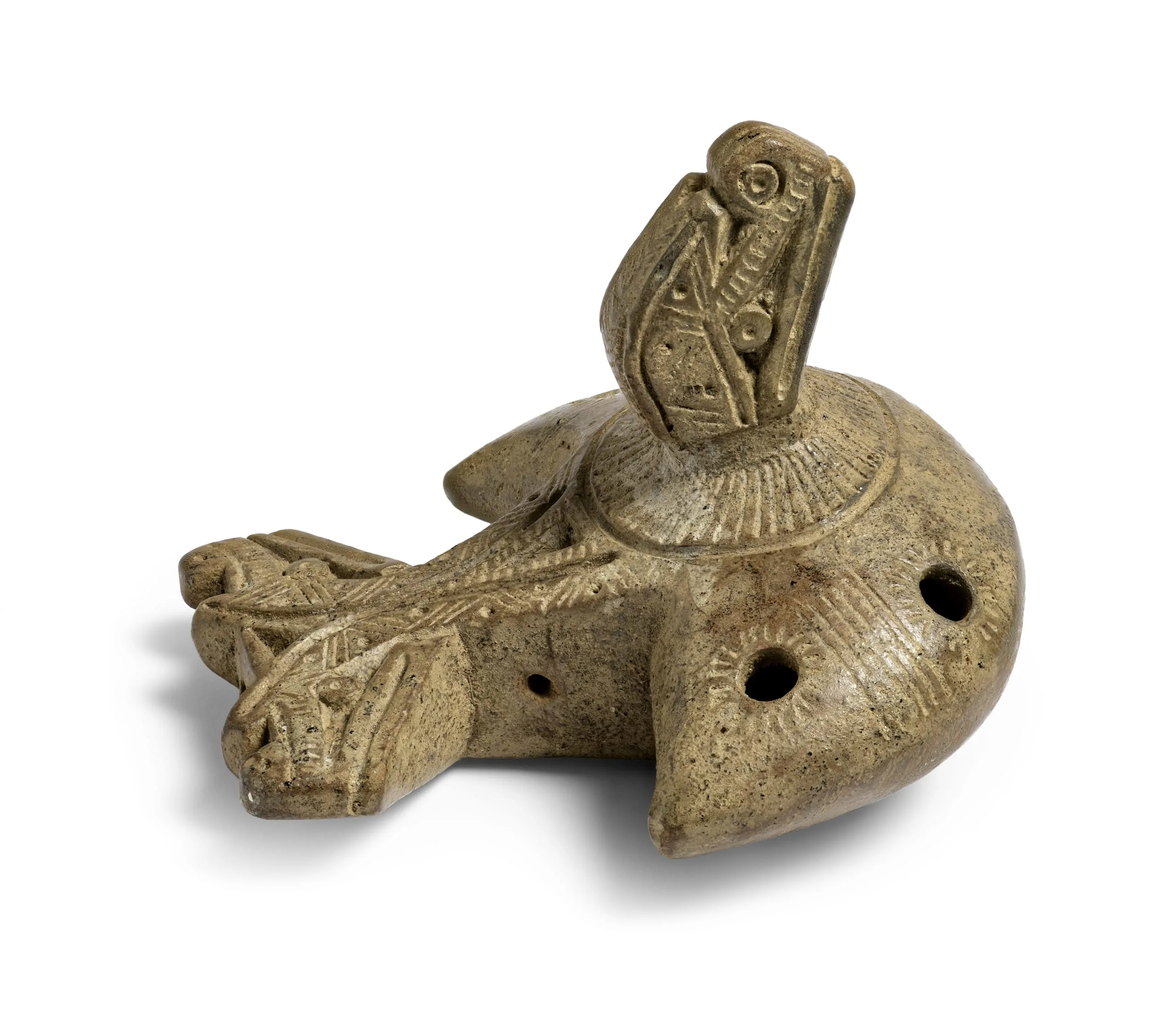
People of the Tairona culture made ocarinas in many shapes, including birds, frogs, humans, and nonfigurative forms (see M.2007.146.10, .447, .448, .462, .466, and .469), so it is unlikely that the shape determined what each ocarina was meant to mimic or communicate with. However, more than 600 species of birds live in the Sierra Nevada de Santa Marta. They and their songs are everywhere, surrounding and accompanying all human life and activity, and it is no wonder that birds have special significance, both in the past and for descendant cultures that live in the region.
As explained by Kaggaba guide Francisco Chimontero Nuibita Dingula (2022: 5859): “In our culture, birds in the beginning were people. The father of the birds, Ziukukui, wanted to leave messengers for people, so he decided to turn some people into birds. That is why all birds exist now, and serve to warn us of things that will happen. I learned this from my grandmother. She explained to me that when the birds sing, they are warning us of something, and that I had to identify each bird song and the different messages they give us. ‘You have to listen and understand; it is for a reason that this hummingbird came to see you,’ said my grandmother. In the future, I want to make people understand the importance of the earth and the respect and gratitude that we must have for her. Everything here has life; plants, animals, mountains, rivers, lagoons, stones, they also feel and speak, the same as we do. That is why I have been very interested in birdwatching as it is a way of teaching others to care for and conserve nature.”
This ethic of care is widespread among the Indigenous communities of the region, and, as Arhuaco elder Jaison Pérez Villafaña tells us, “Caring begins with observation. You have to see all that there is, in detail, to respect it. To get to know it as if it were part of your family.”
Selected Bibliography
Chimontero Nuibita Dingula, Francisco. “Birds of the Sierra Nevada de Santa Marta and Their Significance in Kaggaba Culture.” In The Portable Universe/El Universo en tus Manos: Thought and Splendor of Indigenous Colombia, ed. Julia Burtenshaw, Diana Magaloni, Maria Alicia Uribe, and Hector Garcia Botero. LACMA/DelMonico Prestel, 2022.
Unpacking the Universe: The Making of an Exhibition, Episode 5: “The Magic of Shells,” Los Angeles County Museum of Art, 2022, https://www.youtube.com/playlist?list=PLJy-HLfC3xxCue9_kM1GRNcnPEaNvi_aW.