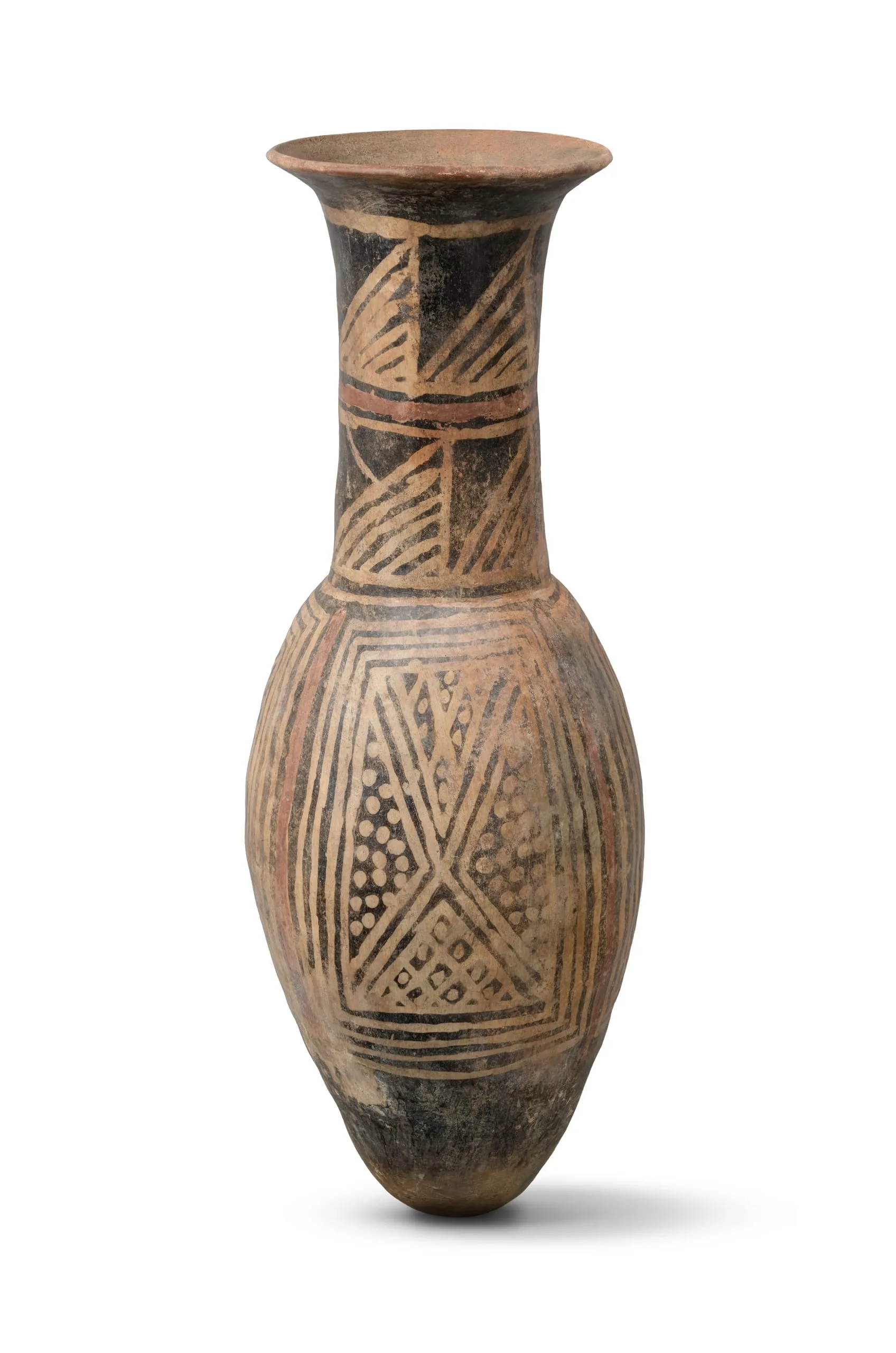
This elegant long-necked vessel was decorated using a resist painting technique. The red lines were painted first. Then the pattern was created with a resist material such as resin or wax. Finally, the entire vessel was covered in a black slip, which adhered only to areas not treated with the resist substance. The geometric designs may imitate bodypaint or textile patterns, both of which “wrapped” human bodies during life and death, imbuing beings with cultural meaning and identity. This same “wrapping” or painting on an urn would have been deemed important for the bones of the ancestors, if that was indeed the purpose of this vessel.
While ceramic objects such as this are often described in museum collections and scholarly discussions as burial artifacts (and indeed have been recorded as deposited in tombs), no archaeological evidence confirms their use as urns. In the central Andes of Peru, similarly shaped vessels known as aríbalos served primarily to store and transport water and other liquids like chicha (fermented corn beer). Whether this applies to our vessel is unknown.
Relatively few Nariño artifacts have been excavated archaeologically. The Nariño region has been and continues to be heavily looted, with little governmental oversight in remote areas, and there is also a rampant trade in replicas and forgeries. All of these factors complicate study of ceramics such as this vessel. However, LACMA conservators sent a sample of the piece for thermoluminescence testing, and the result confirms that it was fired between 700 and 1200.
Julia Burtenshaw
2025