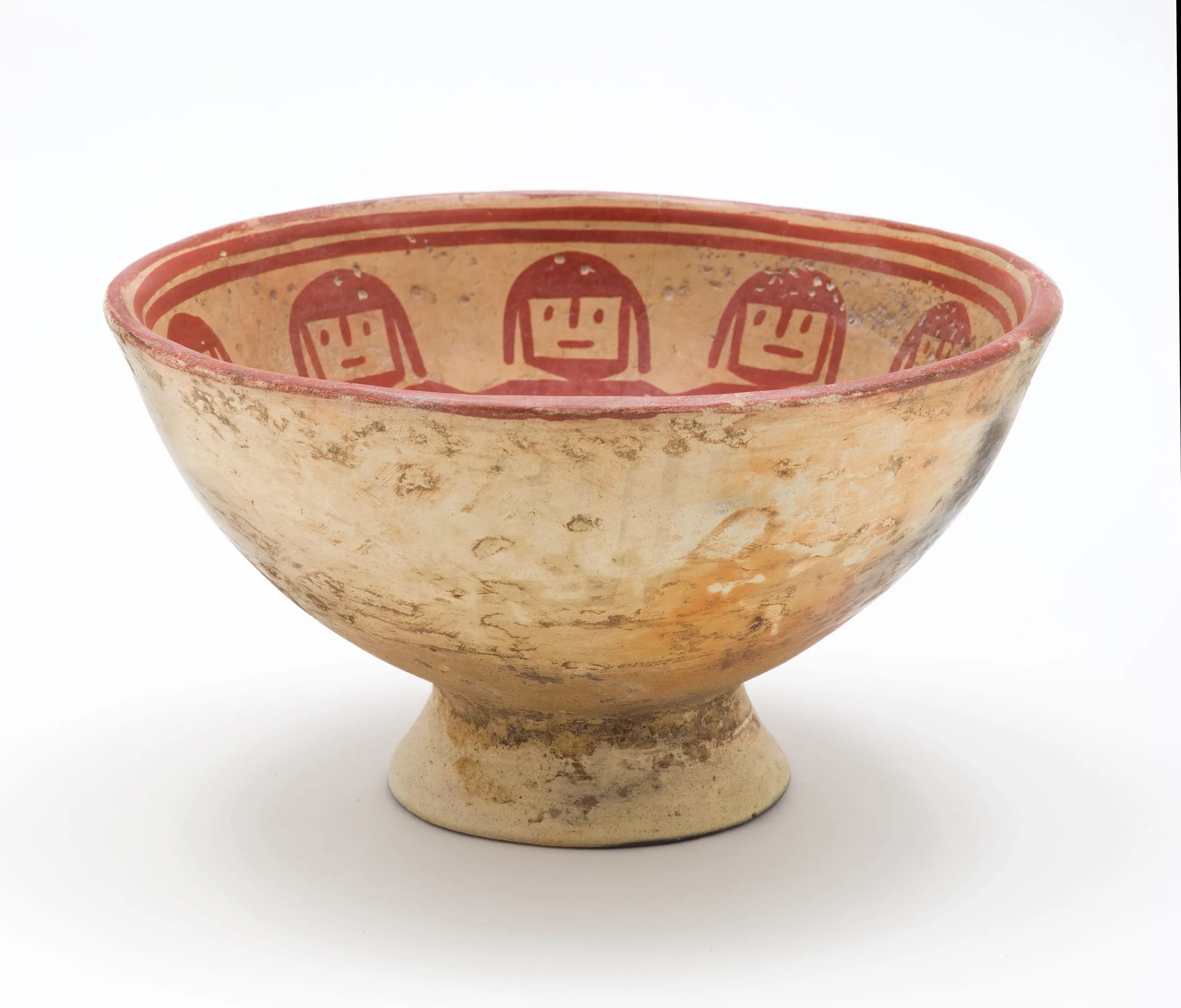
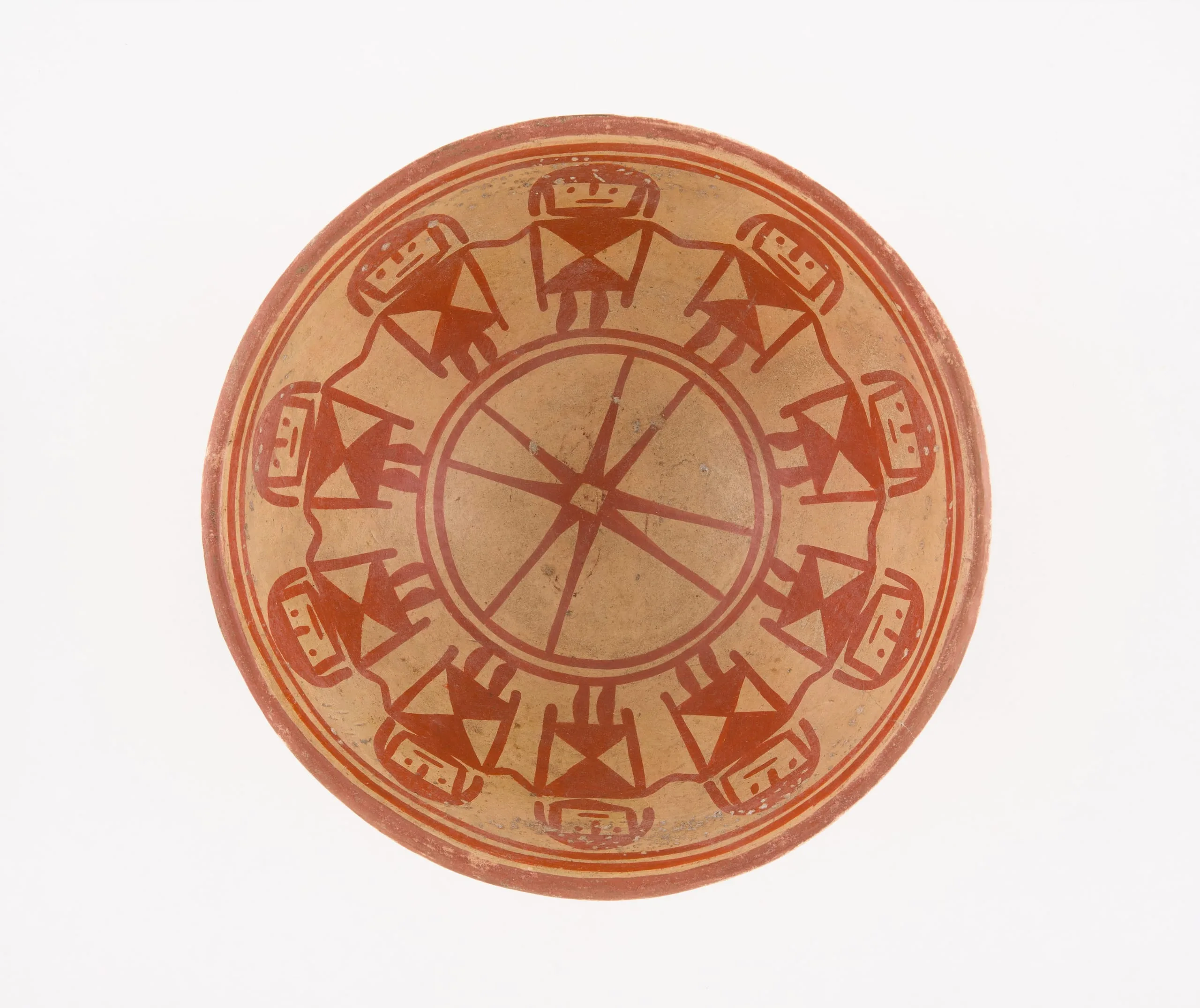
Nariño artists painted their ceramics with red or dark brown/black slip to create geometric and figurative designs featuring humans and animals, as well as possible celestial bodies. These designs are often arranged in symmetrical patterns or concentric circles, as on the interior of this footed bowl. The ten identical figures are linked by wavy lines suggesting arms. Of particular note is the eight-pointed motif resembling a star at the center of this and many other Nariño bowls (see M.2007.146.170, .171, .176, .181, .187, .191, .205, and .211). The so-called Sol de Pasto (Sun of Pasto) is also found on ancient gold jewelry and rock art and clearly held a central place in the cosmologies of Indigenous people of the Nariño region, continuing as a prevalent marker of regional identity today. It decorates the floor of the central plaza of Pasto city and features prominently in festivals and local contemporary art, as well as on the logo of a local Indigenous reserve (Resguardo Indigena de Ipiales).
According to the most common interpretation, the motif embodies the cardinal directions and solstice points, signaling calendrical and cosmic order. In that sense, it is reminiscent of the chakana or Andean cross and its meanings in the central Andes (see M.74.151.14). As with the chakana, modern meanings have also been projected onto the Sol de Pasto (including that very name), serving as a reminder that cultural symbols are both powerful and mutable. Today, the star’s eight rays are said to represent the foundations of human life: family, health, pleasure, friendship, community, children, knowledge, and wealth.
Bowls like this would not have been utilitarian serving or dining vessels but rather were created as funerary offerings and for ceremonial practices, possibly as mnemonic devices for storytelling, calendrical records, and keepers of cultural knowledge.