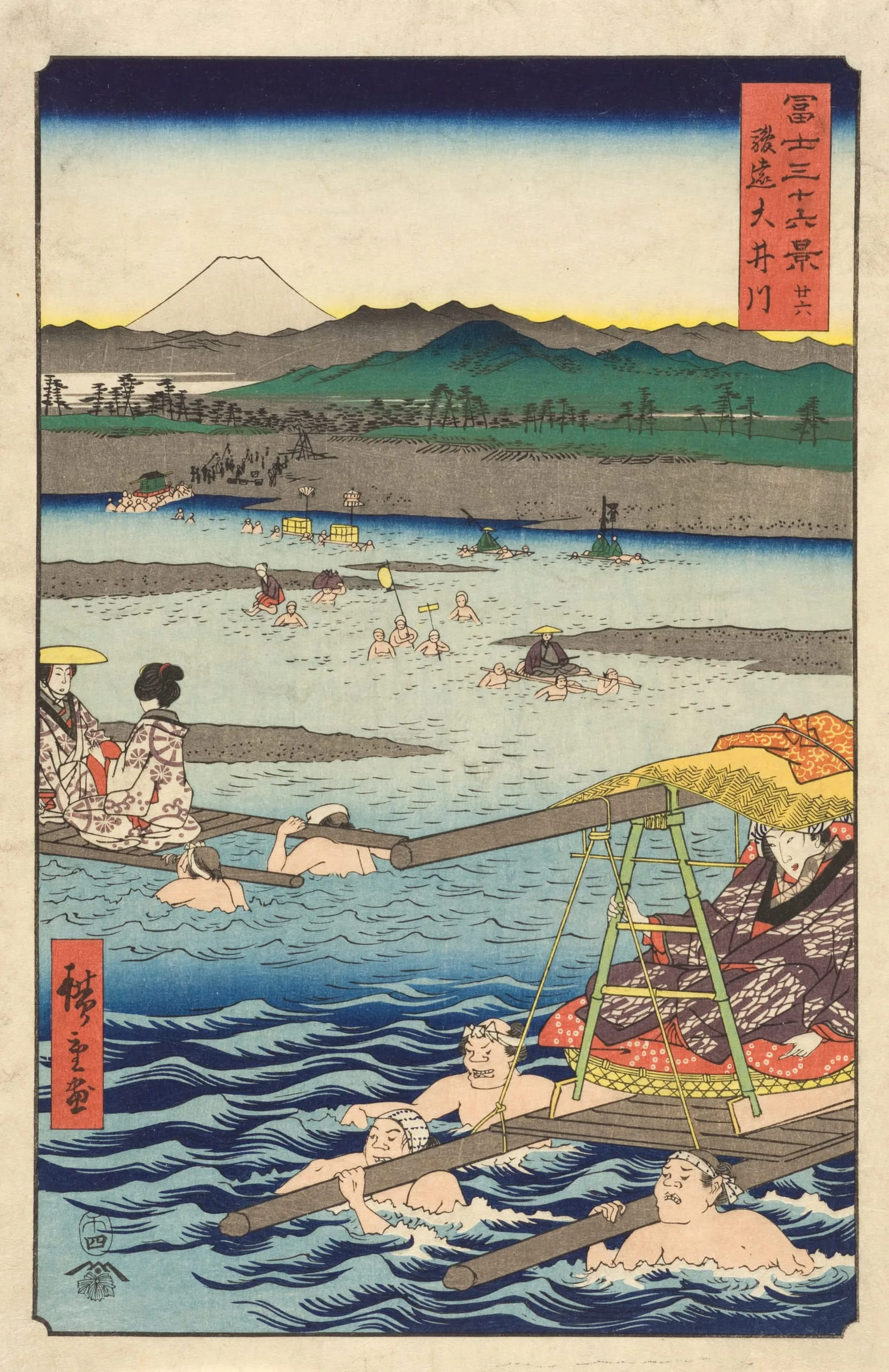
The coastal provinces of Suruga and Tōtōmi were separated by the swift-flowing Ōi River. During the Edo period (1615−1868), to protect the capital (Edo) from insurgents, the Tokugawa shogunate prohibited the building of bridges over large rivers. For some, including the Ōi, the use of ferries was also banned. Crossing the Ōi, however, was part of the trip on the Tōkaidō for travelers making their way between Edo and Kyoto. Depending on one’s social standing and wealth, there were several options for getting across the river. Some hired the services of strong and experienced laborers who earned a living transporting people and goods from one side of the river to the other. Here, we see travelers being conveyed on a variety of flat wood platforms. The woman in the foreground sits comfortably on a large cushion and enjoys protection from the elements by the covering overhead. Slightly further back are a pair of women on a more modest platform, and in the far background is a woman seated on the shoulders of a carrier, the least expensive and most uncomfortable way to make the trip. Baggage, parcels, and other possessions were likewise carried on wood platforms or overhead by hired porters. These modes of transport, used on many rivers, were captured in several prints designed by Utagawa Hiroshige.
In the far distance is Mount Fuji, rendered in outline. During the early 1830s, the print series Fuji sanjūrokkei (Thirty-six Views of Mount Fuji) was published with designs by Katsushika Hokusai (1760−1849). The series made Mount Fuji an iconic landmark that would become one of the most frequently depicted subjects in the arts of Japan. Moreover, the popularity and success of Hokusai’s scenes established landscape as a new direction for print designers, including Utagawa Hiroshige. Combining influences from Hokusai and traditional painting styles, he arrived at a highly individualized approach to landscape design and employed it to much acclaim in his 1833−34 print series Tōkaidō gojūsan tsugi no uchi (Fifty-three Stations of the Tōkaidō Road). While Mount Fuji appeared in many of Hiroshige’s prints, he initially refrained from creating a series focusing on it. Three years after Hokusai’s death, however, Hiroshige designed his first Mount Fuji series, and six years later he produced Fuji sanjōrokkei (Thirty-six Views of Mount Fuji), the series to which LACMA’s print belongs.
2024