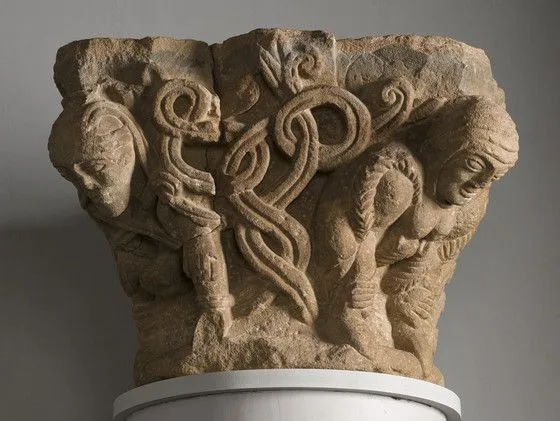
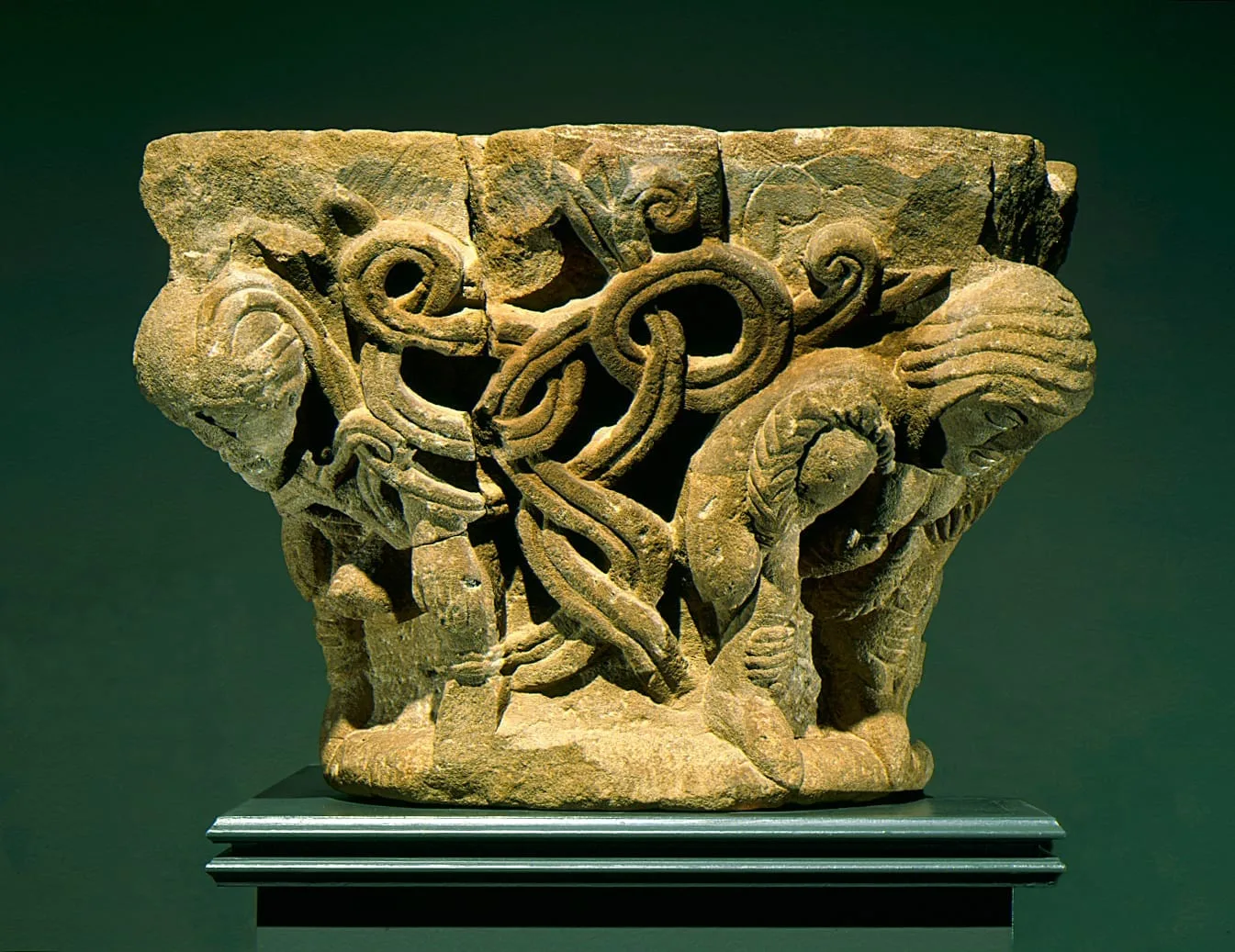
This architectural fragment is one of two capitals that once sat atop engaged columns or piers in a church in western Castile. Carved on three sides, the capitals served as moralizing decoration in a religious space. One capital features two pairs of lions locked in a fierce fight (49.23.15b). Here, the personified figures of Luxuria (Luxury) and Lust are separated by a decorative vine interlace. Luxury is represented as a woman suckling two snakes; Lust is rendered as a male with exaggerated genitalia. While modern audiences may find the iconography a surprising choice for a church setting, in fact this type of erotic imagery appears across Europe, and scholars still debate its precise meaning. Lust and Luxury may have served as warnings against immoral behavior or, like the humorous grotesques in medieval marginalia, offered a moment of secular shock to guide one back to prayer or a sacred subject. Some scholars suggest that salacious visuals in rural Spain relate to carnival festivals or other forms of popular entertainment.
Pictorial and narrative capitals were a fundamental element of Spanish ecclesiastical decoration from this period, found in monastic cloisters and church naves. LACMA’s carved capitals, especially that of the lions, stylistically and compositionally relate to stonework in the Church of San Pedro de Cervatos, helping scholars to date the objects to the late twelfth century. Also located in western Castile, Cervatos is about a day’s walk from the famous Santiago de Compostela pilgrimage route and includes a series of erotic carvings on its exterior windows and north wall.