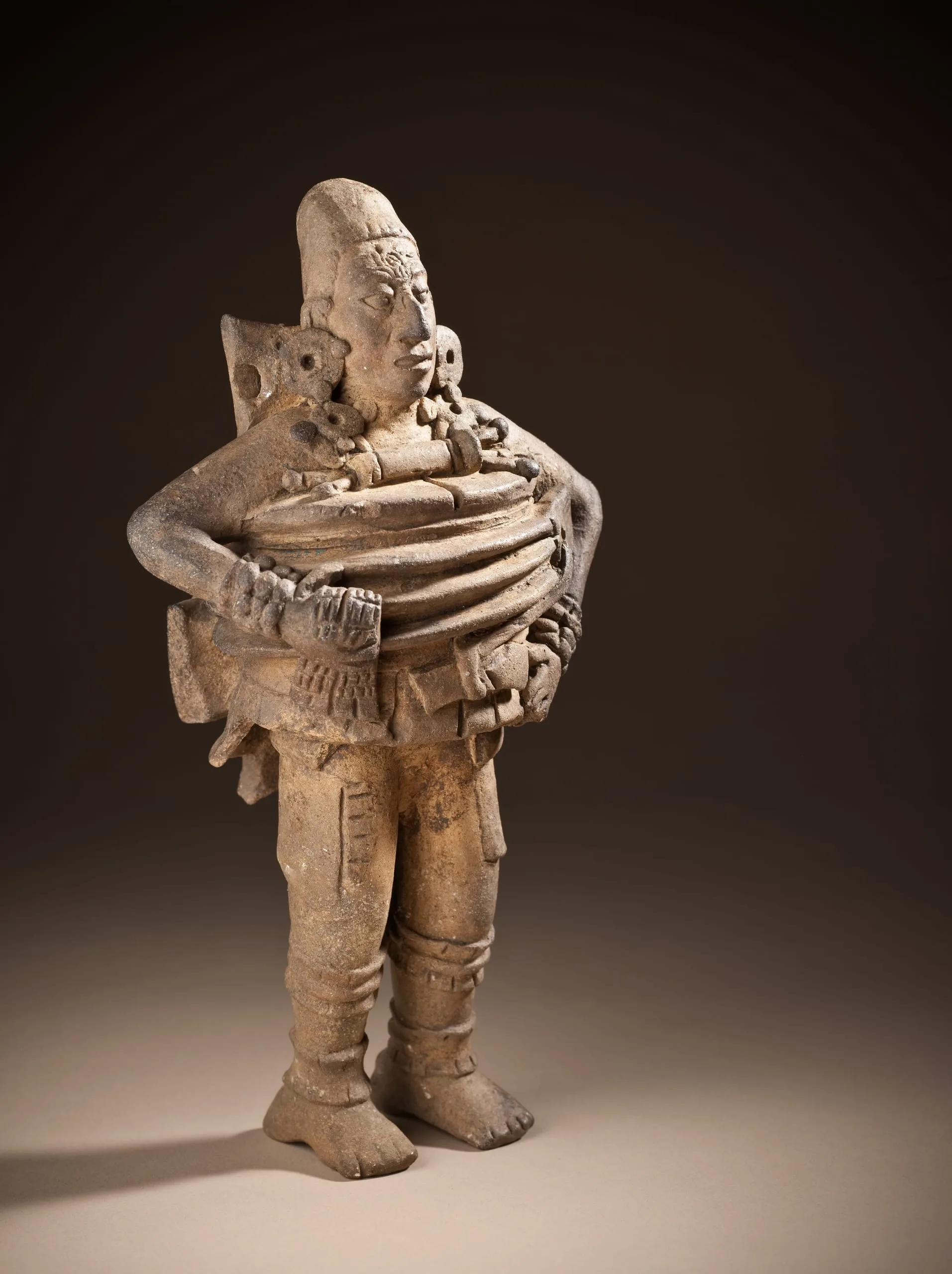
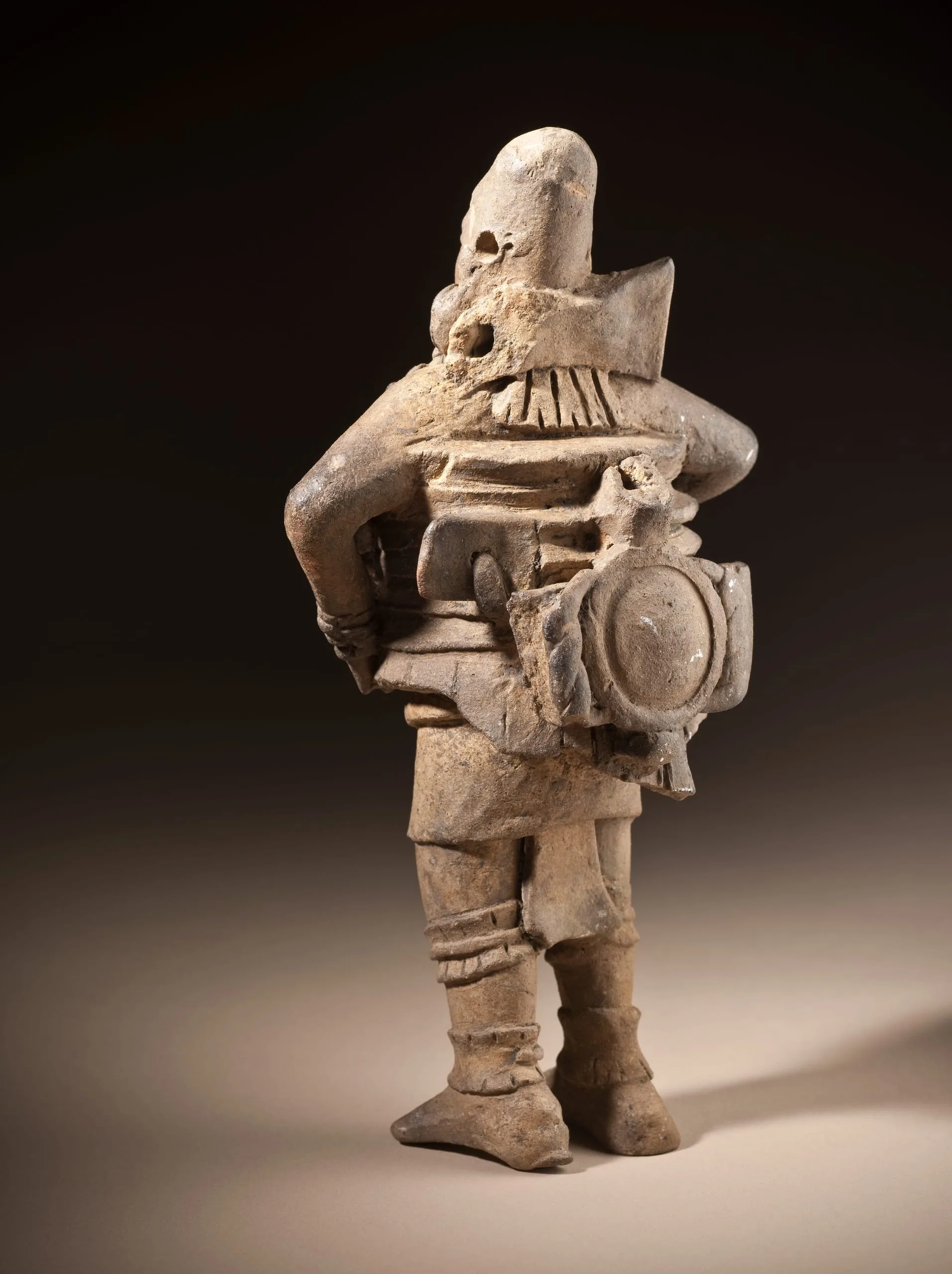
The hefty waist padding identifies this figure as a ballplayer, who wears the protective gear in order to strike a solid rubber ball with his hips. His complex regalia—including royal jewelry consisting of an elaborate bar pendant and doubled ear ornaments—and his portraitlike face suggest that he represents a prestigious historical figure from a Lowland Maya city. Holes drilled through the neck may have held a cord to suspend the small sculpture as part of a royal necklace worn as an heirloom by a descendant. Figures wearing this type of gear along with headdresses and jewelry—also depicted in painted scenes on Maya vessels—are testimony to the high status accorded the ballgame and its players. Far from being a mere contest of athleticism or skill, the ballgame carried complex religious and political connotations.
For the Maya, the ballgame was a life-and-death battle reenacting the mythical match between the Hero Twins and the Lords of Xibalba, as recounted in the sixteenth-century Popol Vuh, the K’iche’ Maya creation narrative. The ballgame ritual was performed to ensure the continued cycles of heavenly bodies and maize growth, and the ballcourt was envisioned as an opening in the earth. Piztil, “ballplayer,” was a title awarded to elite Maya men, associating them with the triumphant nature of the Hero Twins. Ultimately, the ballcourt represented a place of transition between the natural and supernatural, and between death and rebirth.
2024