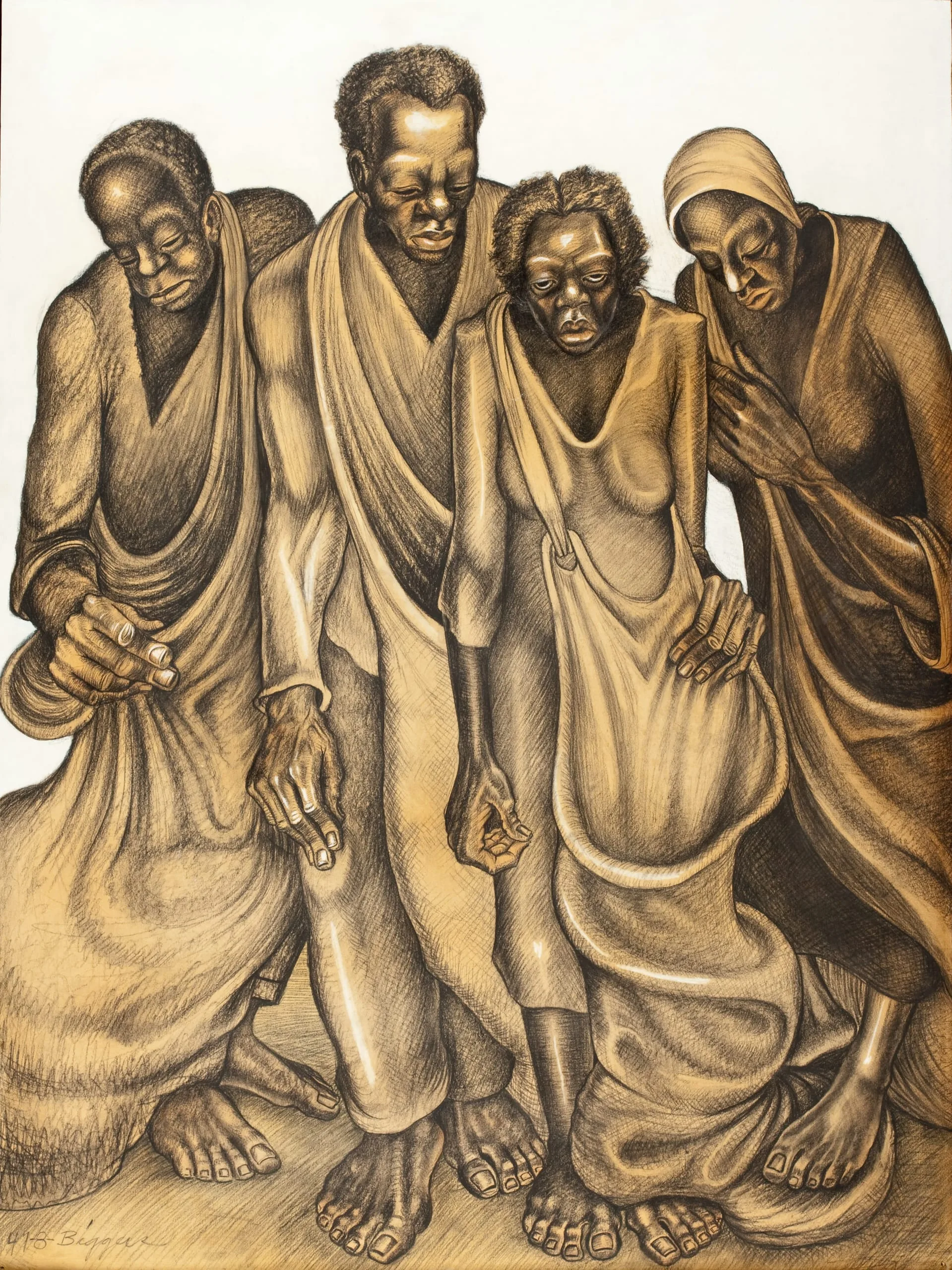
John Biggers translated the heritage of African life into American art, the essence of his long career in the South. Biggers was born in 1924 in Gastonia, North Carolina into a large family that made education their highest priority. In 1937, Biggers's mother enrolled him in Lincoln Academy, a private boarding school for African American children in Kings Mountain, North Carolina. There Biggers was taught by a former missionary to West Africa, who encouraged the students to embrace African heritage.
In 1941, Biggers enrolled at Hampton Institute (now University) in Virginia intending to study plumbing but was drawn to art courses. Several professors recognized and encouraged his talent and interest in drawing. Austrian émigré Viktor Lowenfeld, an artist, art historian and Bauhaus member who had survived the Holocaust, taught his students to confront issues of inequality in their art. Artist-in-residence at Hampton, the renowned painter and muralist Charles White, especially fostered Biggers's abilities to employ narrative and an intensified realism to portray scenes of racial injustice and poverty in his art with extreme pathos, such as Cotton Pickers (1947; LACMA).
Biggers was drafted into the U.S. Navy in 1943. The mural he created that year, Dying Soldier, was exhibited in the Young Negro Art exhibition at the Museum of Modern Art in New York. After World War II, Biggers earned B.S. and M.S. degrees in Art Education from Pennsylvania State University and, in 1949, established the art department at Texas State University for Negroes (now Texas Southern University) in Houston, where he made his career, teaching at Texas Southern until 1983. The completion of his 1953 mural, The Contribution of Negro Women to American Life and Education for a Houston YWCA, became the subject of Biggers's doctoral dissertation, and he earned his Ph.D. in Education from Penn State the following year. A 1957 trip to Ghana in West Africa, transformed Biggers's career, and he began to incorporate further his greater awareness of African culture into his images of African American life.
Actively painting until his death in 2001, Biggers painted numerous public murals on commission and received many awards for distinguished artistic and teaching accomplishments over the course of his career. He is also renowned for such easel paintings as Shotguns (1987; private collection, Houston), which references Shotgun houses, an African-influenced form of architecture prevalent in the South. Biggers was the subject of over 20 solo exhibitions and dozens of group shows. In 1995, the Museum of Fine Arts, Houston presented a major retrospective of his career: The Art of John Biggers: View from the Upper Room.