- Title
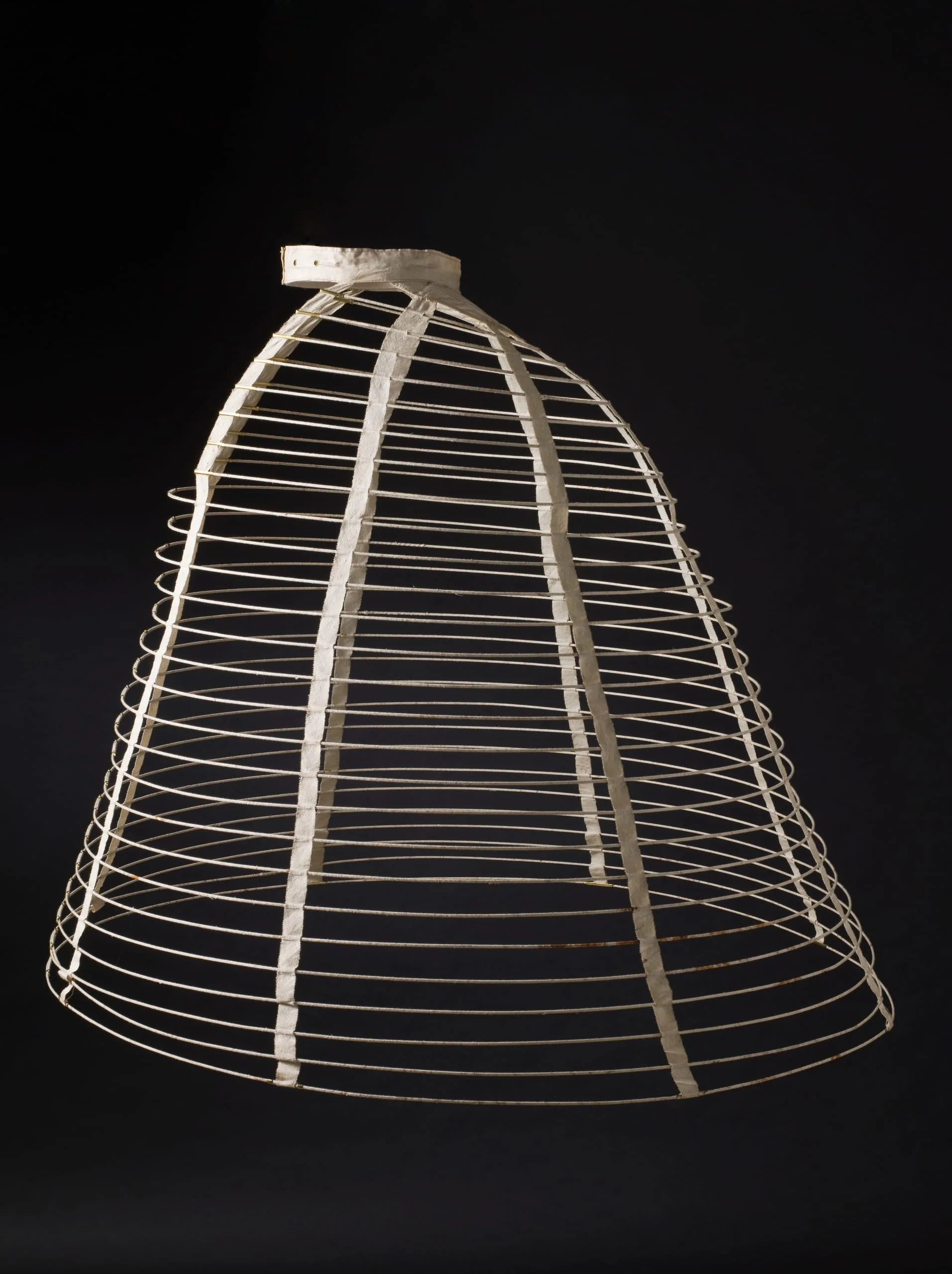
- Woman's Cage Crinoline
- Date Made
- circa 1865
- Medium
- Cotton-braid-covered steel, cotton twill and plain-weave double-cloth tape, cane, and metal
- Dimensions
- Center back length: 36 1/2 in. (92.71 cm); Diameter: 38 1/2 in. (97.79 cm)
- Accession Number
- M.2007.211.380
- Curatorial Notes
The Bessemer process, patented in 1855, greatly increased the malleability of steel, making possible a flexible steel-wire armature (cage crinoline) to replace the bulk of petticoats. This lightweight steel skeleton allowed skirts to widen to excessive proportions, recalling the extremities of the mid-eighteenth-century pannier. Dome-shaped in 1856, the cage became pyramid-shaped in the early 1860s, when style dictated that the massive skirts be swept to the garment’s back.
- Selected Bibliography
- Takeda, Sharon Sadako and Kaye Durland Spilker. Fashioning Fashion: Deux Siècles de Mode Européenne, 1700-1915. Paris: Arts Décoratifs; Los Angeles: Los Angeles County Museum of Art; Munich; New York: Delmonico Books-Prestel, 2013.
- Takeda, Sharon Sadako and Kaye Durland Spilker. Fashioning Fashion: European Dress in Detail, 1700-1915. Los Angeles: Los Angeles County Museum of Art; Munich; New York: Delmonico Books/Prestel, 2010.
- Takeda, Sharon Sadako and Kaye Durland Spilker. Fashioning Fashion: Europäische Moden, 1700-1915. Los Angeles: Los Angeles County Museum of Art; Munich; New York: Prestel, 2012.
- Edwards, Lydia. How to Read a Dress: a Guide to Changing Fashion from the 16th to the 20th Century. London: Bloomsbury Academic, 2017.