- Title
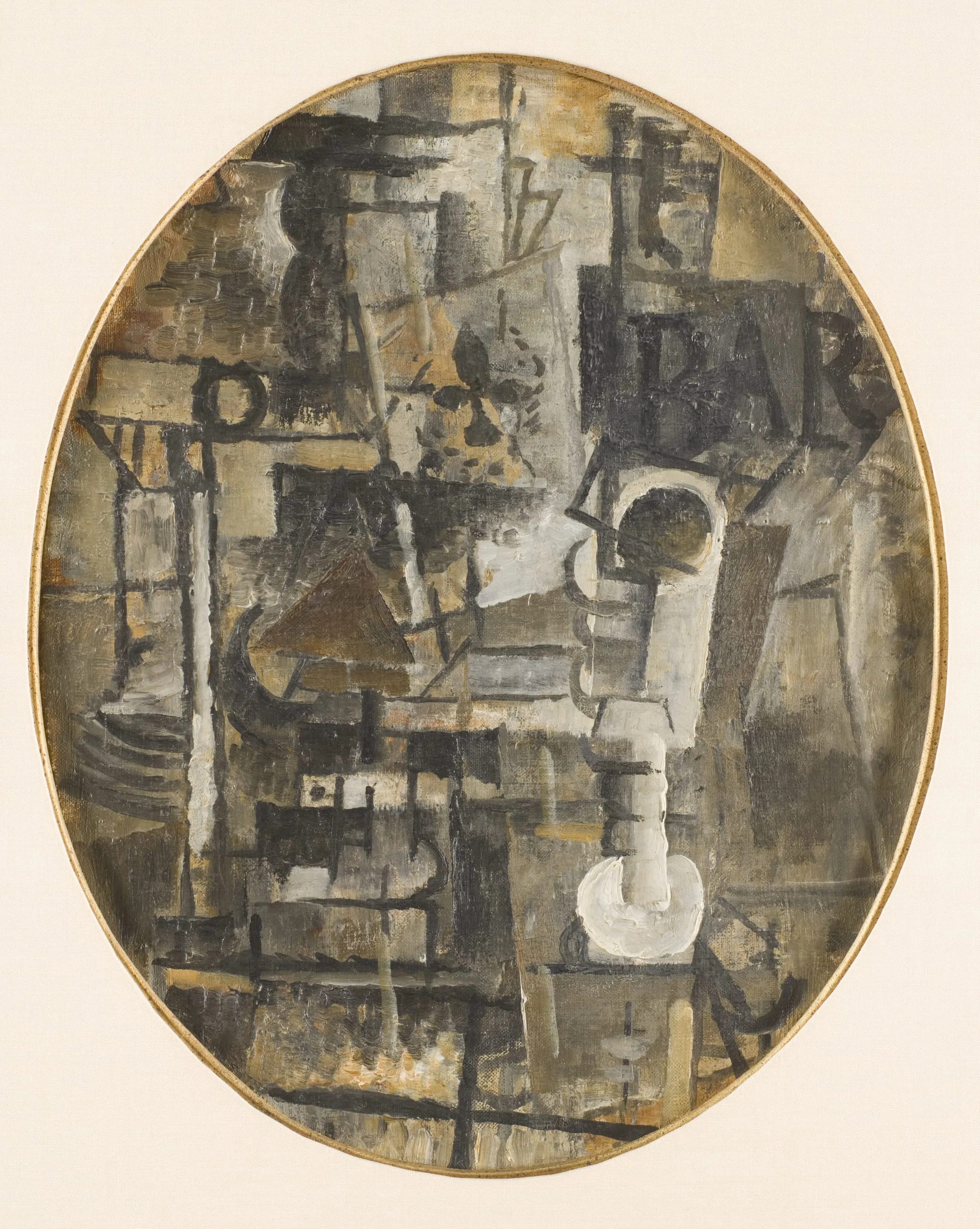
- Glass, Bottle, and Playing Card
- Date Made
- 1912
- Medium
- Oil on canvas
- Dimensions
- 11 13/16 × 9 9/16 in. (30 × 24.3 cm)
- Accession Number
- M.2005.70.14
- Curatorial Notes
In cofounding Cubism with Pablo Picasso, Georges Braque sought new ways to represent three dimensions on a two-dimensional surface. Glass, Bottle, and Playing Card is an example of the analytic style of Cubism. Here, Braque disassembles his subject into planes and lines, highlighting the flatness of the canvas.
Braque later reintegrated color and volume into his still lifes, which featured objects that evoked a sense of touch, such as musical instruments and playing cards. Concert (to the left) underscores this tactility through Braque’s use of trompe l’oeil, or an optical illusion of three- dimensionality. Painted imitations of marble, wood, and wallpaper can be seen behind the table, which slopes for- ward, disrupting traditional perspective. Braque emphasized tactility in several ways, such as incorporating strips of paper in a technique called papier collé and mixing sand with gesso and paint.
Wall label, 2021.
- Provenance
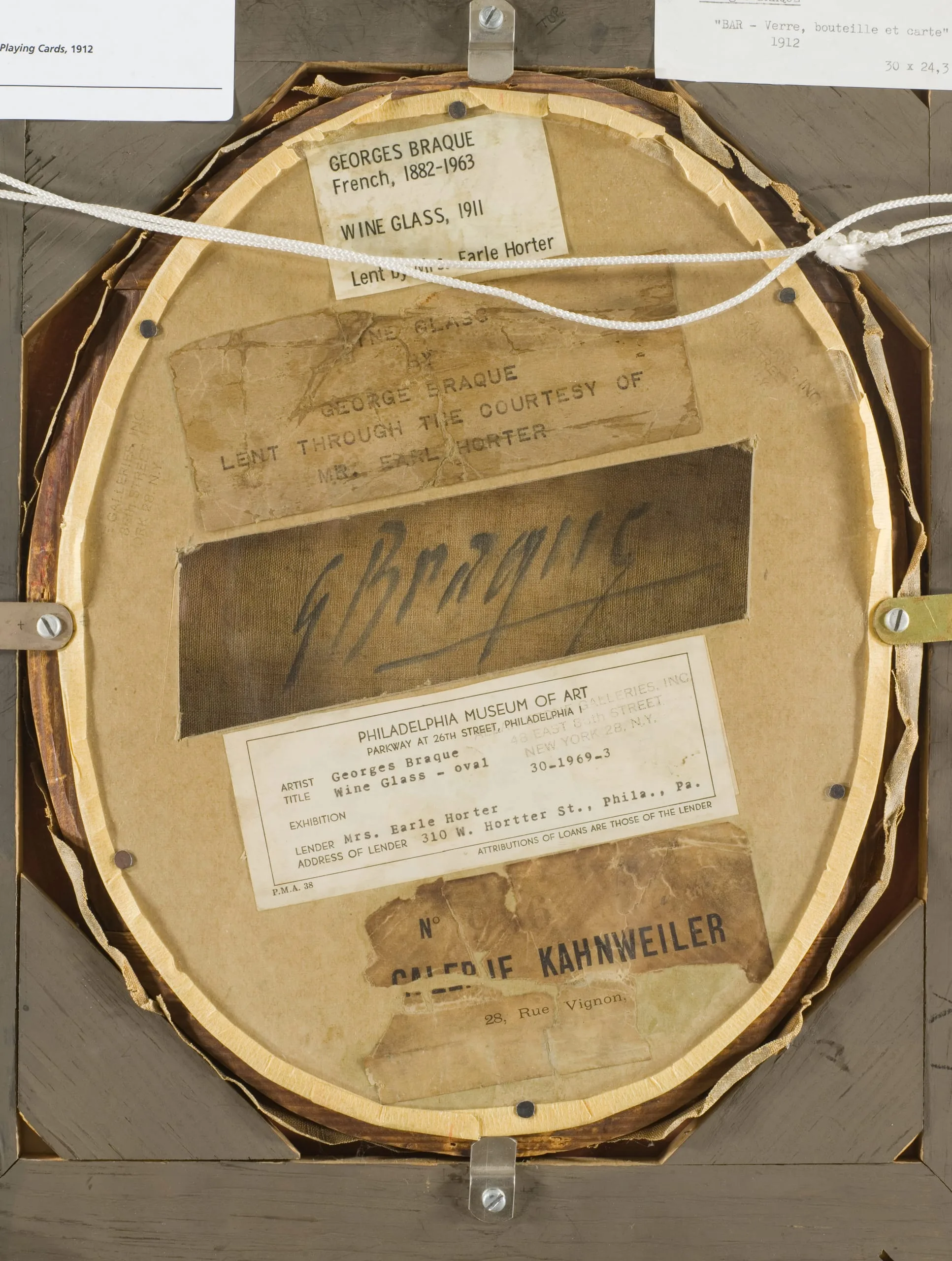
The artist (1882-1963); [Galerie Kahnweiler, Paris, Stock No. 996, photo No. 1041] [1]. Collection Dr. Jacques Soubies, Paris; [sold in 1928 at the "Collection du Dr. Soubies” sale at Hôtel Drouot, Paris, June 14, 1928, lot 27]. Earl Horter (1880-1940), Philadelphia. Harold Diamond (1926-1982), New York. [Allan Stone Galleries, New York]; sold in 1992 to Private Collection, USA; [sold on May 13, 1992, at Sotheby’s, New York, Lot 74]; [to Galerie Rosengart, Lucerne]; sold in 1993 to Janice and Henri Lazarof, Los Angeles; given in 2005 to LACMA.
[1] The work likely went on sale in 1921 at Drouot when Kahnweiler’s property was sequestered by the French government.
- Selected Bibliography
- Nicole Worms de Romilly and Jean Laude. "Braque Oeuvre Catalogue." Vol. 7, “Braque, le Cubisme, fin 1907-1914.” Paris: Editions Maeght, 1982.
- Barron, Stephanie. Envisioning Modernism: The Janice and Henri Lazarof Collection. Los Angeles: Los Angeles County Museum of Art; Munich; New York: DelMonico Books-Prestel, 2012.
- Worms de Romilly, Nicole, and Jean Laude. Braque: Cubism, catalogue of the work, 1907-1914. Paris: Galerie Maeght, 1982. Catalogue raisonné, vol. 7, no. 181, p. 246, illustrated in color.
- Copyright
- © Georges Braque / Artists Rights Society (ARS), New York / ADAGP, Paris