LACMA

ShopMembershipMyLACMATickets
LACMA
Los Angeles County Museum of Art
5905 Wilshire Blvd.
Los Angeles, CA 90036
info@lacma.org
(323) 857-6000
Sign up to receive emails
Subscribe
© Museum Associates 2025

Museum Hours

Monday

11 am–6 pm

Tuesday

11 am–6 pm

Wednesday

Closed

Thursday

11 am–6 pm

Friday

11 am–8 pm

Saturday

10 am–7 pm

Sunday

10 am–7 pm


  • About LACMA
  • Jobs
  • Building LACMA
  • Host An Event
  • Unframed
  • Press
  • FAQs
  • Log in to MyLACMA
  • Privacy Policy
© Museum Associates 2025
Collections

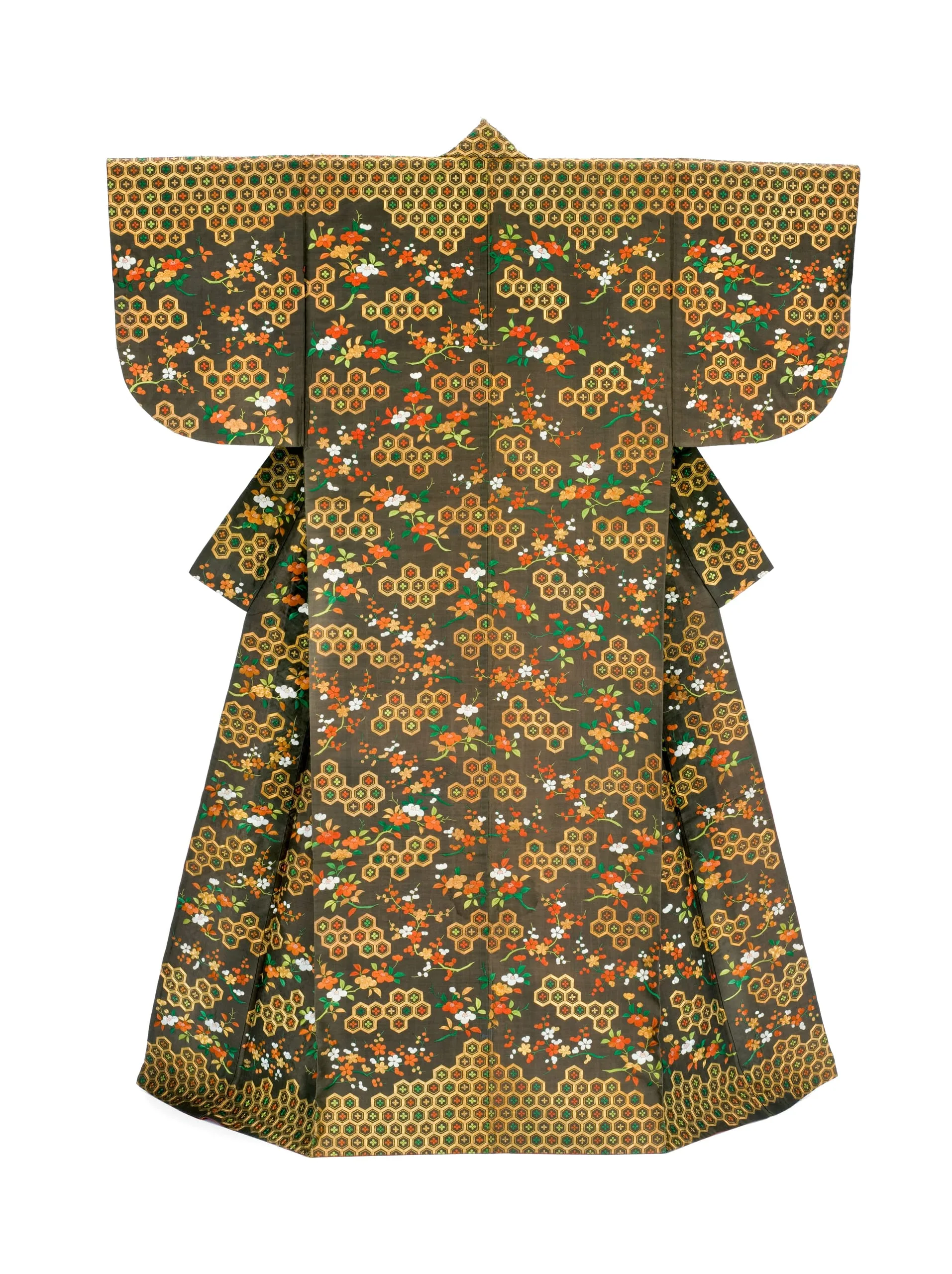
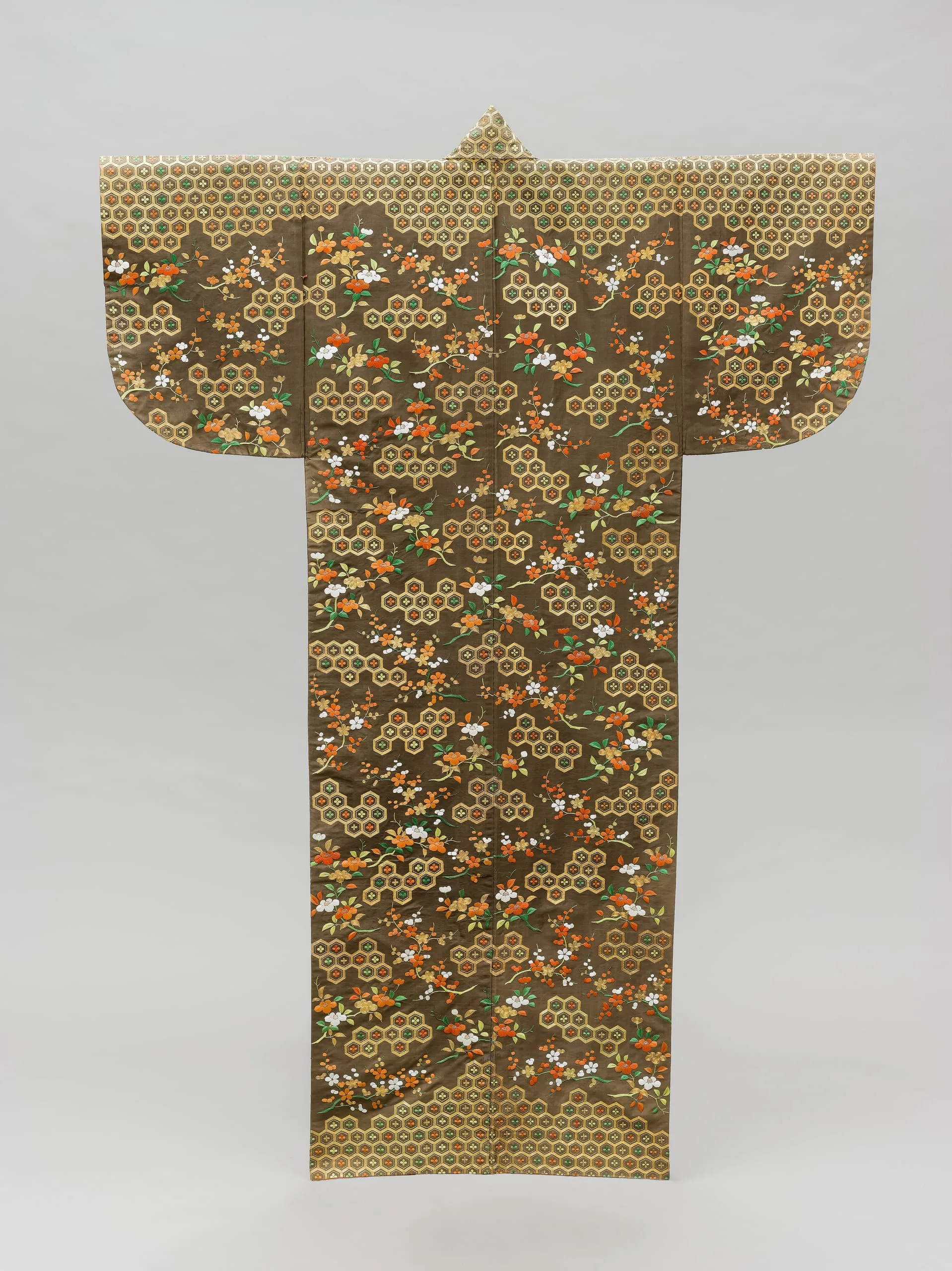
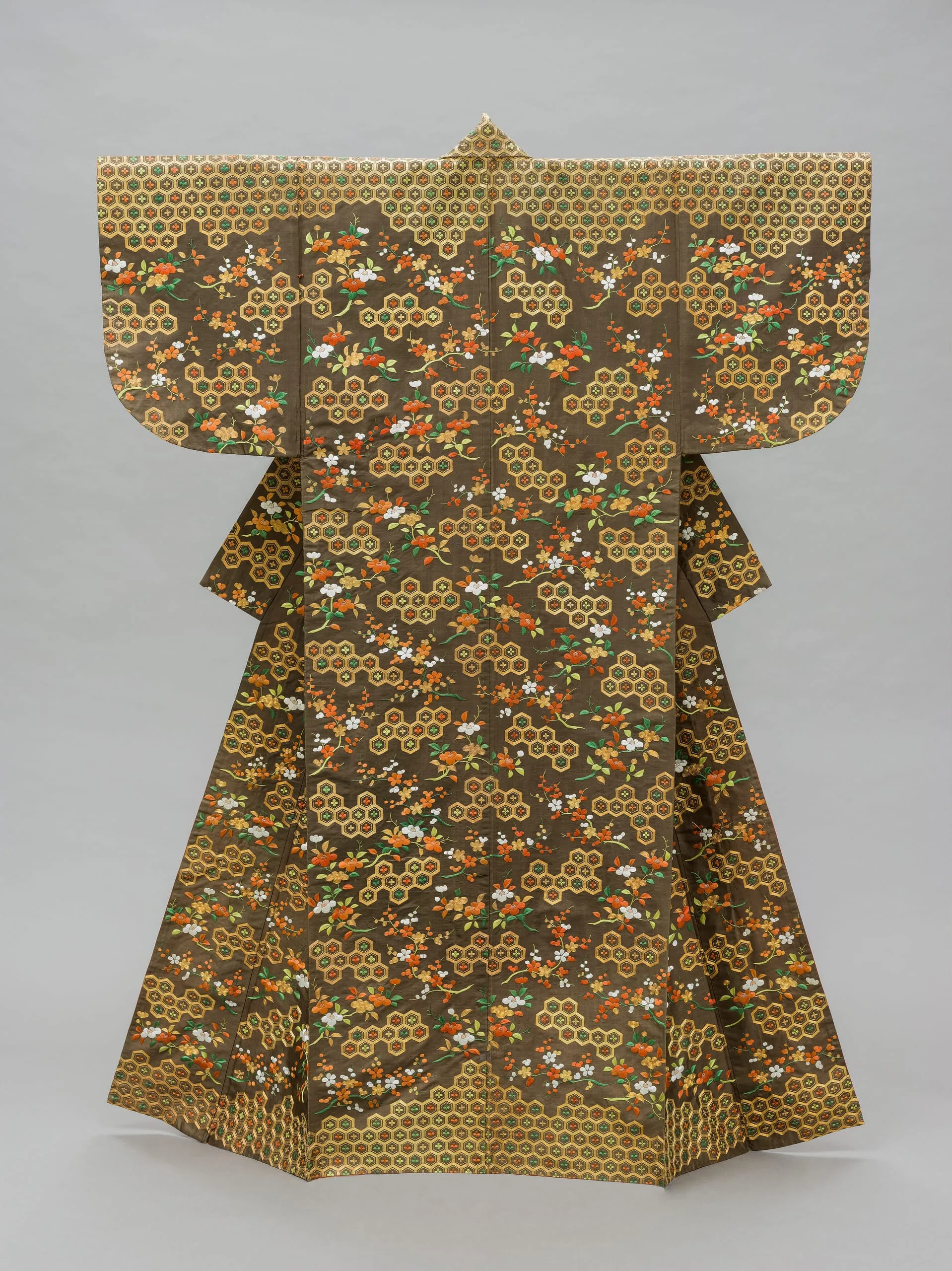
Samurai-Class Woman’s Summer Formal Outer Robe (Koshimaki)late Edo period (1615-1868), early 19th century

Not on view
Full-length kimono with dark olive-brown ground, scattered gold hexagonal honeycomb clusters, and small floral sprigs in red, orange, and white
Kosode displayed flat against a gray background, olive-brown silk ground with an allover tortoiseshell (kikko) lattice pattern in gold, overlaid with scattered flowering branches in orange, white, and green.
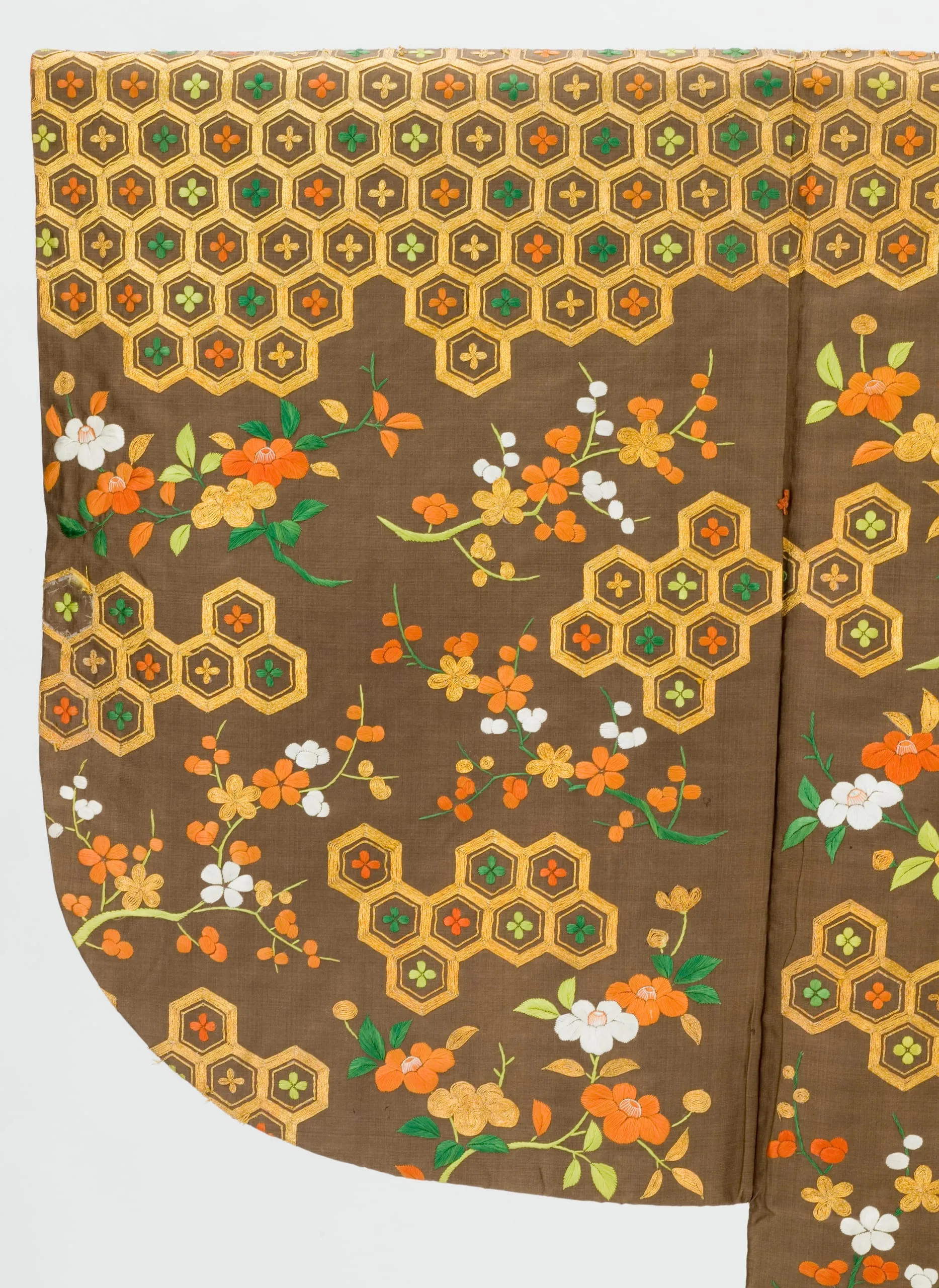
Silk kimono displayed flat, dark olive-brown ground covered with scattered clusters of orange, white, and green flowers interspersed with gold hexagonal tortoiseshell (kikko) patterned medallions; gold brocade border at hem, cuffs, and collar.
Silk textile, likely a kimono panel, with taupe ground woven in gold kikko (tortoiseshell) hexagonal pattern containing small floral motifs, overlaid with embroidered orange, white, and gold flowering branches in scattered arrangement.
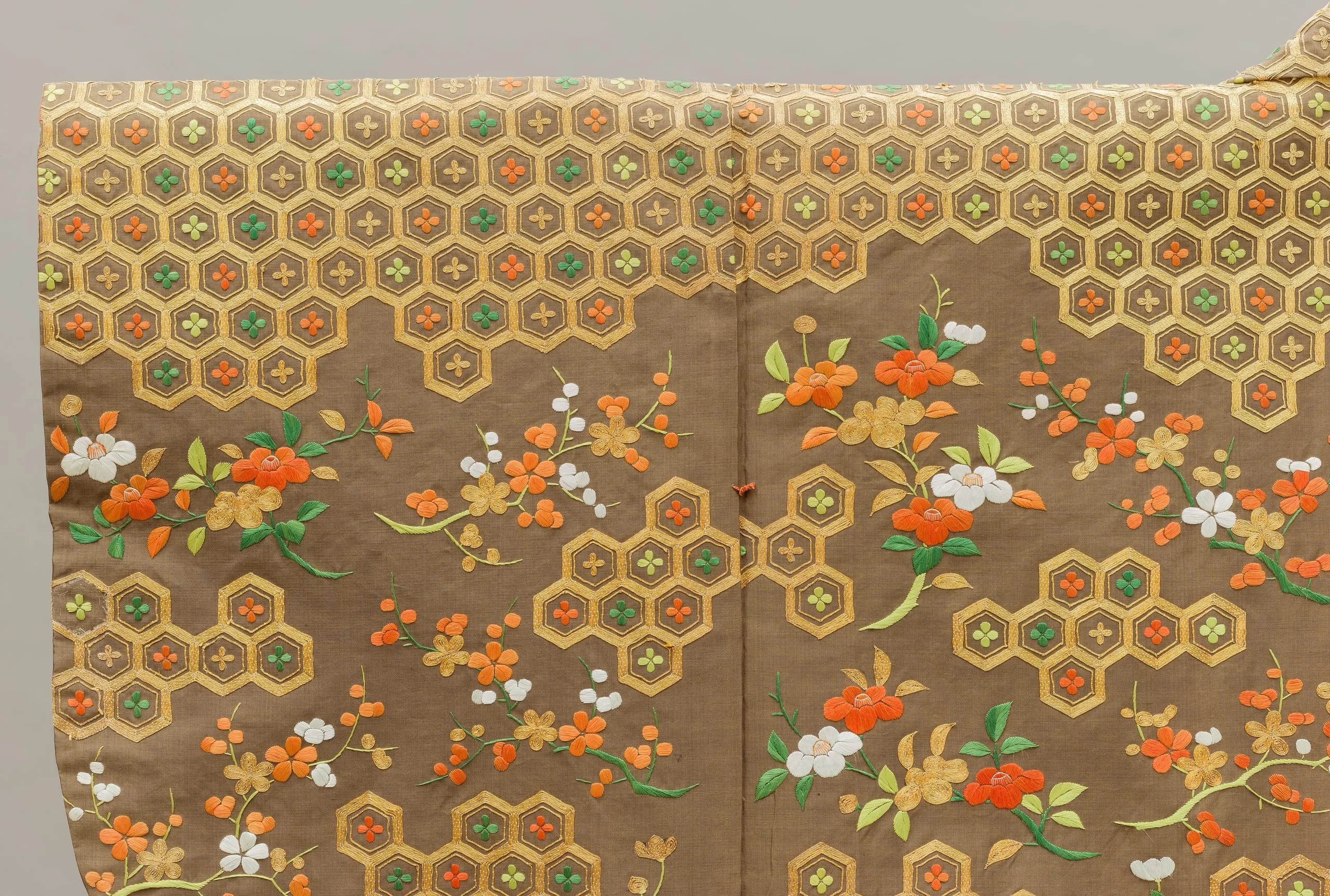
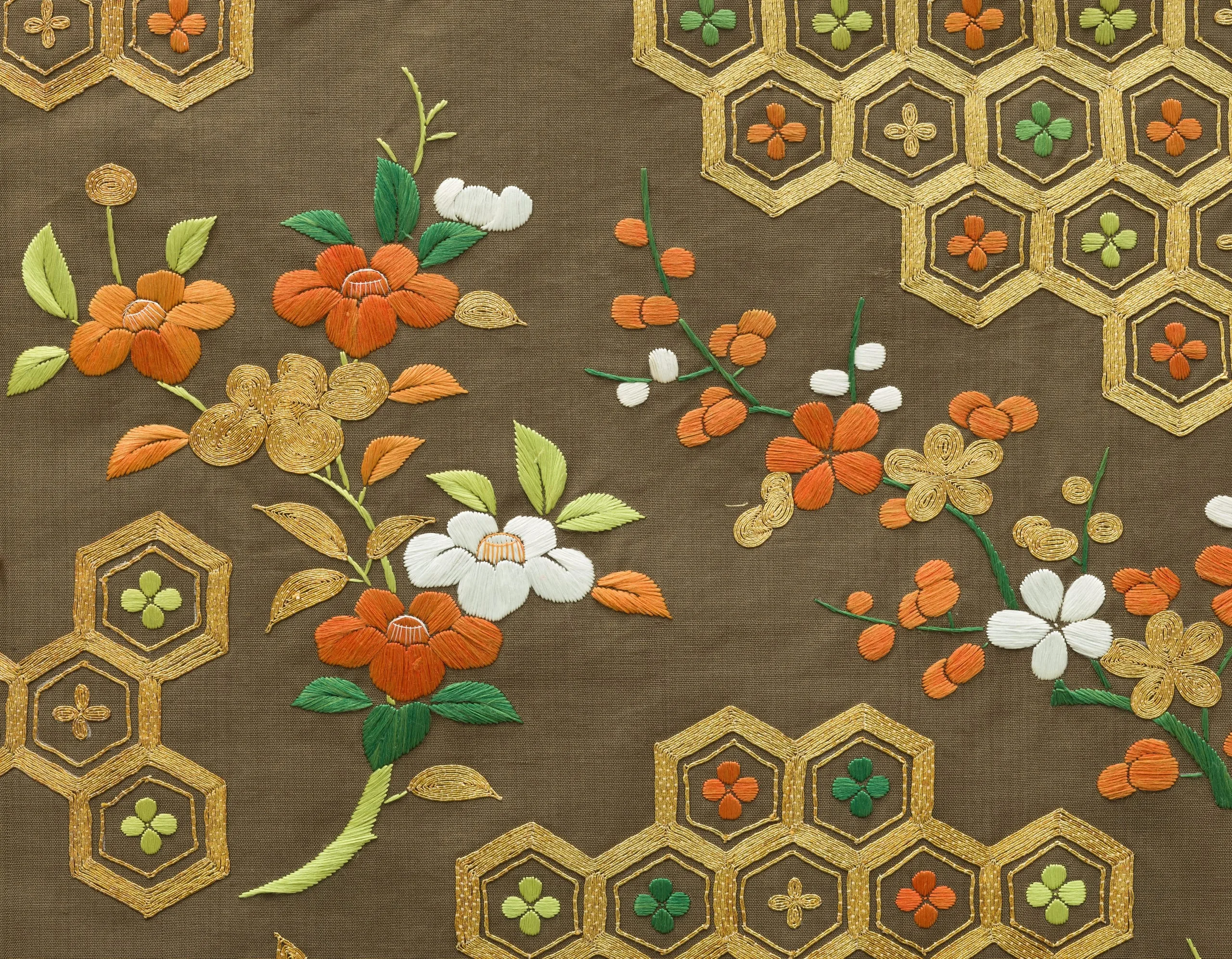
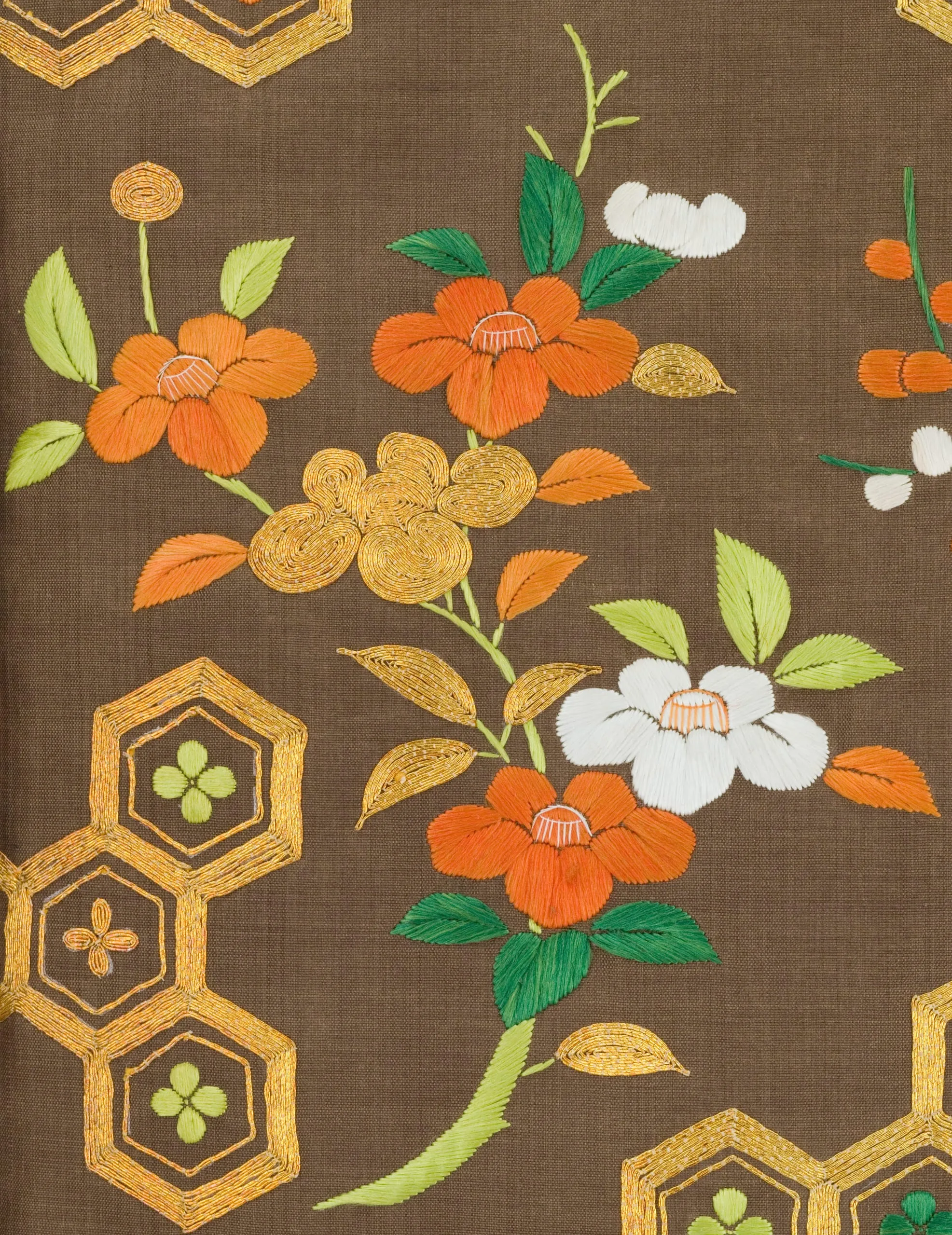
Embroidered textile on olive-brown ground, with orange, white, and gold silk floral sprays including camellia and plum blossoms, alongside geometric honeycomb medallions worked in gold thread with small four-petal flowers in green, orange, and red.
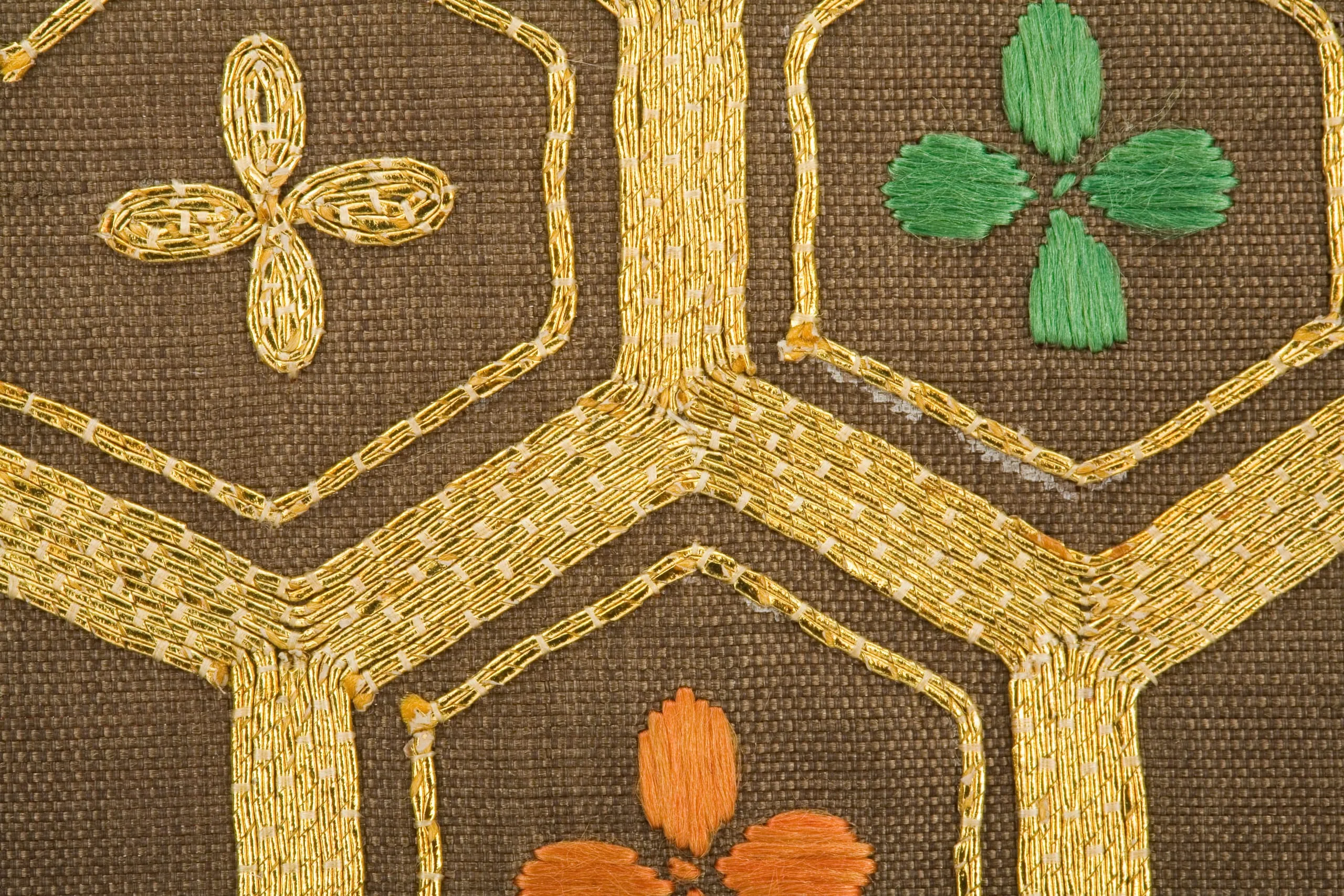
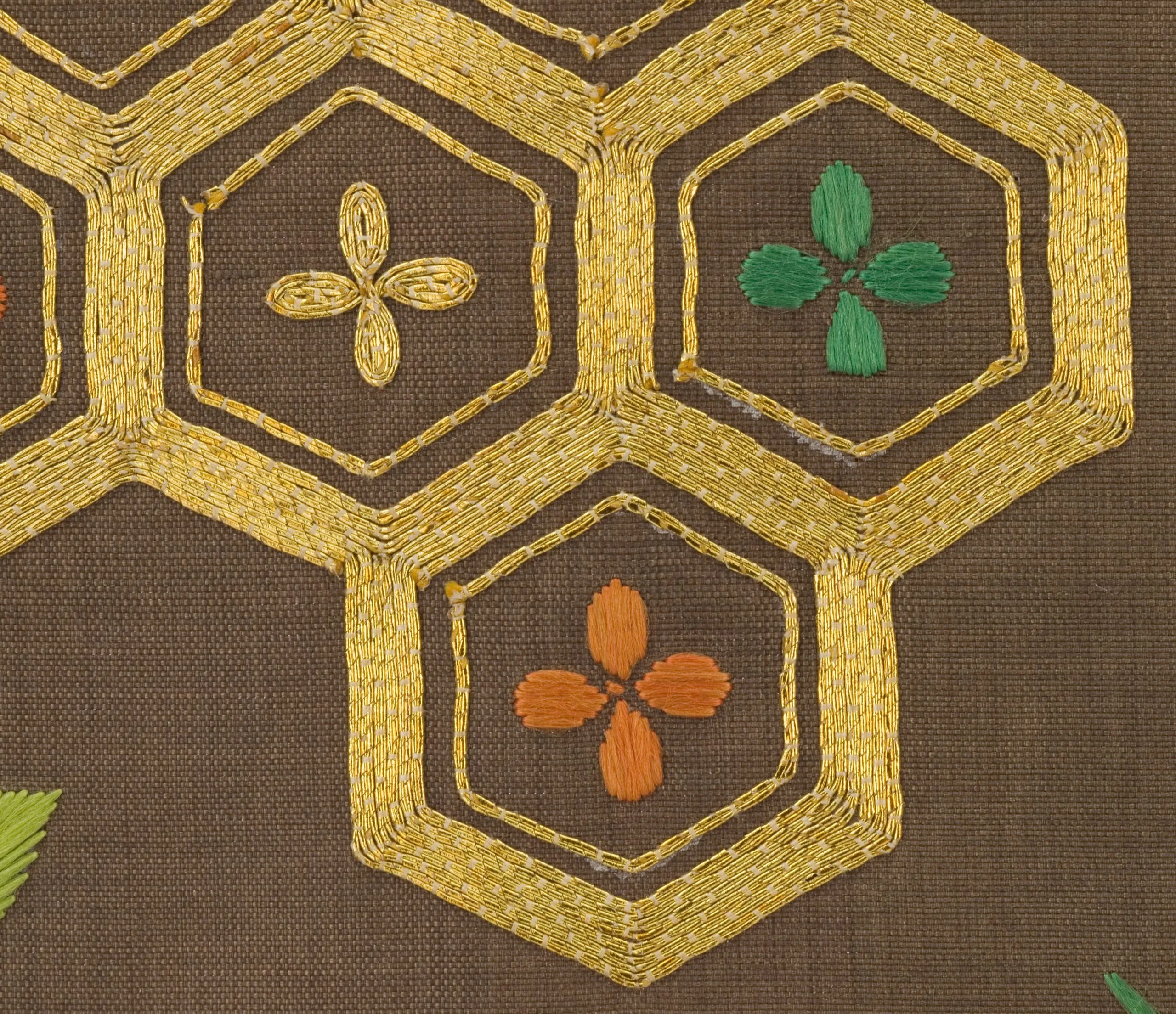
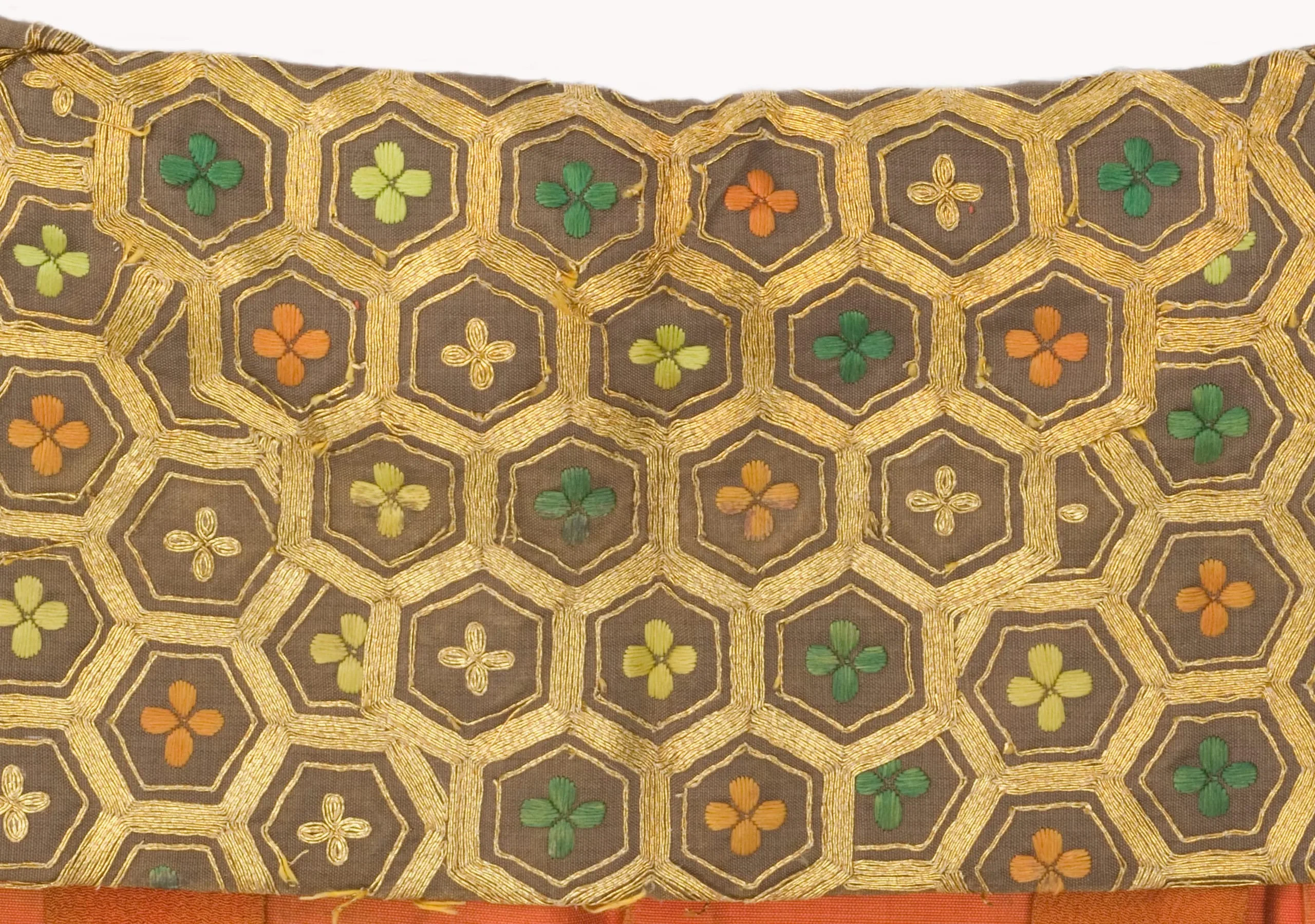
Close-up of embroidered textile on brown woven ground, featuring gold metallic thread worked into a honeycomb lattice pattern with small floral motifs in green and orange satin stitch within each cell.
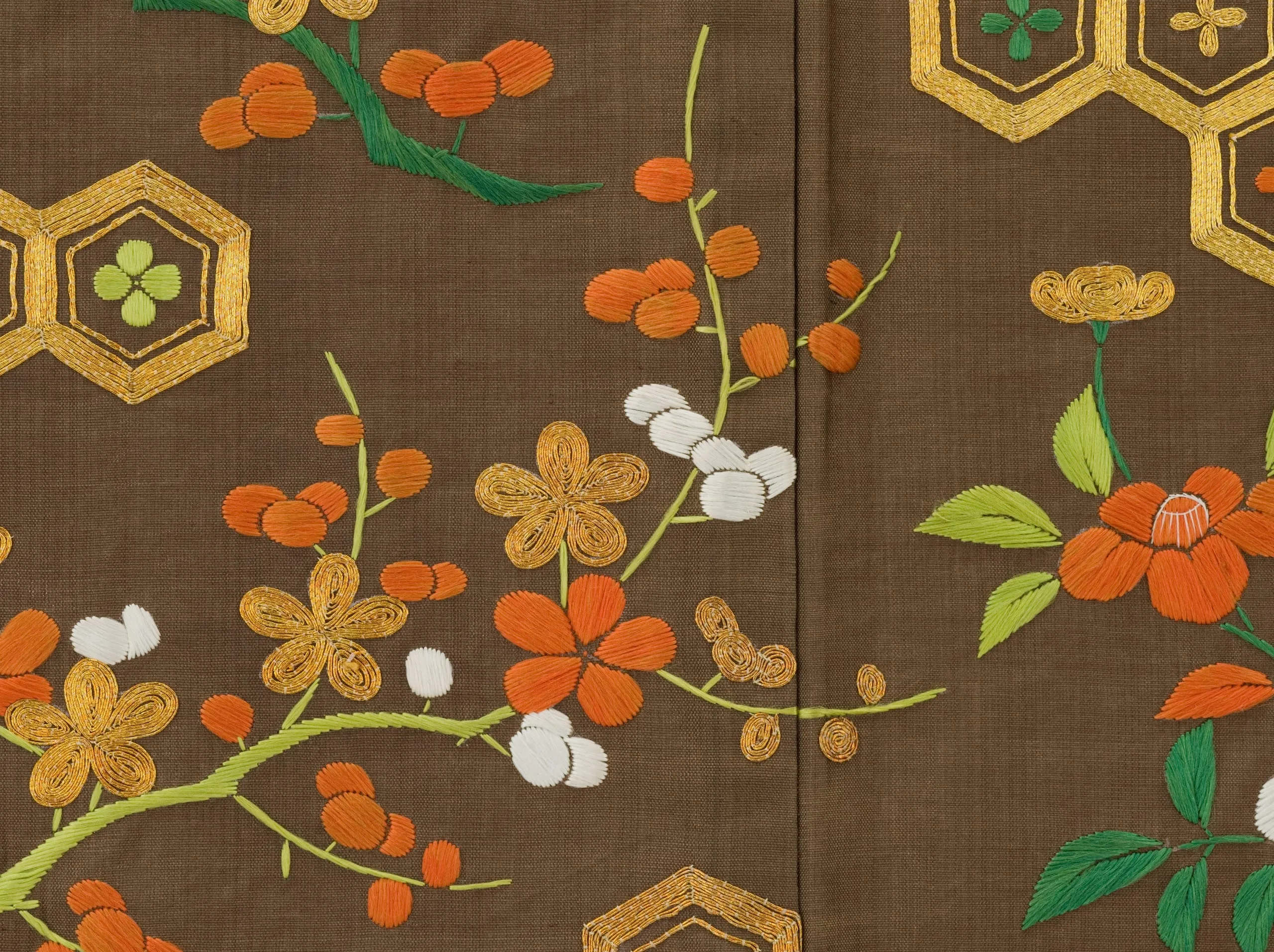
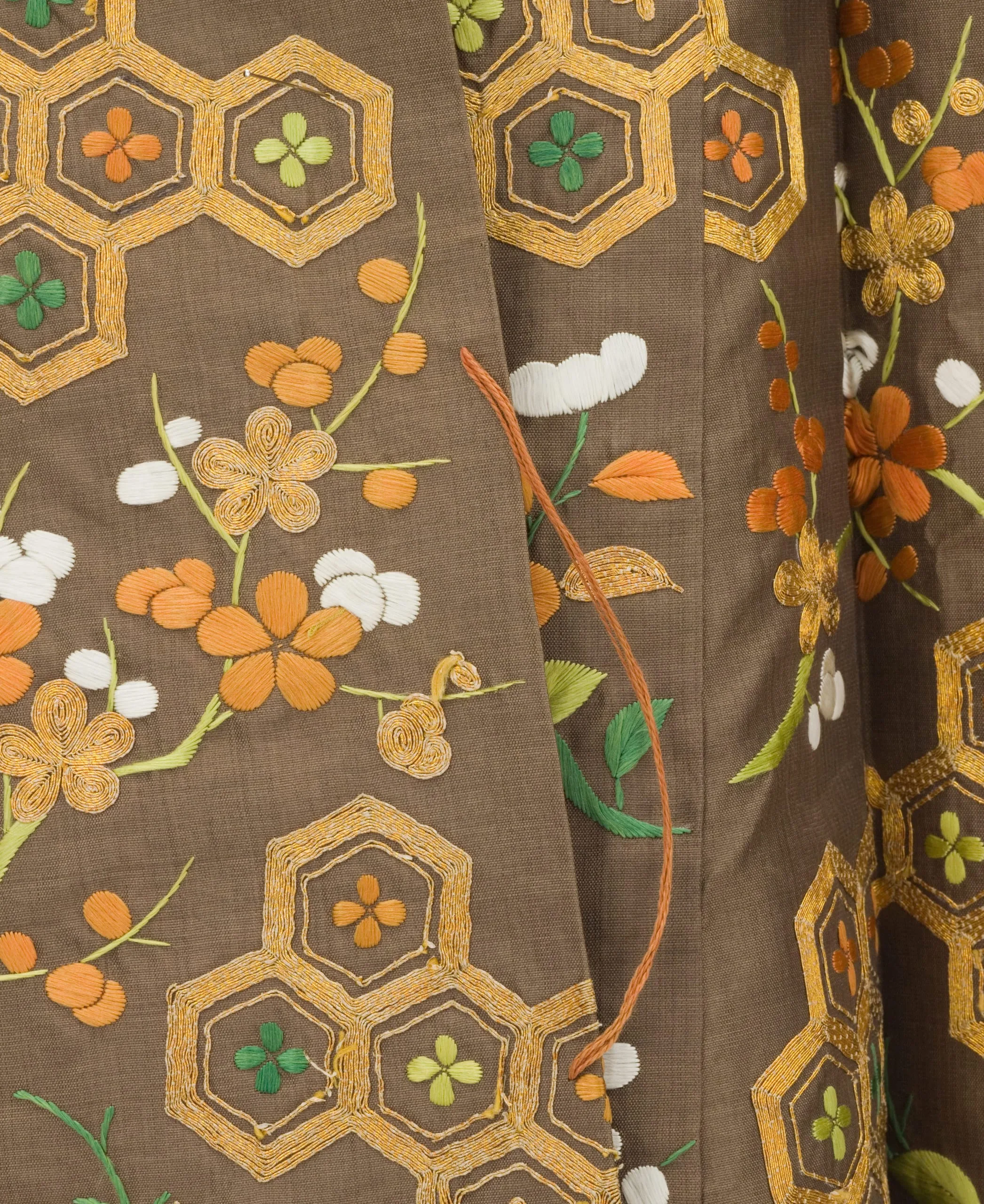
Embroidered textile with brown ground, featuring dense floral motifs in orange, gold, and white thread with green stems and leaves, and repeating hexagonal medallions with gold couching along the edges.
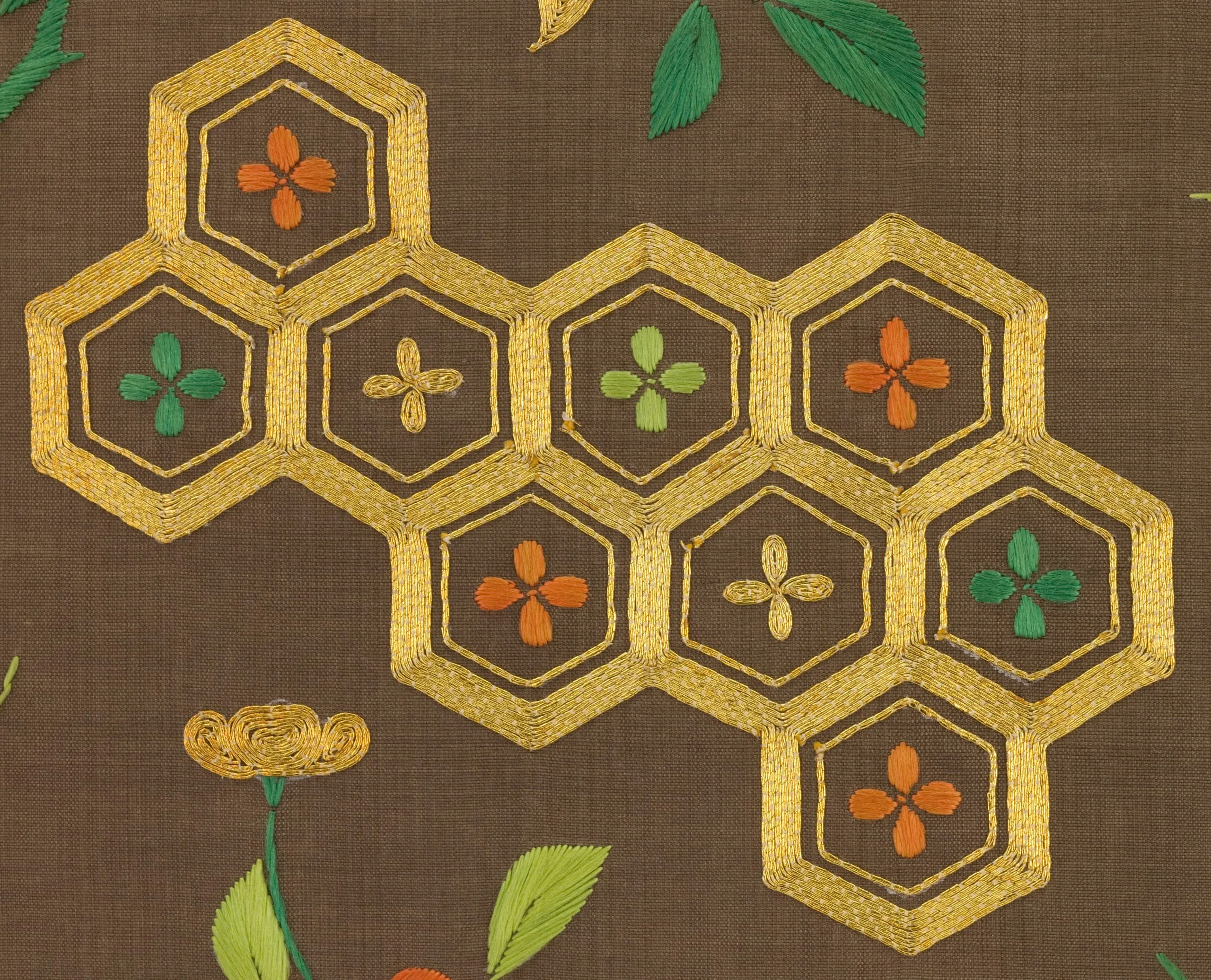
Embroidered textile on brown ground, cluster of gold satin-stitch hexagons in a honeycomb arrangement, each containing a small four-petaled flower in orange, green, or cream thread; scattered green embroidered leaves and a yellow flower at the edges.
Embroidered textile fragment on brown ground, with gold satin-stitch hexagons forming a honeycomb lattice, each cell containing a four-petaled flower motif in gold, green, or orange thread.
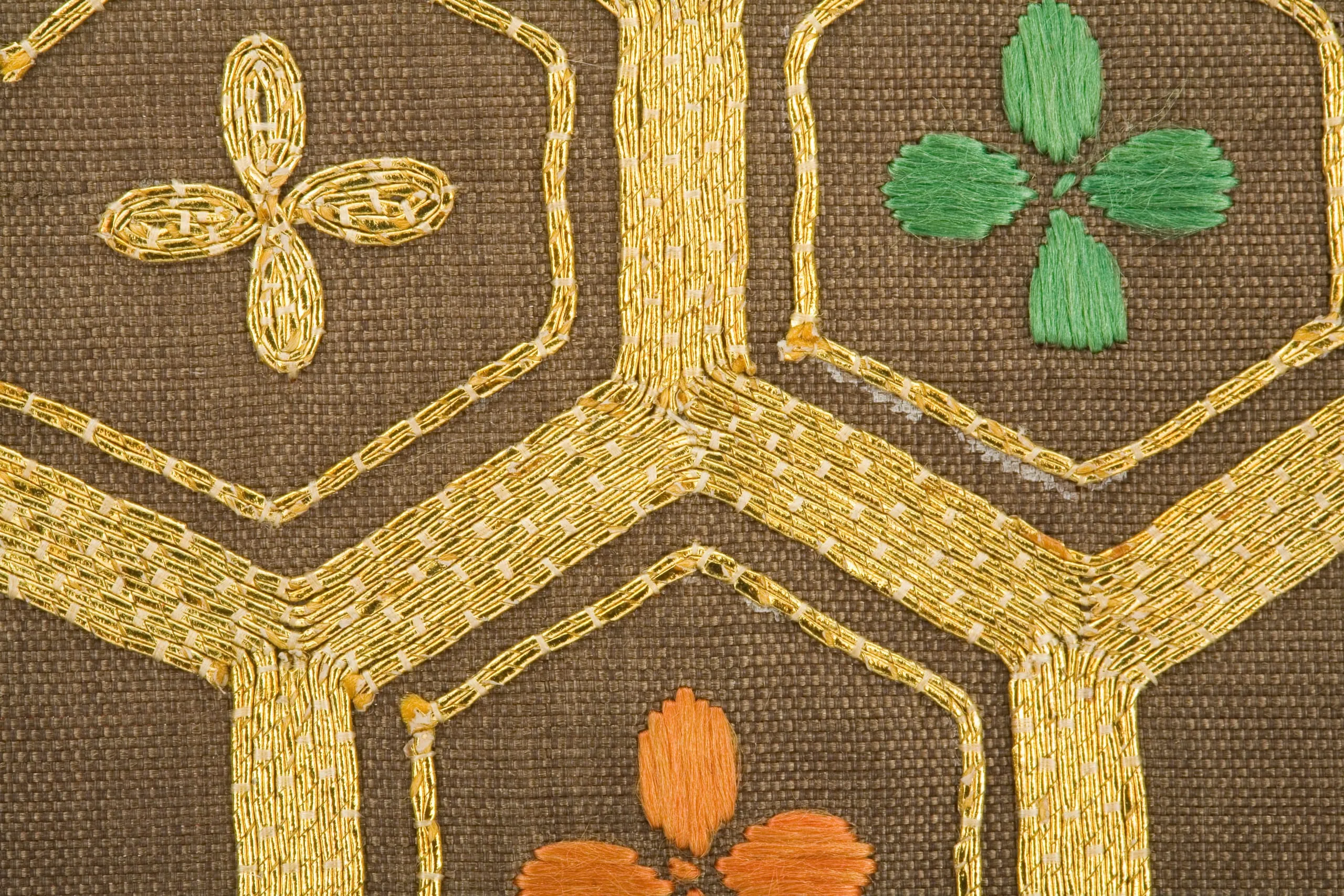
Embroidered textile on brown woven ground, with gold thread couching forming a hexagonal lattice pattern enclosing floral motifs in yellow, green, and orange satin stitch.
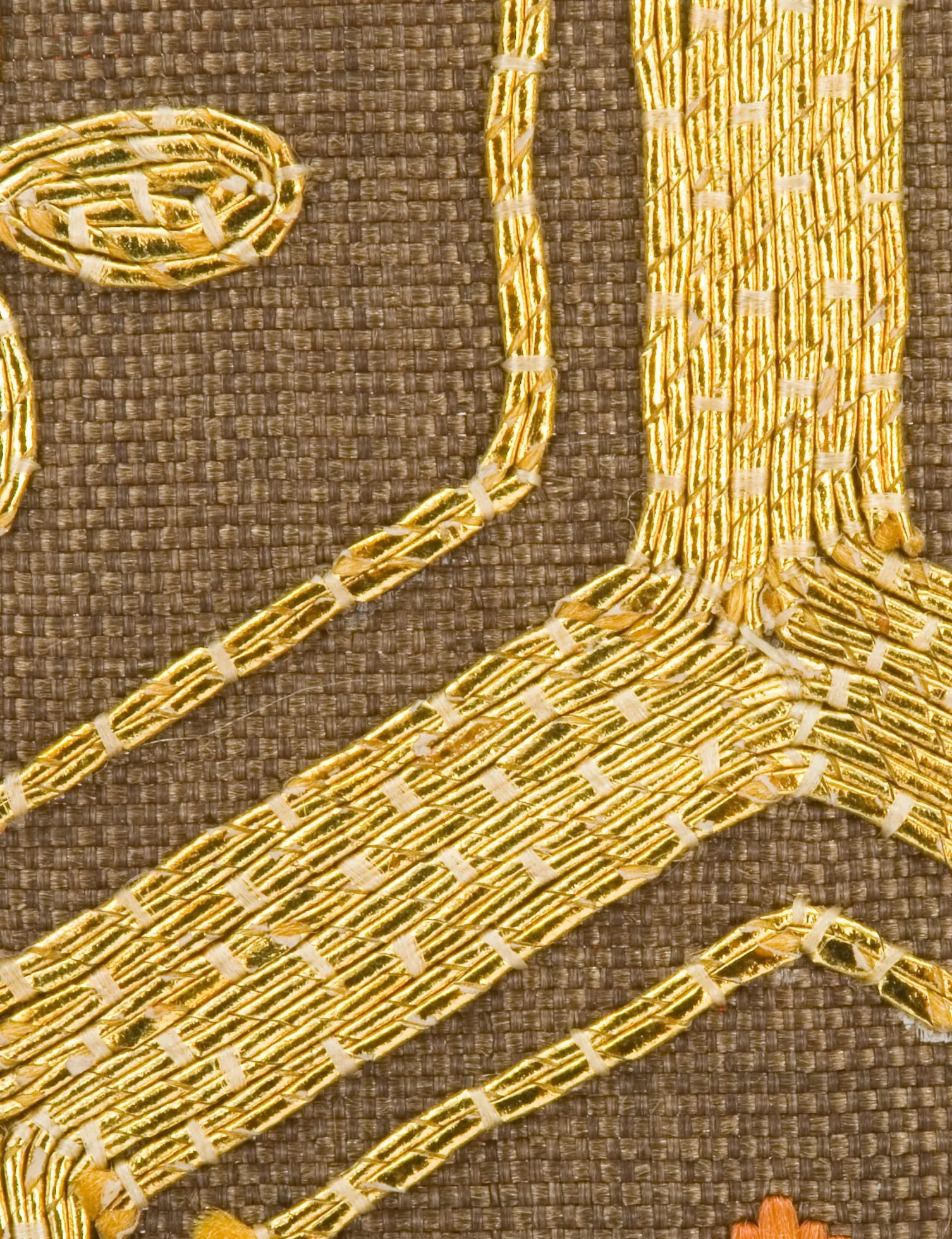
Close-up of goldwork embroidery on brown woven ground fabric, with dense parallel rows of metallic gold thread couched in geometric and curved bands, including an oval motif at upper left.
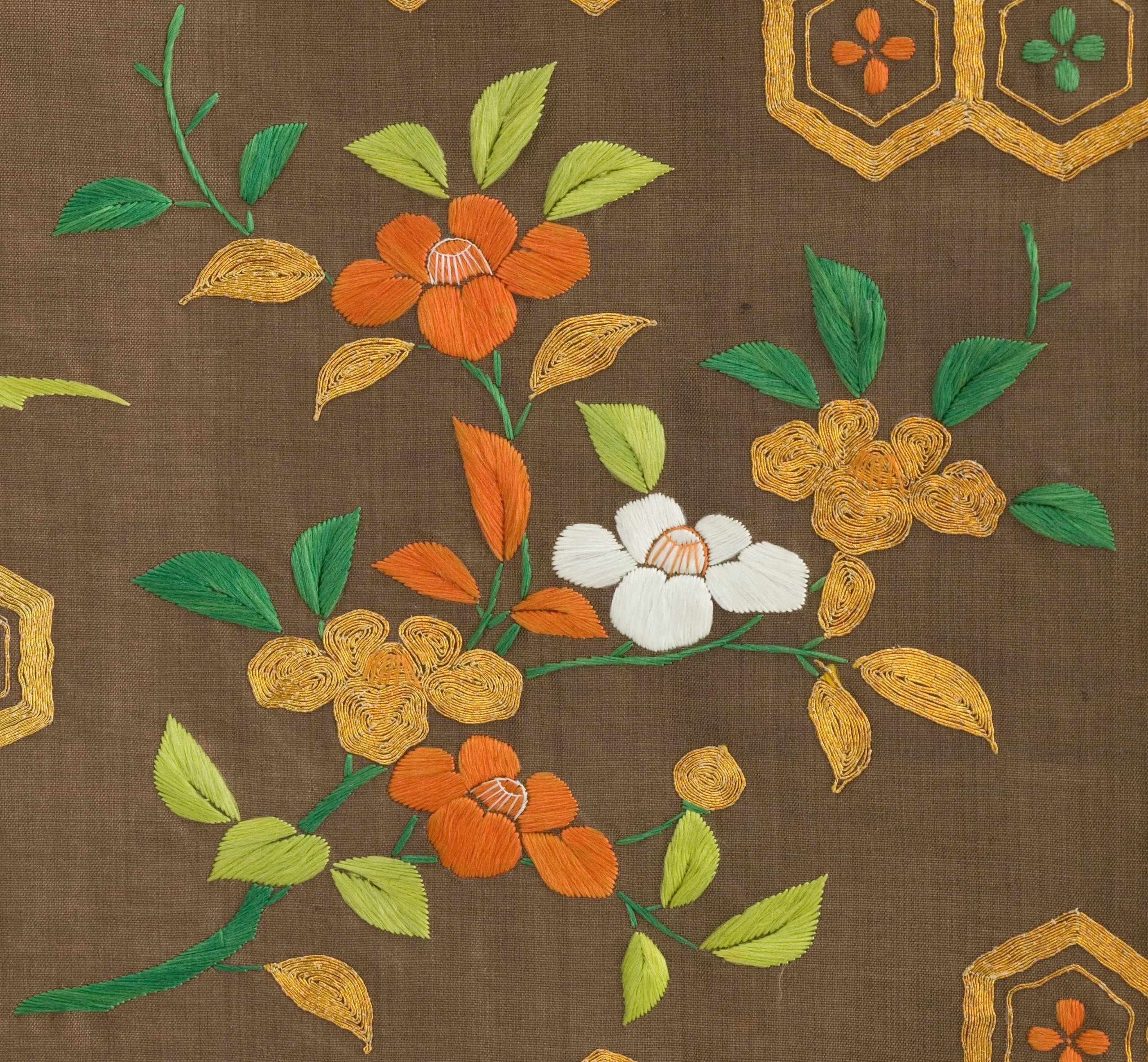
Embroidered textile panel on brown ground, with silk and metallic thread floral sprays featuring orange, white, and gold flowers with green and yellow-green leaves; gold coiled-thread blossoms and hexagonal medallions at corners.
Embroidered textile panel on brown ground, with satin-stitch floral sprays in orange, white, and gold-wrapped thread, interspersed with hexagonal geometric medallions containing four-petal motifs in gold and green.
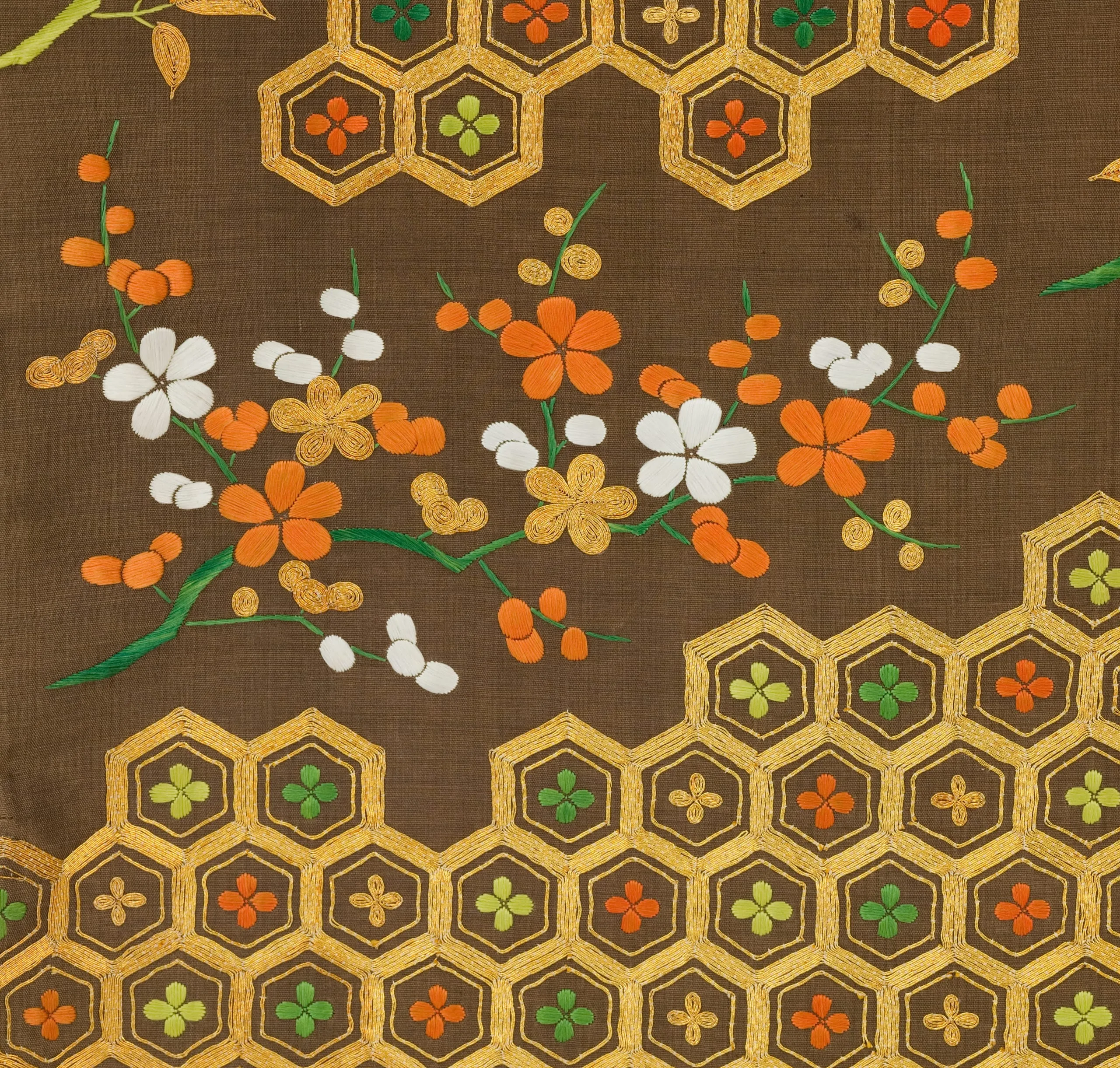
Embroidered textile fragment on brown ground, with orange, white, and gold floral sprays across the center, and gold hexagonal tortoiseshell-pattern borders at top and bottom, each hexagon enclosing a small four-petaled flower in orange, green, or white silk thread.
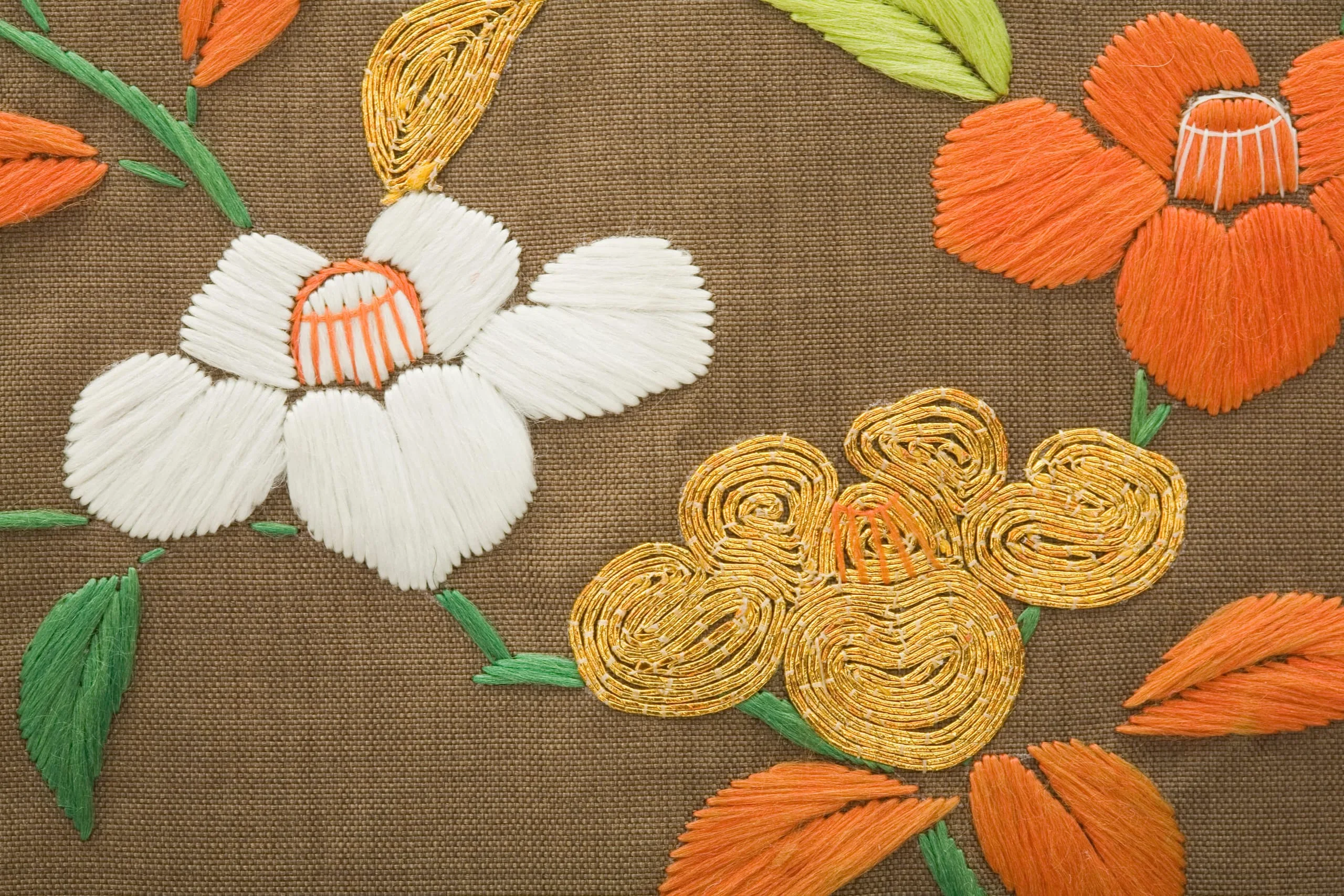
Embroidered textile on brown linen ground, featuring gold metallic coiled-thread flowers, white satin-stitch blossoms, and orange padded buds on green stems scattered across the surface.
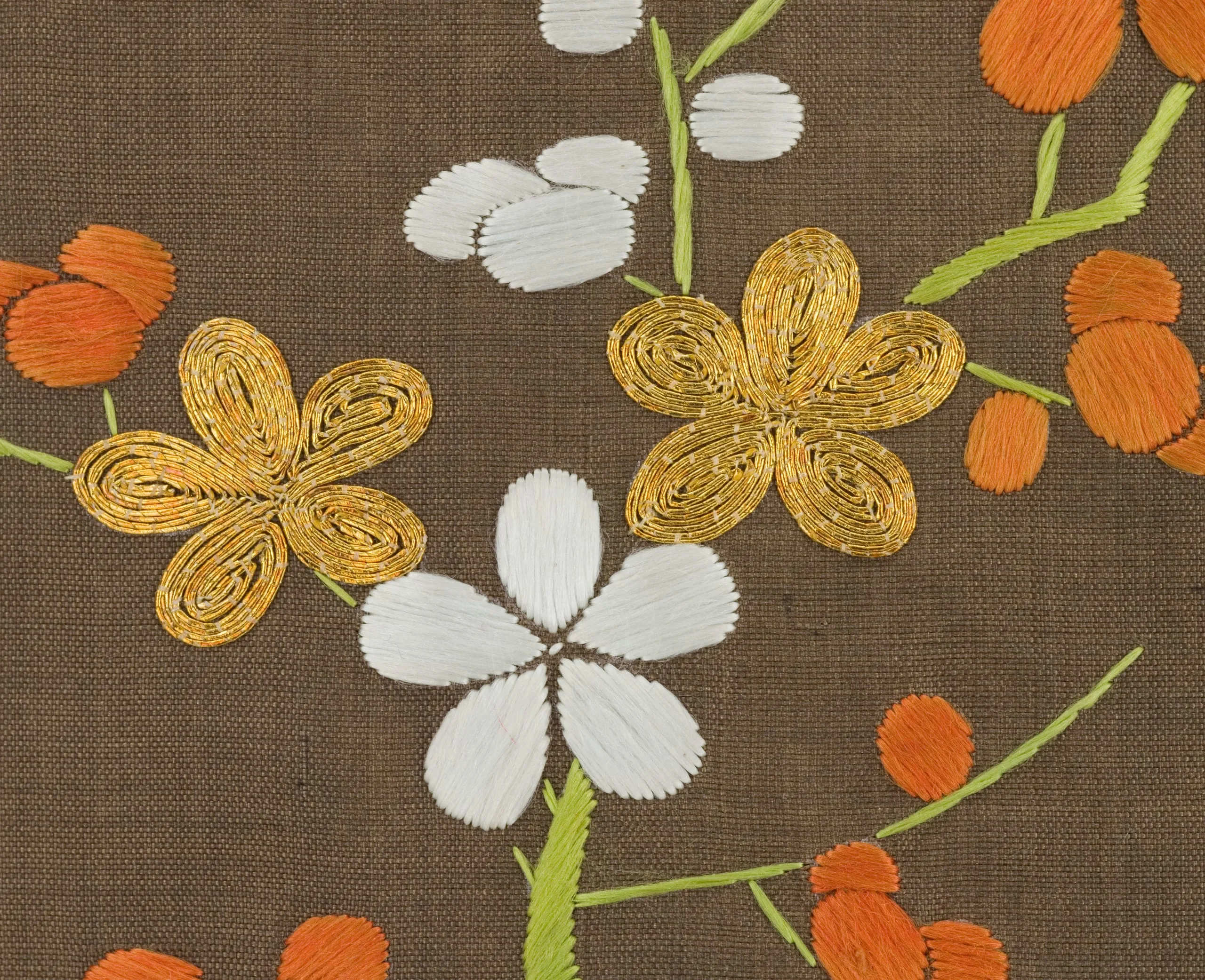
Embroidered textile on brown linen ground, featuring two gold coiled-thread flowers and one white satin-stitch flower at center, with orange tulip-like blooms and green stems extending to the edges.
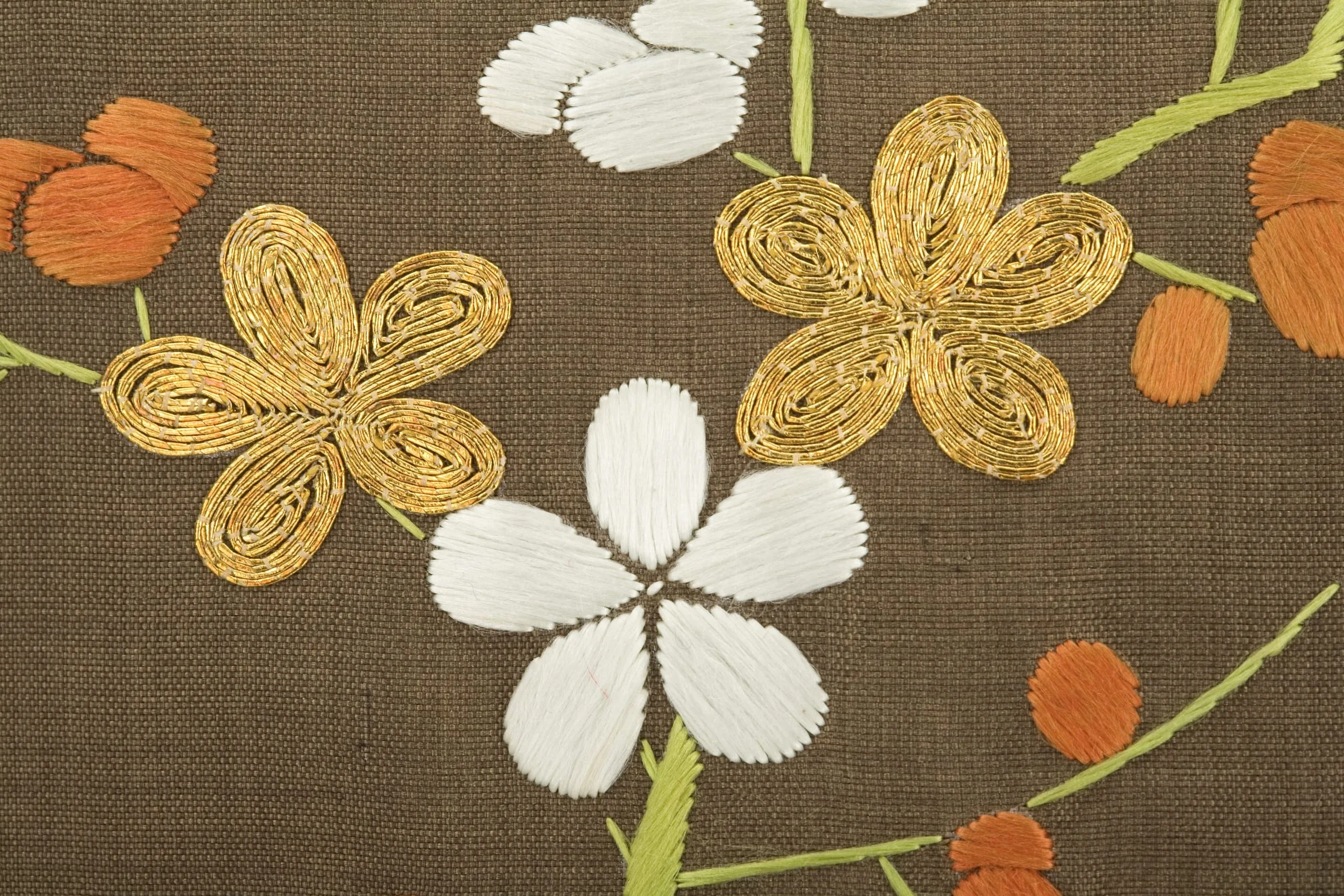
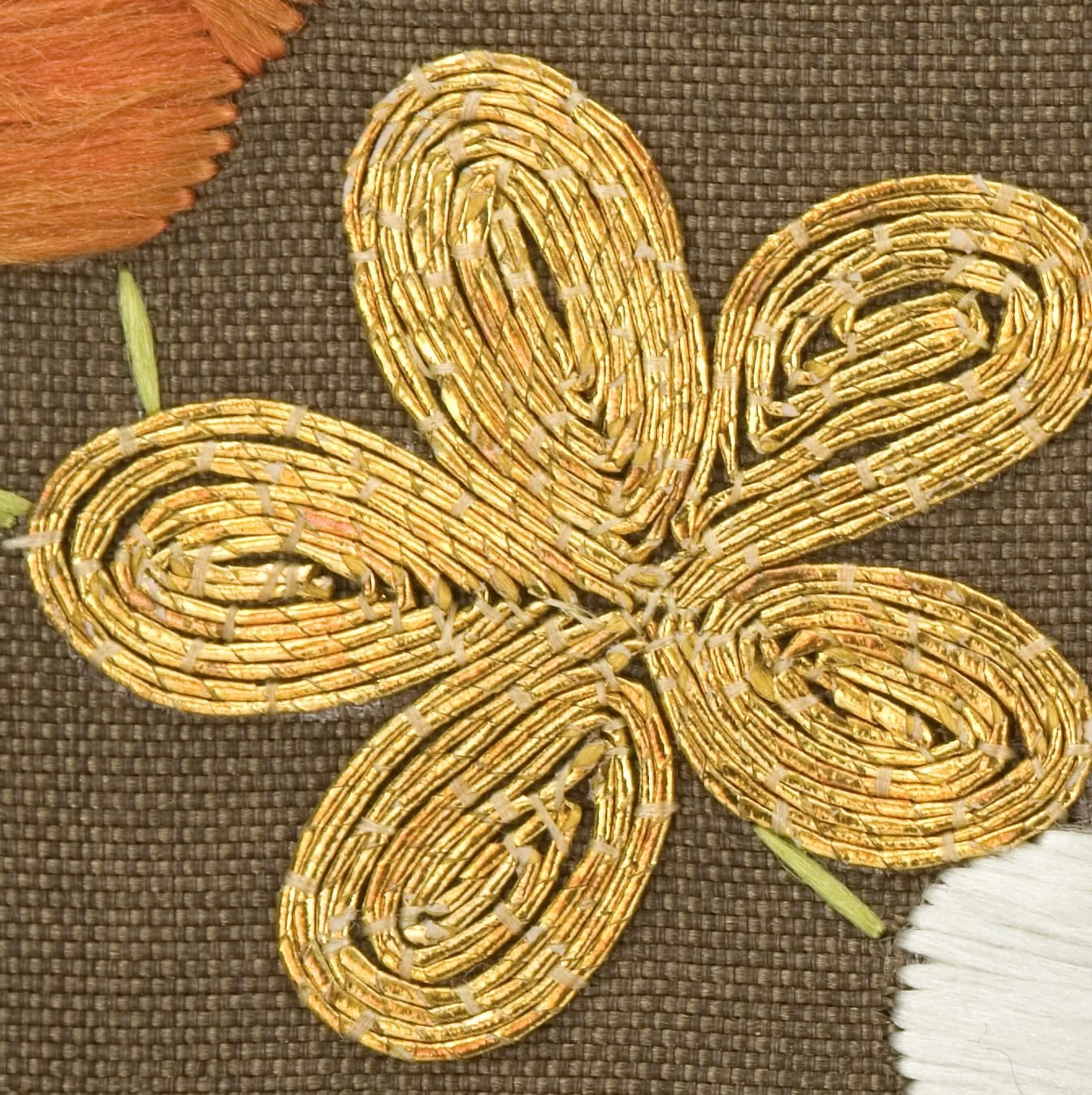
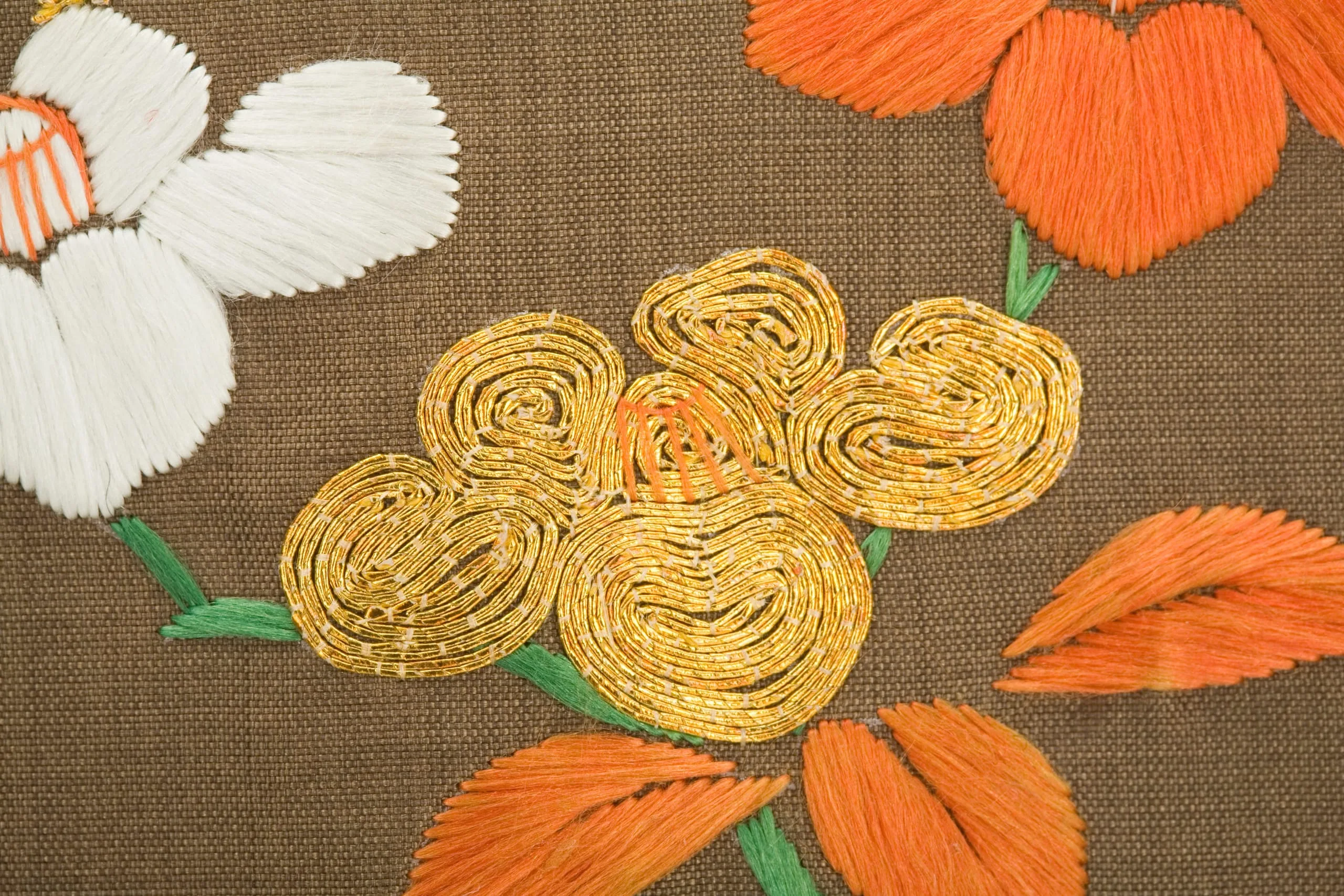
Embroidered textile detail showing a five-petaled flower worked in coiled gold metallic thread on brown woven fabric, with green stem stitches and partial orange and white floral motifs at the edges.
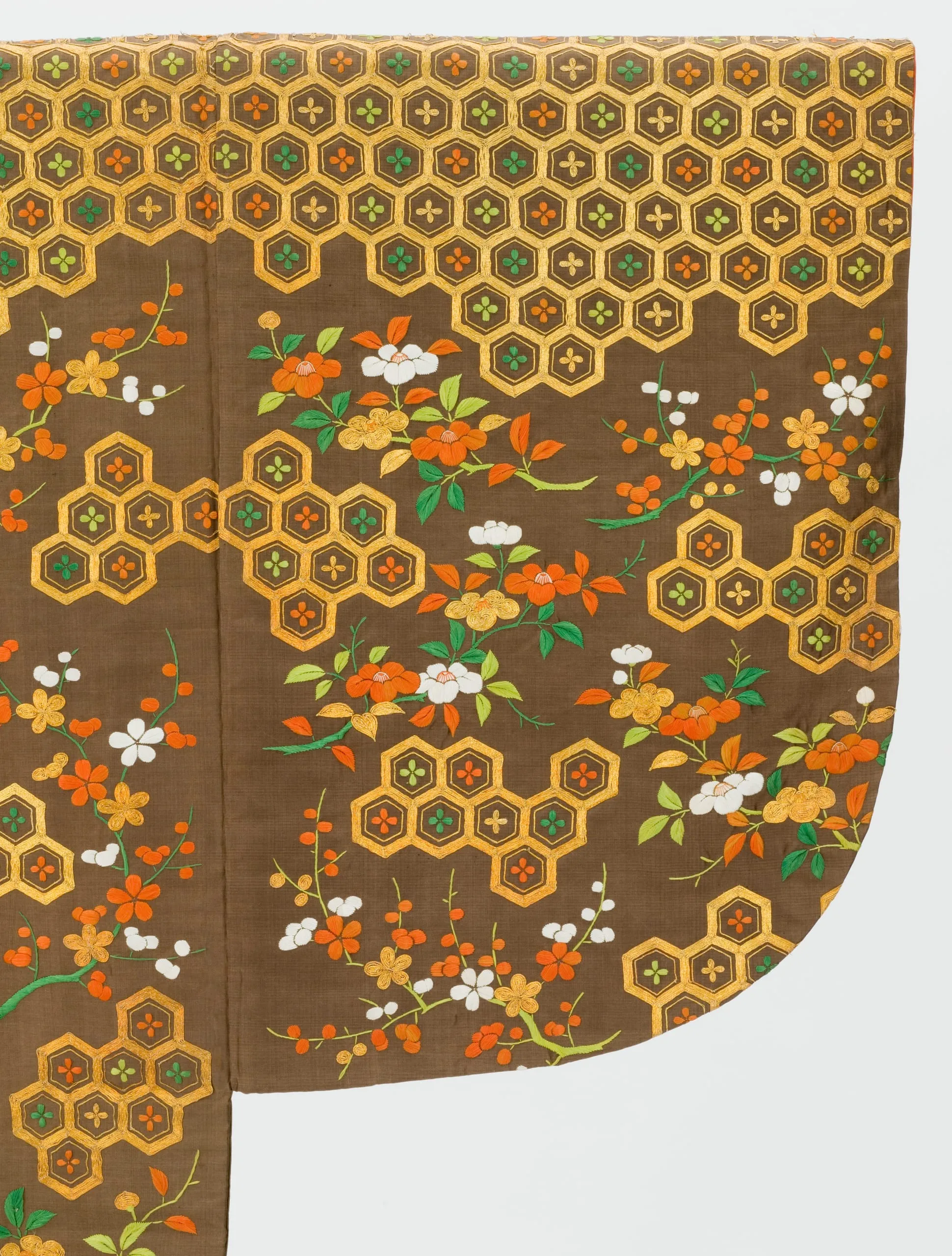
Kosode or similar Japanese garment in dark brown silk, decorated with gold tortoiseshell (kikko) hexagonal lattice clusters interspersed with flowering branches in orange, white, yellow, and green; dense all-over pattern with scattered blossoms in yuzen-style dyeing.
Textile garment, likely a Japanese kosode or kimono, in olive brown with allover pattern of gold hexagonal tortoiseshell (kikkō) motifs and scattered sprays of orange, white, and gold blossoms with green foliage.
Embroidered textile on taupe ground with repeating gold hexagonal lattice pattern and scattered floral sprays in orange, white, and green silk thread.
Embroidered textile with floral motifs on tan linen ground; a large white flower with satin stitch petals and orange center, a gold flower with coiled couching technique, and orange blooms with green leaves in stem stitch.
Embroidered textile on brown linen ground with floral motifs; central yellow flower worked in tight coiled goldwork beads, flanked by white satin-stitch and orange padded-stitch blooms with green stem details.
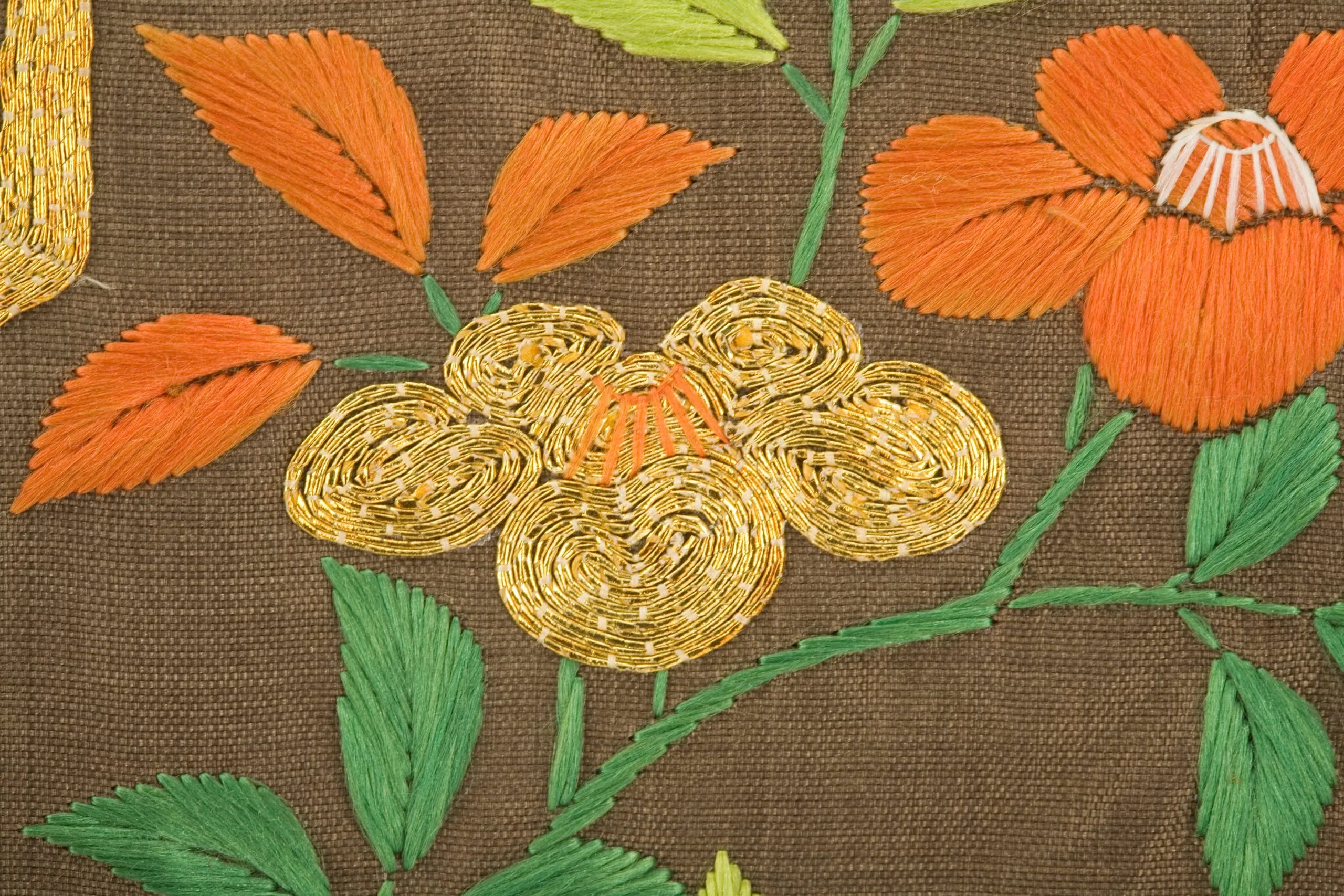
Embroidered textile panel on brown woven ground, depicting orange and yellow flowers with green stems and leaves; the central yellow flower rendered in tight coiled satin stitch, orange petals worked in long parallel stitches.
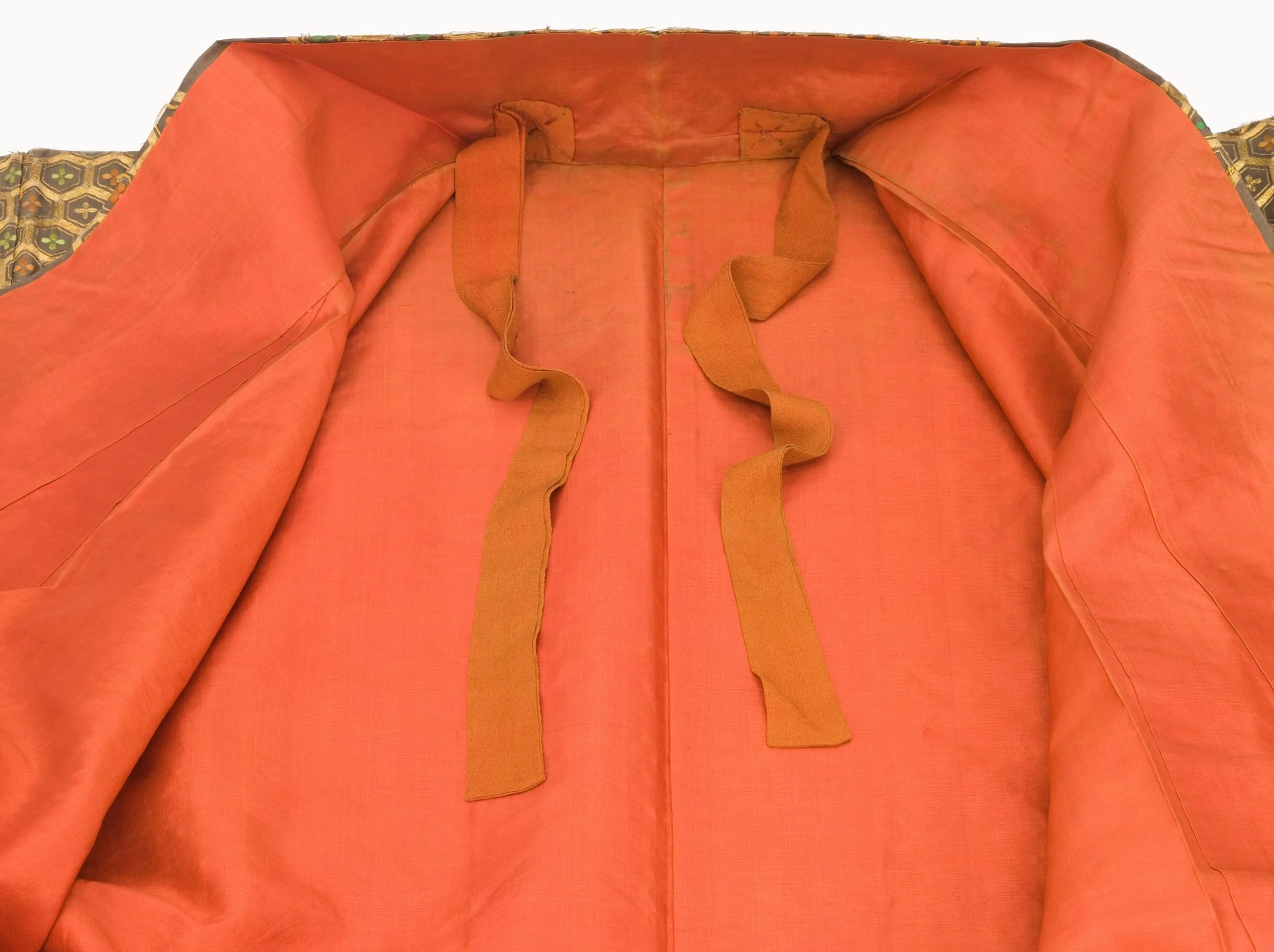
Textile garment shown open to reveal a smooth orange-red silk lining with two pairs of fabric ties hanging from the interior neckline; exterior fabric visible at edges shows a geometric repeat pattern in green and gold.
Embroidered textile panel with a honeycomb grid of gold-thread hexagons on a taupe ground, each cell containing a four-petaled flower in alternating green, orange, and yellow silk thread.
Title
Samurai-Class Woman’s Summer Formal Outer Robe (Koshimaki)
Place Made
Japan
Date Made
late Edo period (1615-1868), early 19th century
Medium
Silk plain weave (nerinuki) with silk and gilt-paper-wrapped-silk-thread embroidery
Dimensions
Length: 71 3/4 in. (182.25 cm)
Credit Line
Gift of the 2007 Collectors Committee
Accession Number
M.2007.51
Classification
Costumes
Collecting Area
Costume and Textiles
Curatorial Notes
Japan's Edo period (1615—1868) was characterized by more than two hundred and fifty years of peace, fostering an environment for patrons who supported the arts for aesthetic pleasure and as evidence of their refined taste and elevated social status. Fashion and dress played a significant role in this unprecedented flourishing of the arts. Exquisitely designed and crafted examples of the period's universal garment, the kosode (a precursor of the modern kimono), were worn by men and women of the military elite—the ruling shogun, his principal lords, daimyo, and their retainers, the samurai. This kosode was made near the end of this era, created exclusively for a high-ranking samurai woman.
Although layers of magnificent robes distinguished ceremonial court dress as early as the eighth century, the kosode was originally an undergarment that was subsequently embellished and adopted as formal dress in the fourteenth century. During the ensuing years, this garment developed into a "canvas" for accomplished painting, weaving, innovative dyeing techniques, and lavish embroidery of silk and precious metals. The singular style of one type of kosode, the koshimaki ("waist wrap"), evolved in the fifteenth century from the practice of allowing a heavy outer robe, the uchikake, to slip off the shoulders but remain a part of the ensemble with its sleeves tied at the waist over the kosode beneath. In its later and most distinctive configuration, the koshimaki hung from a specially designed obi (sash) that knotted at the back of the waist. Stiff paper tubes filled with straw were inserted into the obi's long tie ends, creating a winglike extension over which yhe koshimaki's sleeves projected to their full width, permitting the remainder of the garment to spread out over the floor as a sweeping train.
In the late Edo period, the format and composition of the koshimaki became standardized as summer formal attire for elite samurai women. Its ground fabric was of dark brown, black, or gray nerinuki, a silk textile made with unglossed warps and glossed wefts. Small-scale auspicious symbols decorated the surface; flowering plum blossoms, signifying purity, and hexagonal "tortoise shells" and camellias, for longevity, are meticulously embroidered on this robe with multiple threads of gold.
The koshimaki was always worn over a light and airy unlined kosode (katabira) made of crisp linen like fibers such as hemp or ramie. LACMA has a beautifully embroidered katabira, and this exquisite koshimaki completes the summer ensemble, joining other Edo Period artworks and Japanese textiles in the collection.