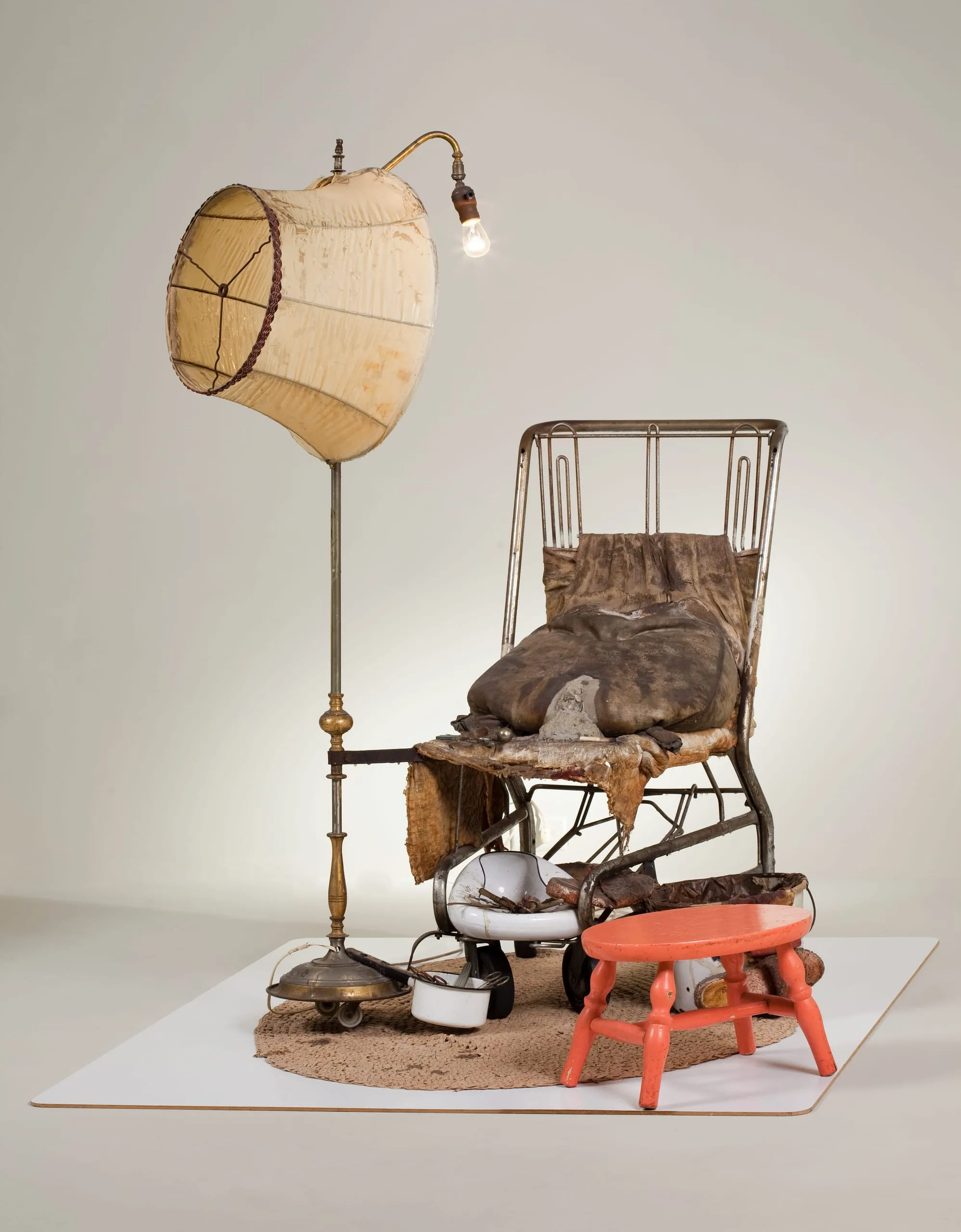
- Artist or Maker
- Edward Kienholz
United States, Washington, active Indiana, Hope, and California, Los Angeles, 1927-1994 - Title
- The Illegal Operation
- Date Made
- 1962
- Medium
- Polyester resin, pigment, shopping cart, wooden stool, concrete, lamp, fabric, basin, metal pots, blanket, hooked rug, and medical equipment
- Dimensions
- 59 x 48 x 54 in. (149.86 x 121.92 x 137.16 cm)
- Credit Line
- Partial gift of Betty and Monte Factor and purchased with funds provided by the Art Museum Council, Daniel Greenberg and Susan Steinhauser, the Modern and Contemporary Art Council, Dallas Price-Van Breda and Bob Van Breda, the Robert H. Halff Fund, David G. Booth and Suzanne Deal Booth, Virginia Dwan, Elaine and Bram Goldsmith, The Grinstein Family, Ric and Suzanne Kayne, Alice and Nahum Lainer, Frederick R. Weisman Art Foundation, Mrs. Harry Lenart, The Robert Gore Rifkind Foundation, Philippa Calnan and Laura Lee Woods
- Accession Number
- M.2008.107a-d
- Curatorial Notes
Long associated with the assemblage movement that distinguished Southern California art of the 1960s, Edward Kienholz created works that incorporate social and political commentary. Often shocking in their realism, these sculptures are scathing narratives that confront social hypocrisy. In A Lady Names Zoa, box forms and containers define body parts, making reference to social class and roles. History as a Planter, complete with a wandering Jew plant, alludes to the Holocaust and news headlines connected with the 1961 trial of Nazi war criminal Adolf Eichmann. With The Illegal Operation, the artist addresses the controversy over abortion. Created almost a decade before the Supreme Court's Roe v. Wade decision that legalized abortion, the piece is rooted in Kienholz's personal experience with his then wife, who underwent the procedure when it was still illegal.
Kienholz is also closely associated with LACMA's own history. In 1966, LACMA organized a mid-career survey that provoked intense reaction among local politicians, who threatened to shut down the museum. Ultimately the most "offending" work of art Back Seat Dodge '38 was acquired by LACMA through the generosity of the Art Museum Council. The Illegal Operation was recently acquired by the museum through the generosity of numerous supporters.
View other works by Edward Kienholz in the museum's collection.
Stephanie Barron, Senior Curator, Modern Art, (2008)
- Copyright
- © The Edward and Nancy Kienholz Foundation, Inc. Courtesy of L.A. Louver, Venice, CA.