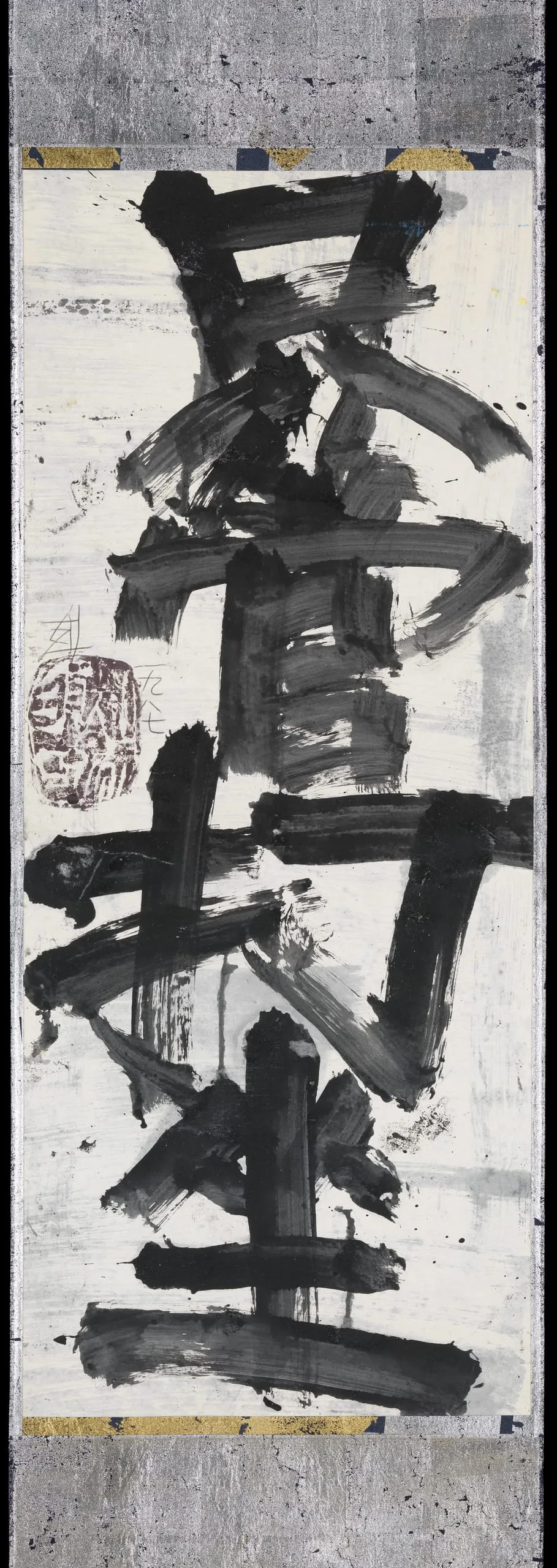
Suda Kokuta was a person of deep determination. Inspired in his youth to become a painter after seeing work by Van Gogh, Suda failed to enter the central university of the arts in Tokyo despite his numerous applications. Undaunted and self-taught, he then went on to make a career as an artist in the concrete style, gaining entrance into painters' associations and winning awards. Suda worked in an abstract manner in mid-career, returning to semi-realistic painting later in life. His calligraphy is strong, unconventional, and enthralling in its directness.
Much of Suda's calligraphy reflects his study of Zen, and the writings of the master Dogen (1200-1253) in the Zen classic Shobogenzo (Treasury of the True Dharma Eye). To Dogen, the practice of meditating was not merely a means to an end of Enlightenment, but was the practice of Enlightenment itself. The idea can be expressed approximately as follows: while one meditates, concentrating on concepts, letting go of subjectivity and allowing for pure apprehension of the object of concentration is a form of Enlightenment, which must be repeated constantly through the practitioners lifetime.
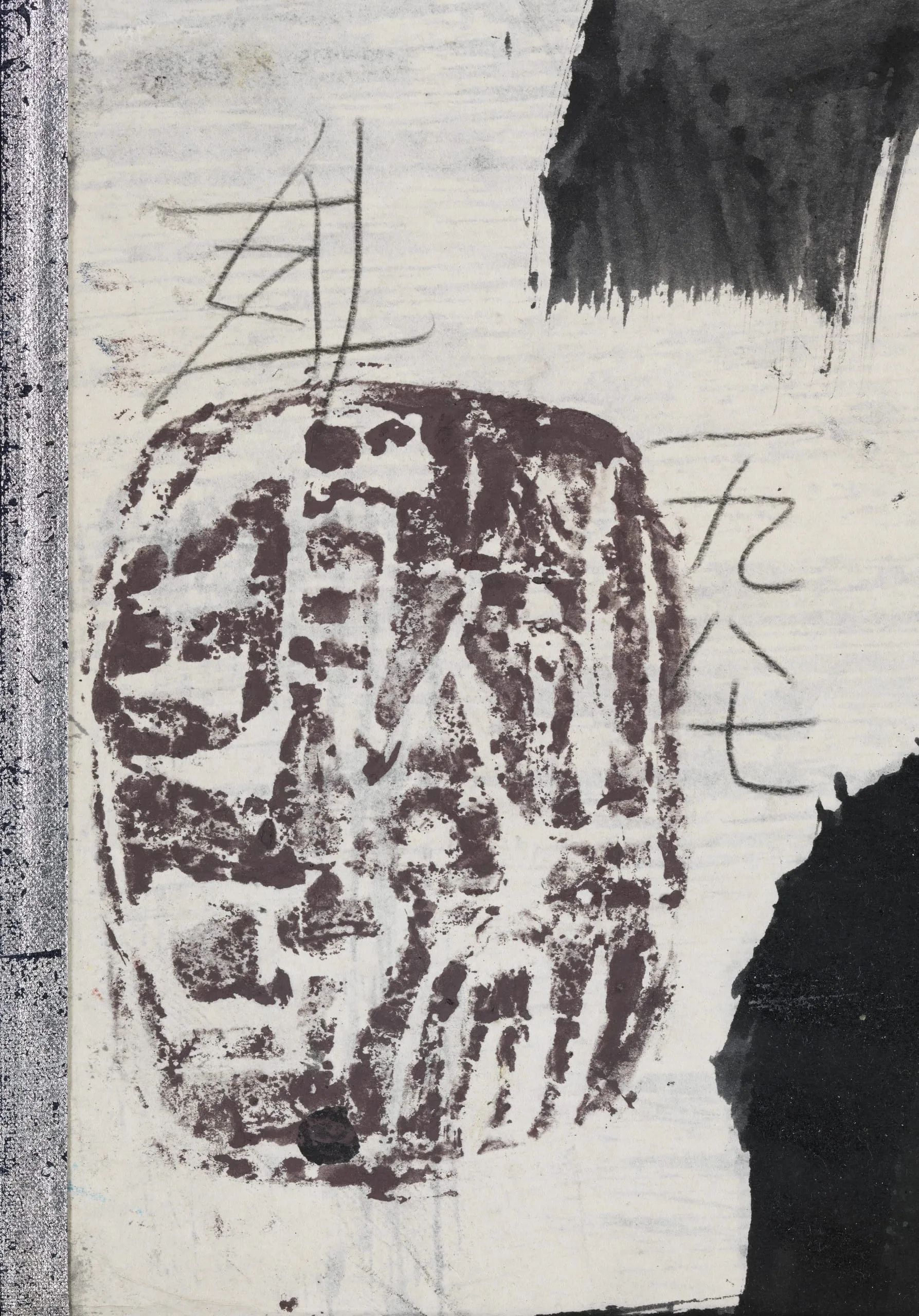
Suda claimed to want to express himself like a child. As such, he approached the ink and paper with pure emotion and intensity, apparently without the diluting overlay of subjectivity that comes with life experience. Suda painted the background paper with a white over dark effect, white pigment on the face of the paper revealing ink washed across the reverse of the sheet that soaked through to the front. He then decorated the mount with randomly placed gold and silver leaf, and called upon his skills as a painter, rather than on orthodox rules of calligraphy, in this bold statement. The enormous seal at the left reads "Suda Kokuta", in a format reminiscent of a section of a tree trunk.
The message, Shikan taza, is like a shout to Zen practitioners not to waste time on extraneous activities, but to always keep to their discipline. The stridency of the words is compounded by dense black ink and stick-like brush strokes that run over one another on the way to the bottom of the paper.