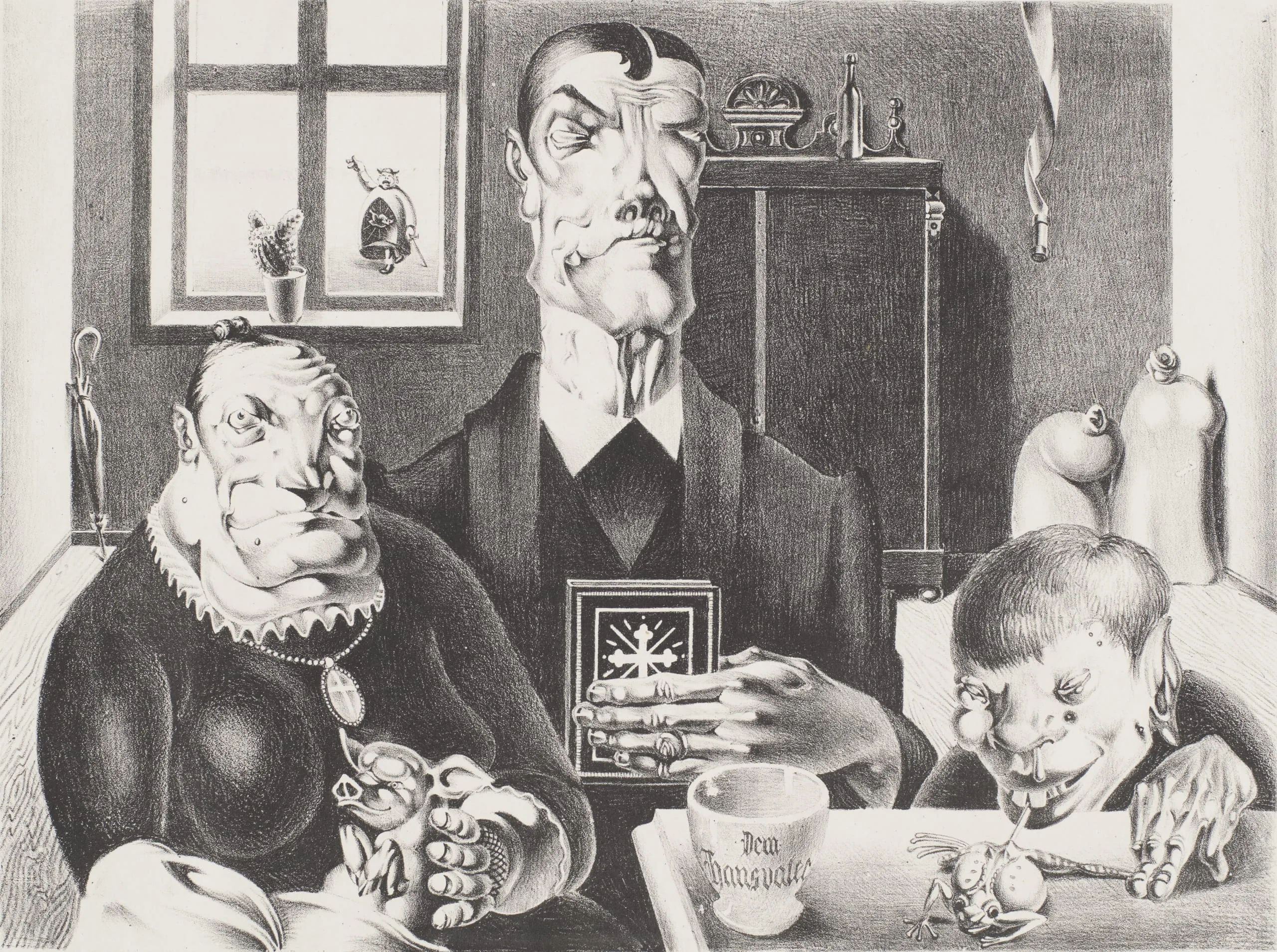
Industrial Peasants (Industriebauern) is a perfect embodiment of the transition from Expressionism and Dada to the New Objectivity of the 1920s. While Georg Scholz had mastered the techniques of lithography as a student at the Karlsruhe Academy, he had then gone through several styles as a painter and printmaker after being released from military service in 1918, including a fusion of French Cubism and Italian Futurism. Industrial Peasants is a powerfully disturbing codification of his collage painting of the same title (Von der Heydt Museum, Wuppertal), where the Bible-clutching farmer is shown with actual money erupting from his forehead. Such collage elements are now left behind in a grim portrayal of a peasant family at Sunday meal conveying the values of the industrialization that Germany was then undergoing.
Scholz’s parody is dominated by a self-righteous father—alluded to by the words “Dem Hausvater” (the house patriarch) on the mug—whose grotesque child blows menacingly on a frog through a straw. The monstrous-seeming mother clasps a pig; the window behind her shows an approaching preacher, whose rotund stomach contains a roasted turkey. The family occupies a stark room containing little more than a cupboard, umbrella, flypaper, and two anthropomorphic flour sacks. As an illustrator for such activist periodicals as Der Gegner (The Adversary), Scholz gained the skills to convey the bigotry, barbarism, and avarice of an actual family he had encountered in the countryside during World War I—hence the lithograph’s alternate title, Profiteering Peasant Family (Wucherbauernfamilie). Yet his objectivity and respect for aesthetic solutions transcend the social satire, enabling his work to “overcome this petty trading in aesthetic formula through a new concreteness,” as he proclaimed with his colleagues George Grosz, Otto Dix, Rudolf Schlichter, and others in Der Gegner.
Timothy Benson
2017