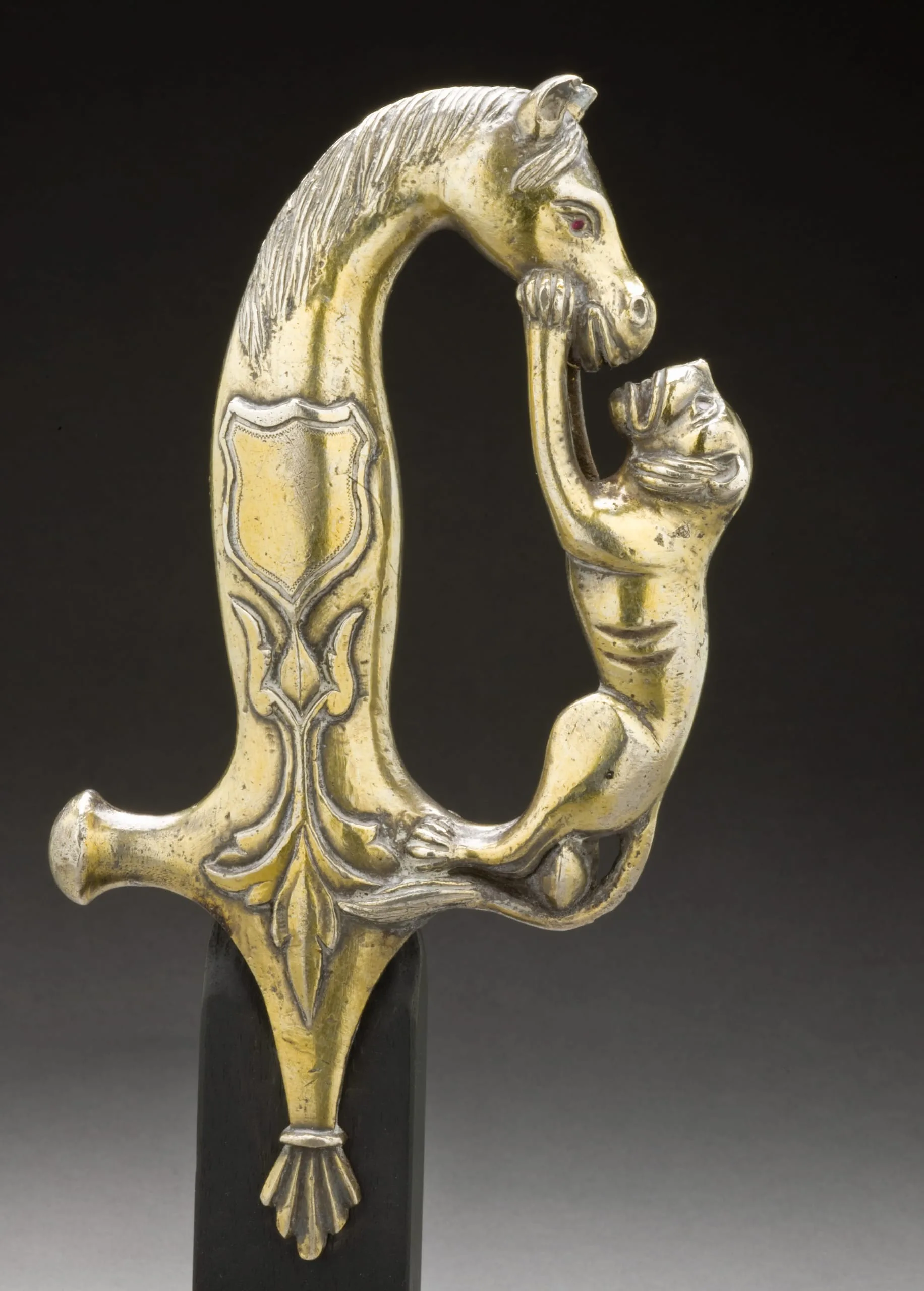
This zoomorphic sword hilt has a horse-head pommel and a knuckle guard in the form of a tiger grasping the horse behind its muzzle. The tiger stands on a quillon with a hemispherical terminal. The langets (pendent extensions of the quillon block used to secure sword in scabbard) are in the form of banded reeds. Both sides of the grip are adorned with a stylized floral motif consisting of calyx and an ovary, out of which issues an uninscribed monogram shield, and a splayed tripartite pedicel.
The sword hilt exemplifies the animal-headed hilt forms found in South Asian weaponry. Horses, lions, nilgais (blue-gray Indian antelopes), camels, elephants, parrots, rams, and goats were the preferred animals for reproducing as handles on swords, daggers, and knives. Swords with animal-headed pommels and tiger or hare knuckle guards were produced in Rajasthan by the late 19th century. See examples in the Victoria and Albert Museum, London (IS.87-1981), Mehrangarh Museum Trust, Jodhpur (ARM/76/17), Umaid Bhavan Palace, Jodhpur (UBP/4), Albert Hall Museum, Jaipur, and the National Museum, New Delhi.