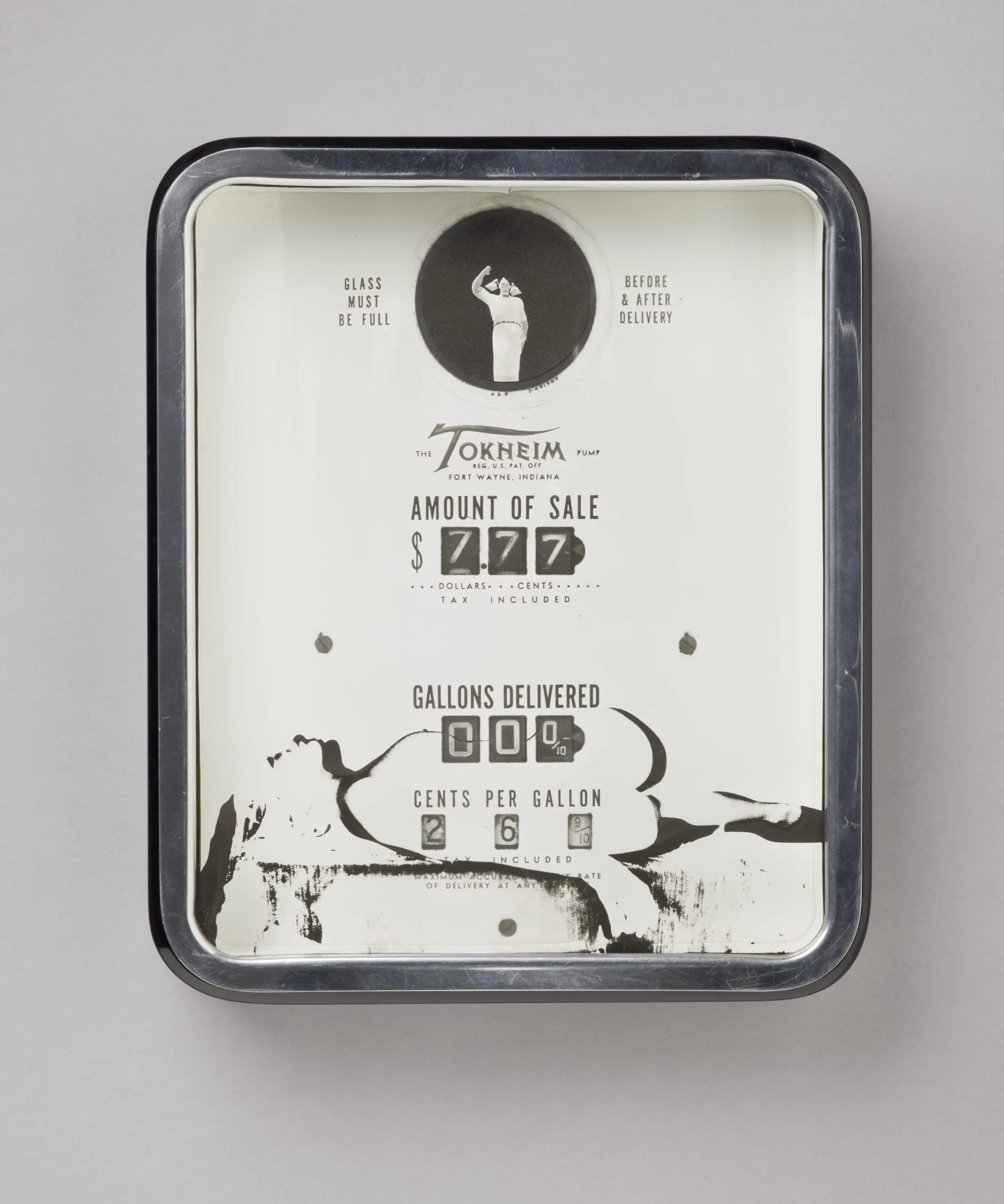
The most basic definition of a photograph—a record of the world, captured on light-sensitive film and printed on paper in a darkroom—prevailed for more than half the twentieth century. Photographs were most often seen in newspapers, magazines, and family albums, and then on museum walls. In the late 1960s, countercultural impulses challenged these conventions. Darryl Curran’s 777 doesn’t deliver information in a straightforward, illustrative manner. It both depicts and functions as a physical object (in this case, the face plate of a Tokheim gas pump, printed at actual size and encased in aluminum and glass), using Pop art strategies. The work’s title comes from the “amount of sale” numbers, three repeated digits associated with good luck and divine guidance. At one level, this work may critique the oil industry and its impact on the environment and society. At a more specific level, Curran comments on life in Los Angeles, centered as it is around cars and the vagaries of traffic.
Darryl Curran is part of a generation that introduced experimental and conceptual approaches to photography in the 1960s and 1970s. He has explored alternative processes, including photograms and nontraditional printing techniques, to question the nature of photographic representation. From 1967 to 2001, Curran was a professor at California State University, Fullerton, where he influenced generations of photographers.
Britt Salvesen
2025