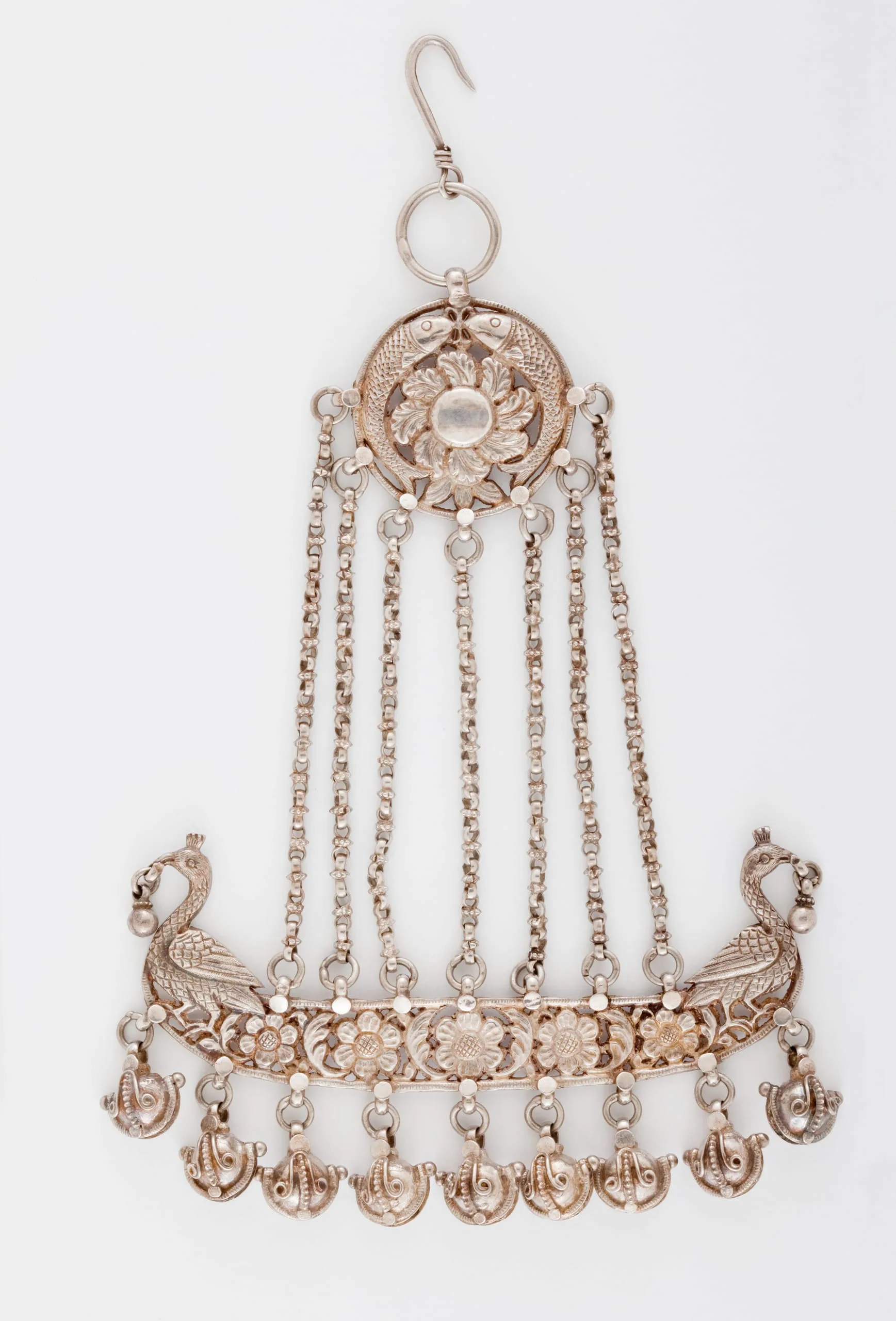
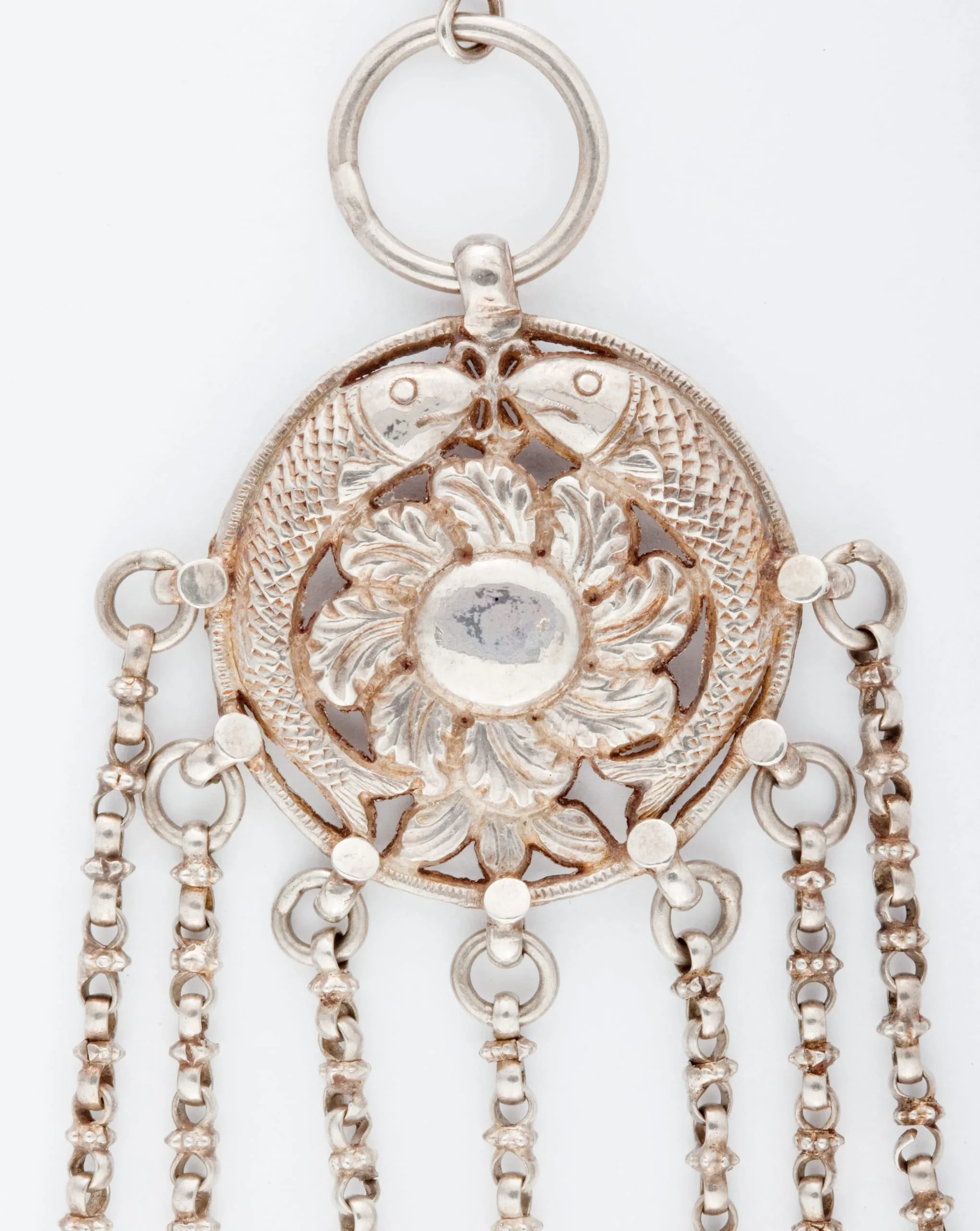
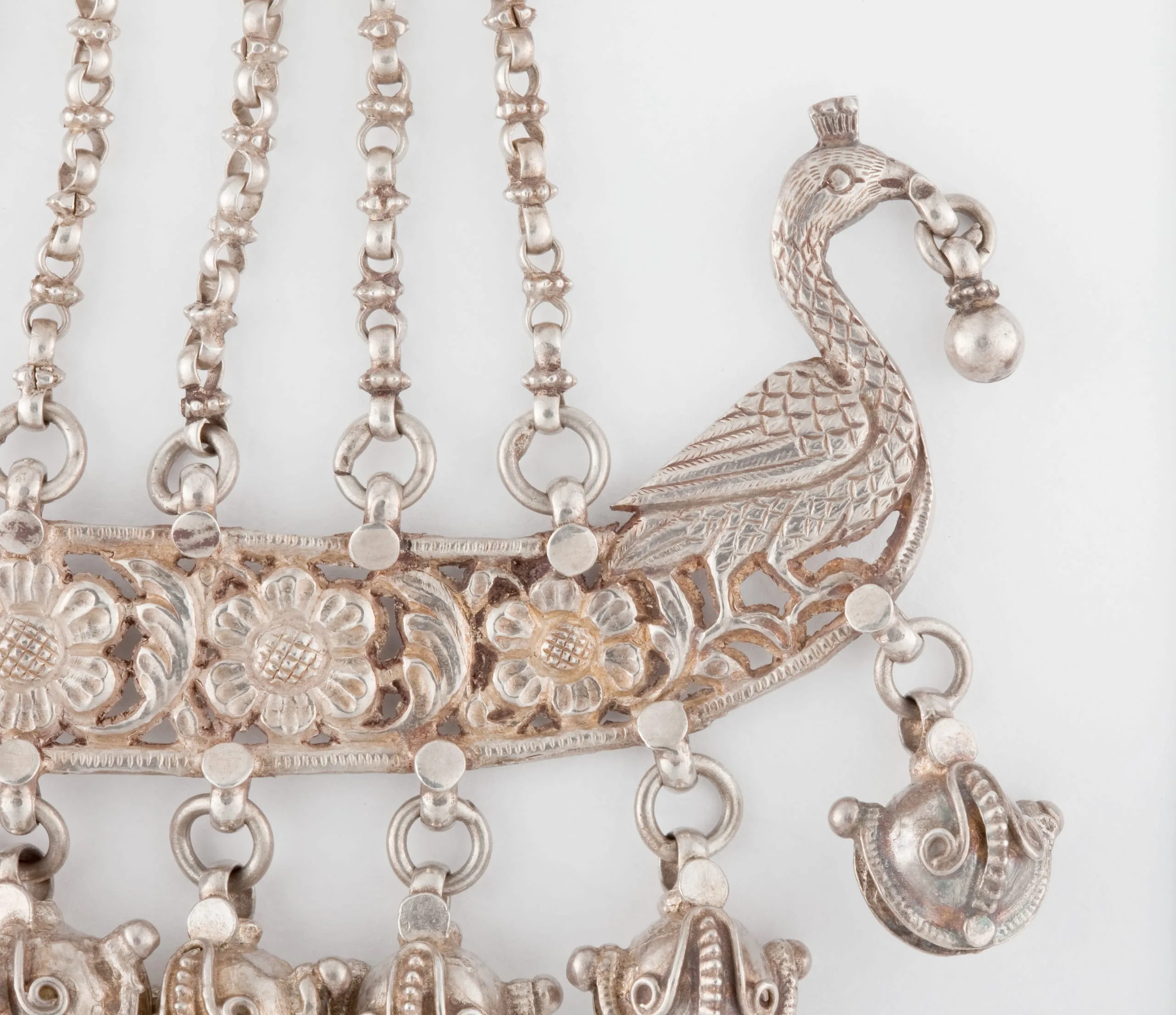
This woman's silver head ornament is called a jhumar (chandelier), which is typically worn on the left side of the head by Muslim brides, noble women, or court dancers. The top medallion is adorned with a symbolic pair of fish, arranged head-to-head with their curved bodies forming a circle. The fish surround a foliate blossom, which is echoed by the five flowers and leaf clusters embellishing an openwork pendant in the shape of a royal barge adorned with twin figureheads of peacocks. Silver bells dangle from the barge, which hangs from the medallion by light chains. Known as a peacock barge, this type of royal pleasure boat was used for river outings by the Lucknow and other Mughal governors. The head ornament epitomizes Lucknow jewelry, which is traditionally described as being exceptionally delicate and graceful.
The distinctive motif of the circular pair of fish was the official leitmotif of the Lucknow court and was used as a cultural identifier throughout Lucknow’s arts and architecture. The fish emblem represented the Mughal insignia of exalted rank known as the mahi-ye maratib (Fish of Dignity). Conferred in recognition of valorous service by high ranking military commanders, the fish insignia has a long heritage in the Middle East and South Asia. The prestigious award was accorded in 1720 by the Mughal Emperor Muhammad Shah (r. 1719-48) to the governor of the Akbarabad (Agra) province, Saadat Khan, for his role in suppressing a rebellious insurrection. Two years later he was appointed the governor of the Lucknow region and served from 1722 to 1739. His direct descendants inherited the award’s honorific status and its use as the dynastic symbol continued thereafter.
See Stephen Markel, "Luxury Arts of Lucknow." Arts of Asia 23:2 (March-April 1993), p. 118, no. 132; Oppi Untracht, Traditional Jewelry of India (New York: Harry N. Abrams, 1997), p. 216, no. 423; and Oppi Untracht, India: A Jewelry Spectrum (New York: The Bard Graduate Center for Studies in the Decorative Arts, 1998), p. 33, no. 149.