LACMA

ShopMembershipMyLACMATickets
LACMA
Los Angeles County Museum of Art
5905 Wilshire Blvd.
Los Angeles, CA 90036
info@lacma.org
(323) 857-6000
Sign up to receive emails
Subscribe
© Museum Associates 2025

Museum Hours

Monday

11 am–6 pm

Tuesday

11 am–6 pm

Wednesday

Closed

Thursday

11 am–6 pm

Friday

11 am–8 pm

Saturday

10 am–7 pm

Sunday

10 am–7 pm


  • About LACMA
  • Jobs
  • Building LACMA
  • Host An Event
  • Unframed
  • Press
  • FAQs
  • Log in to MyLACMA
  • Privacy Policy
© Museum Associates 2025
Collections

Buddhist Priest's Mantle (Kesa)early Edo period, 17th century

Not on view
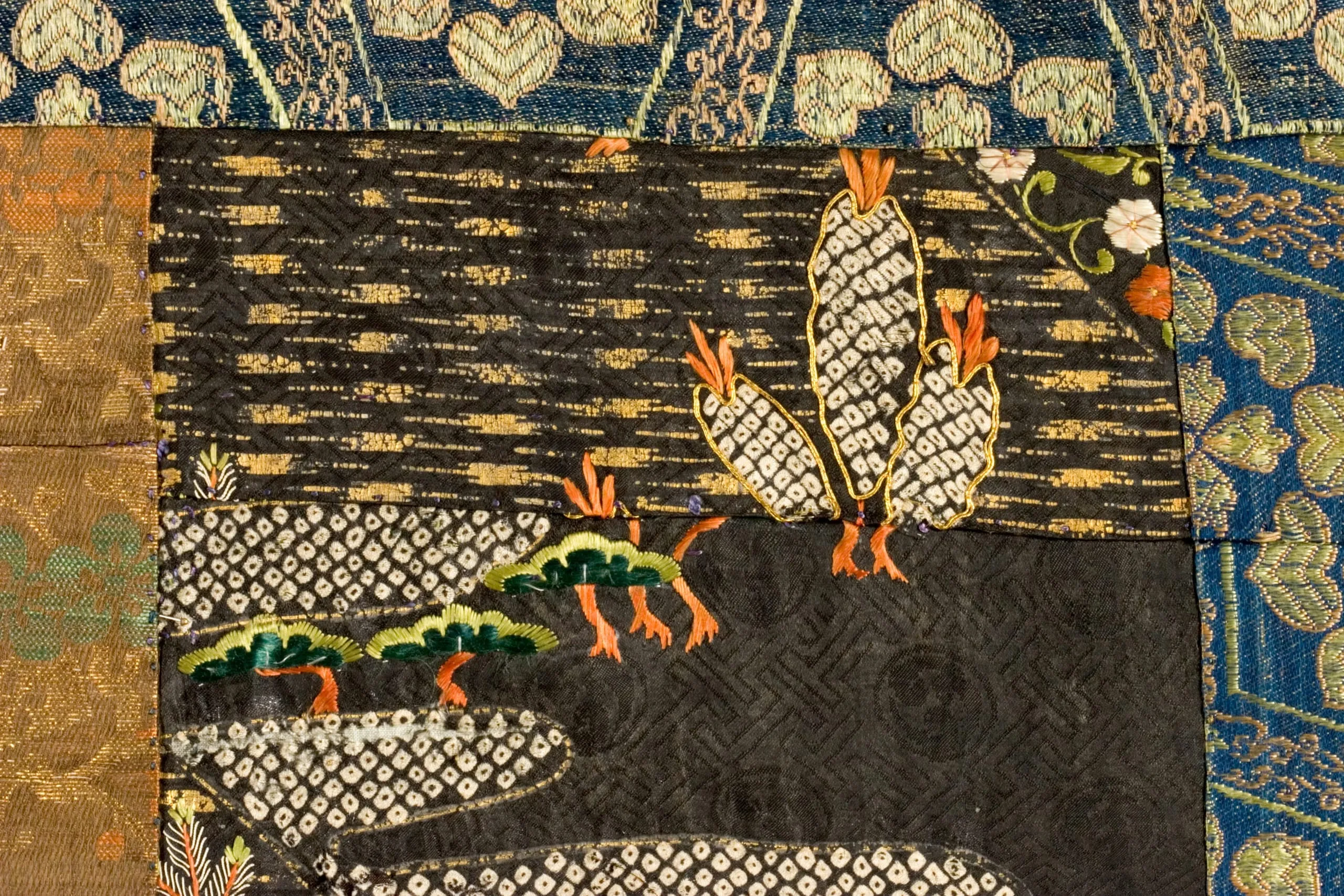
Japanese textile fragment with embroidered and woven panels: dark brown ground with geometric fret pattern, ivory lattice landmass, and stylized pine trees in green and orange
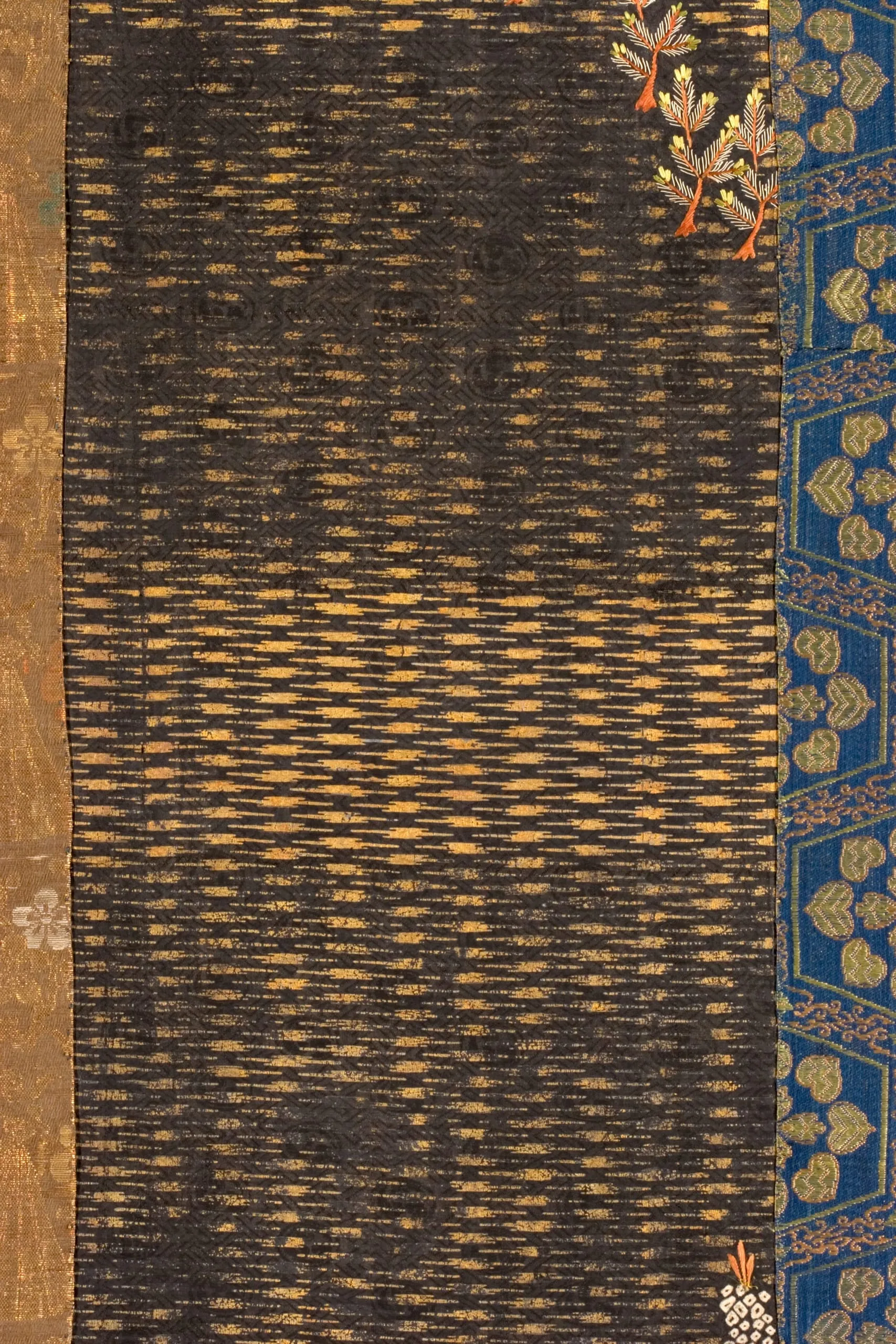
Woven textile fragment with a dark ground and small gold diamond motifs in an allover ikat pattern; bordered by a gold-brown panel at left with floral brocade, and a deep blue border at right with dense green and gold floral brocade; small embroidered sprigs in orange and green at upper and lower right.
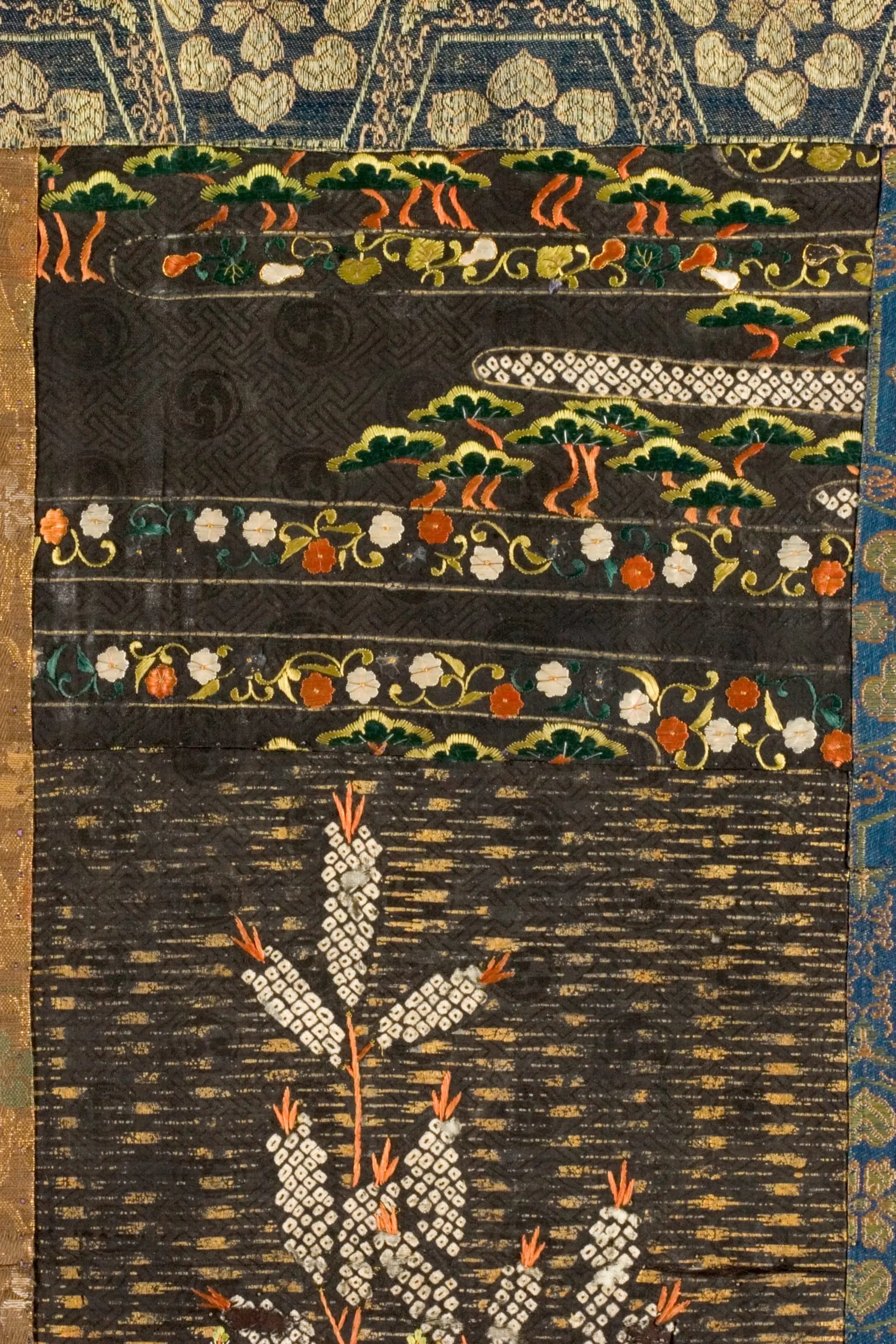
Fragment of Japanese embroidered textile on black ground with gold thread, featuring horizontal bands of pine trees, scrolling vines, and white and orange blossoms; lower panel shows flowering branches in white and coral against gold-streaked ground; bordered by blue and gold brocade.
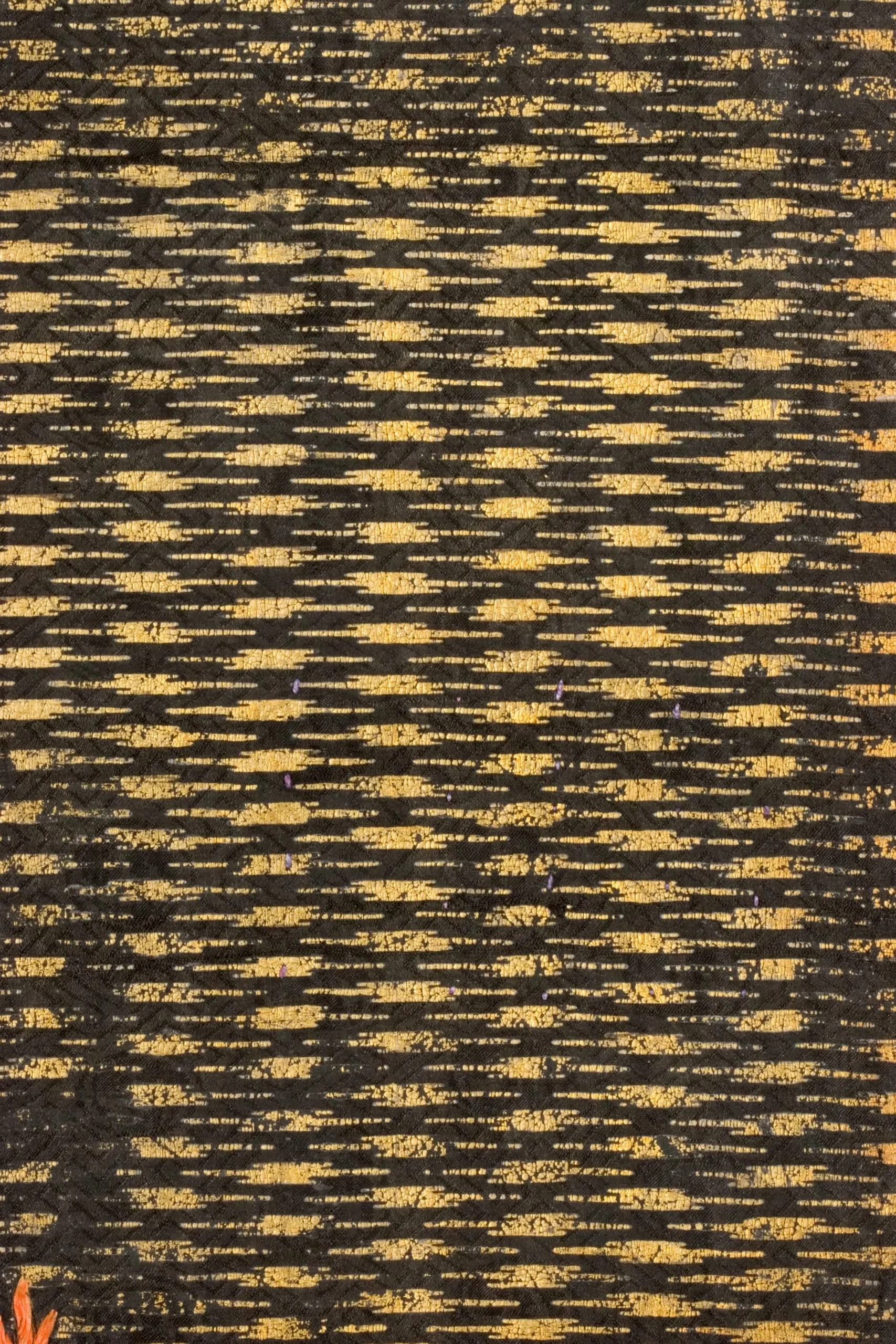
Abstract composition of densely packed horizontal stripes in gold and black, with heavily textured brushwork creating a broken, flickering pattern across the surface; a small orange-red mark visible at lower left corner.
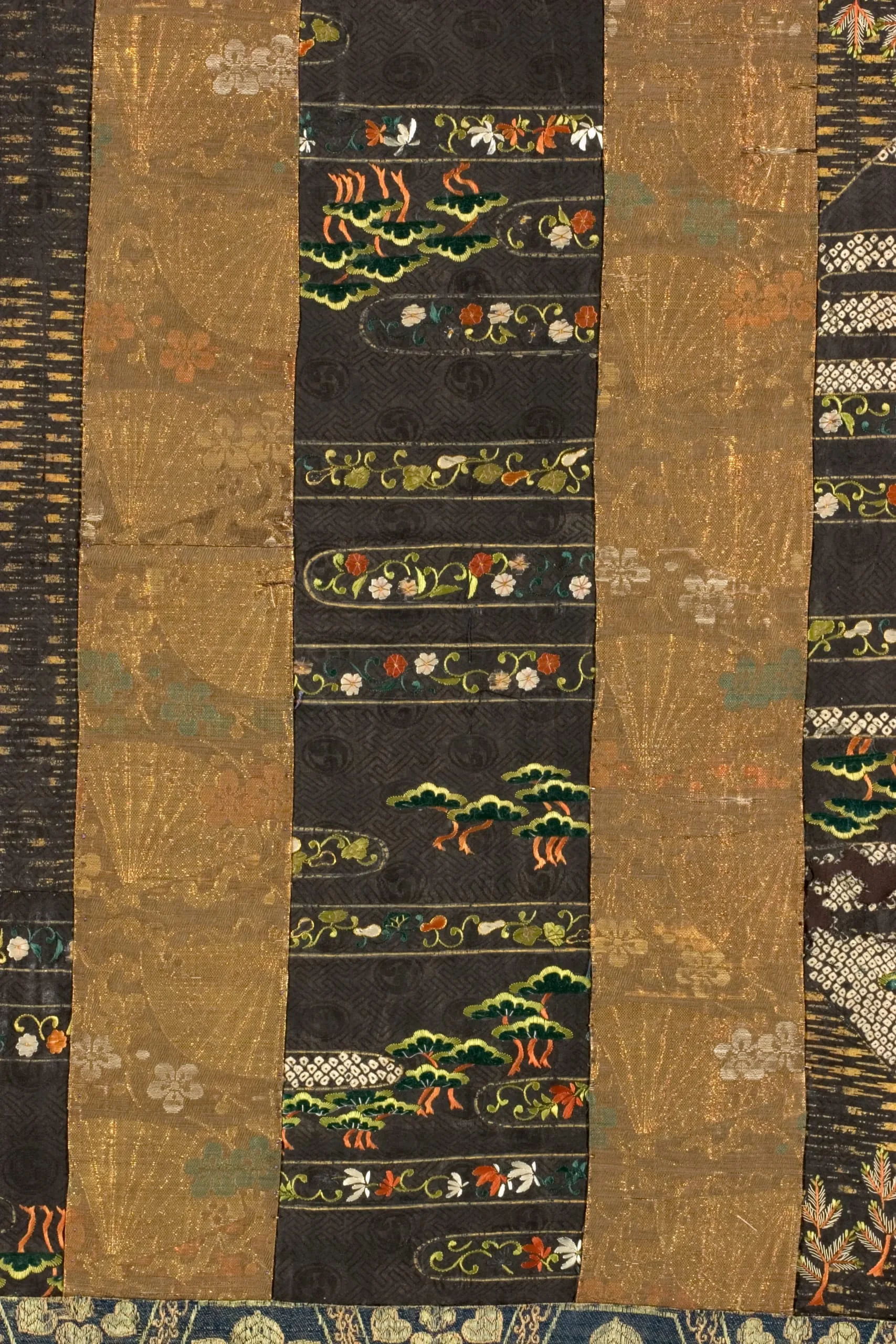
Silk textile with vertical alternating bands of gold brocade and dark ground fabric; dark panels feature horizontal registers of embroidered pine trees, scrolling vines, and blossoms in green, orange, red, and white.
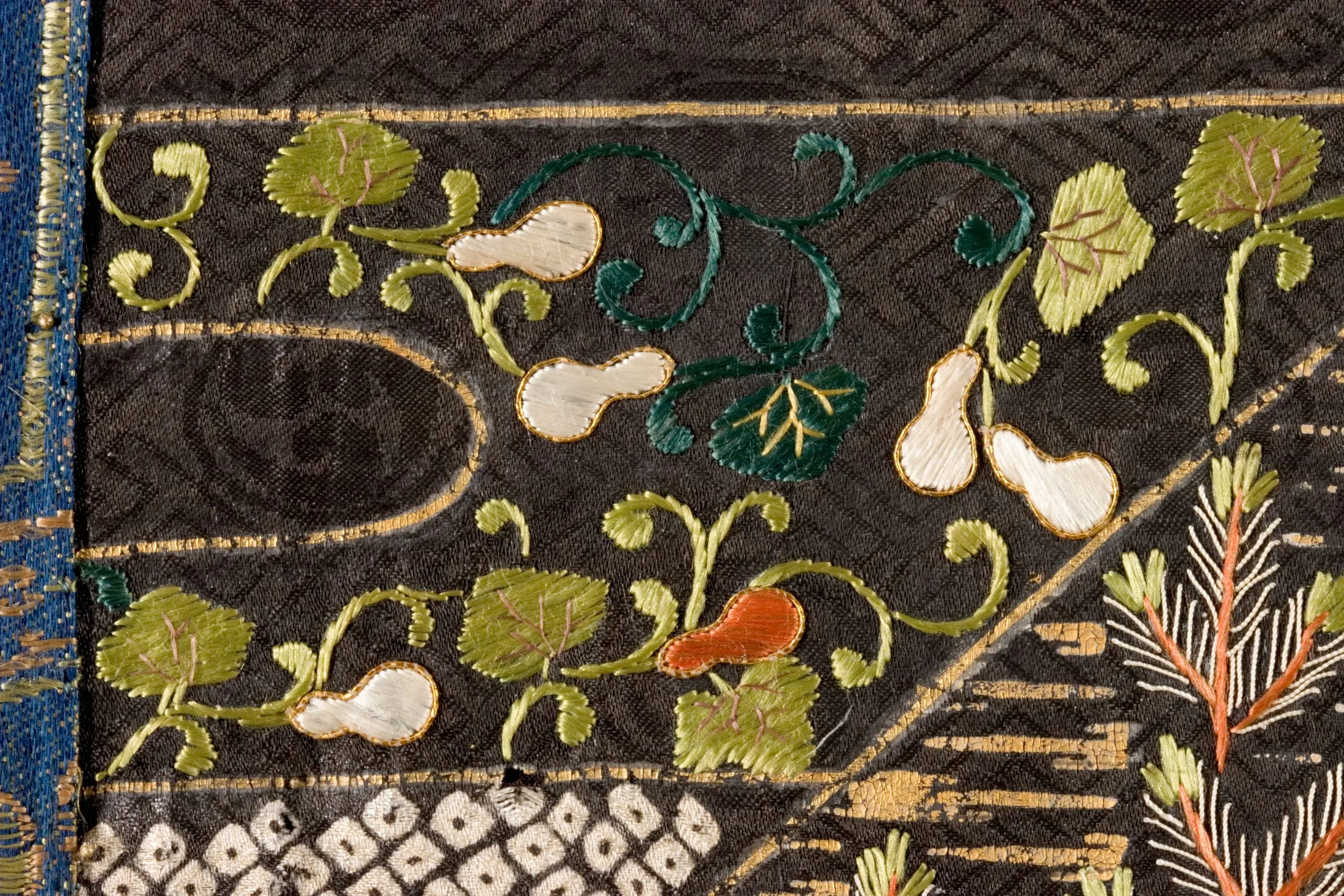
Detail of embroidered textile with dark ground, featuring silk-stitched gourd vines with green leaves and white and orange gourds, gold couched diagonal lines, and a blue border at left.
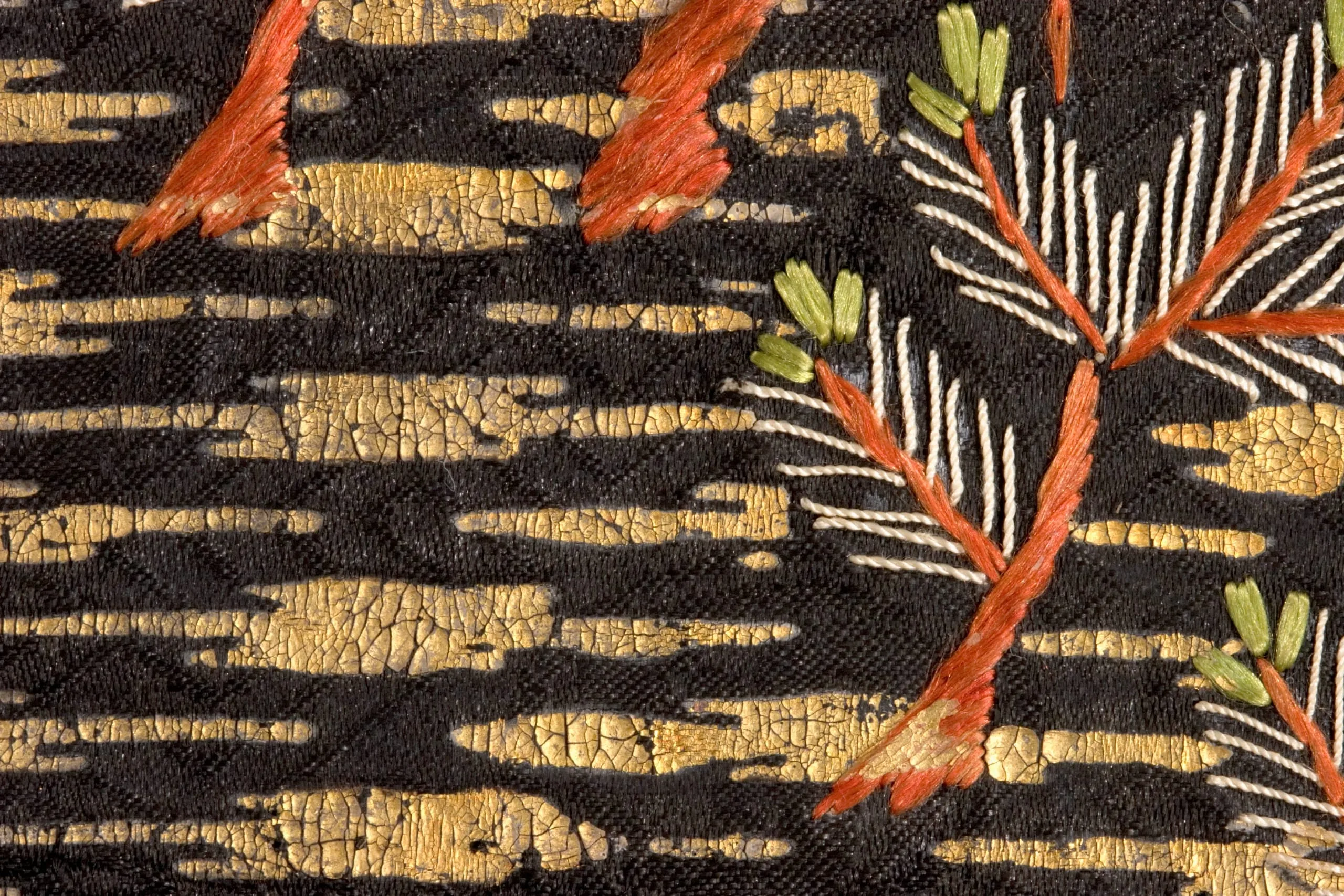
Detail of embroidered textile with black ground, horizontal bands of crackled gold leaf, and embroidered pine branches in red-orange, white, and green thread.
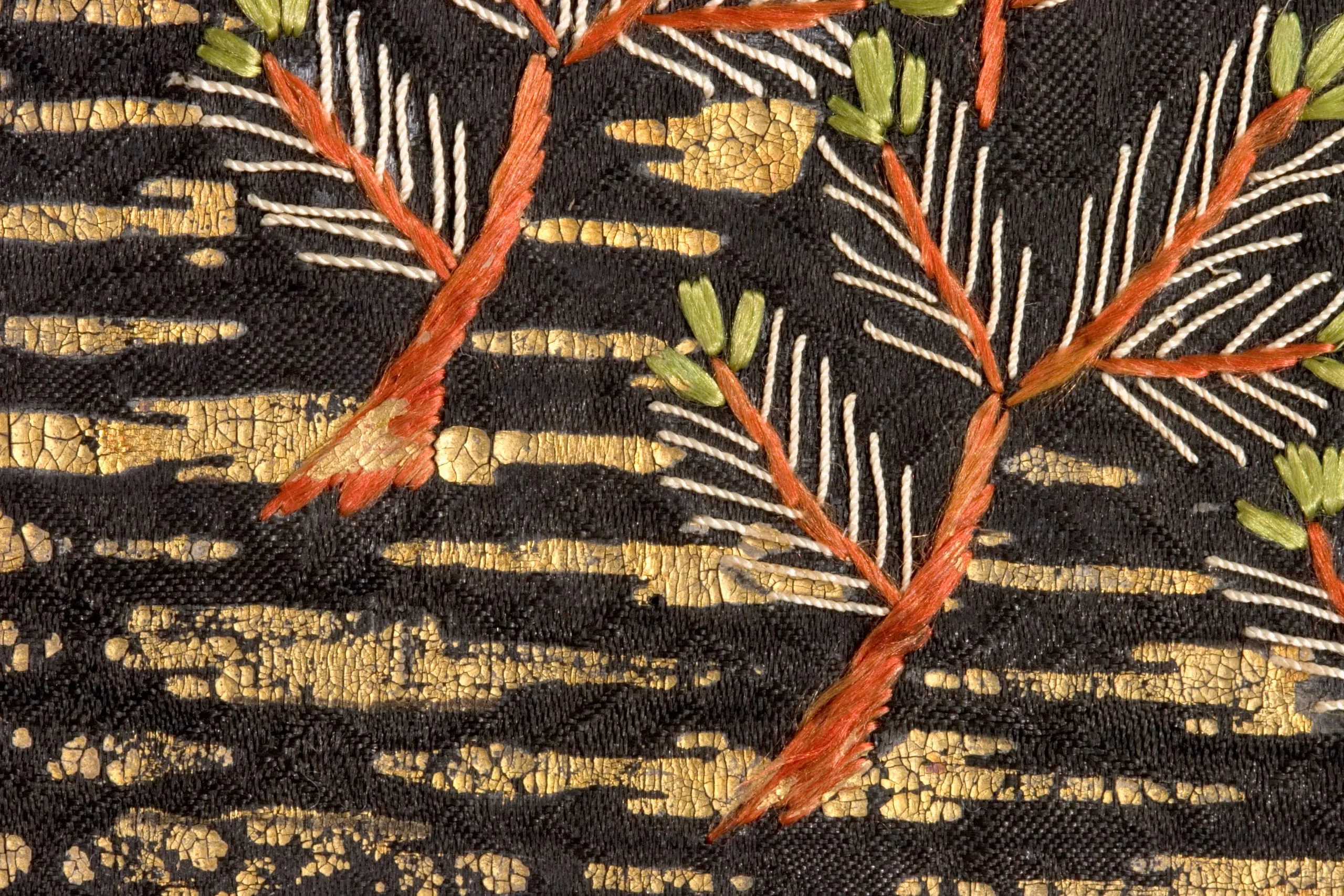
Close-up of embroidered textile with dark ground, featuring pine branches in orange-red and white stitching with small green needle clusters, against horizontal bands of crackled gold leaf.
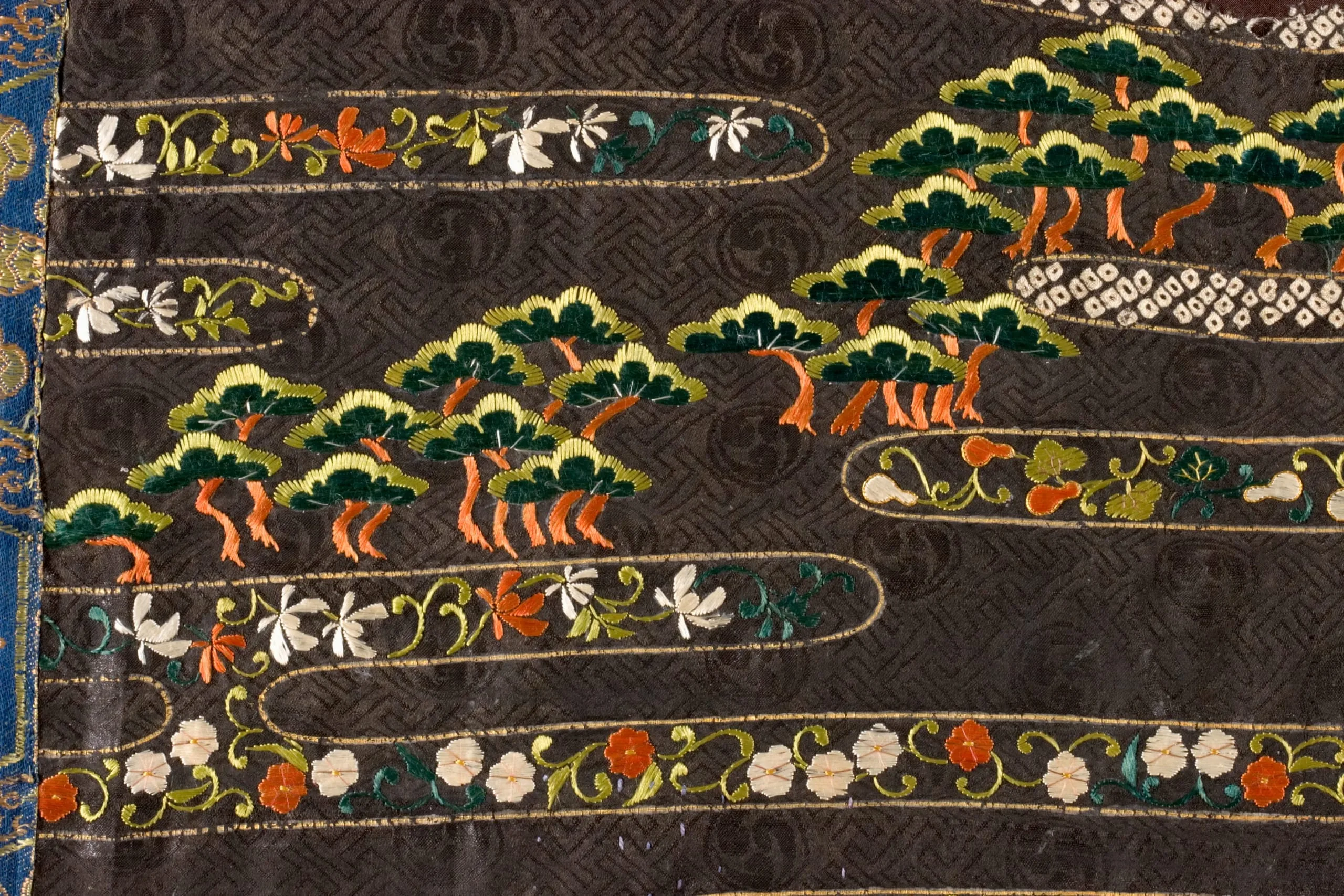
Embroidered textile panel with dark brown ground woven in a geometric diaper pattern, decorated with horizontal bands of pine trees in green, orange, and gold silk thread, and oval cartouches filled with flowering vines in white, red, and green; fine satin-stitch embroidery with metallic gold accents; blue border visible at left edge.
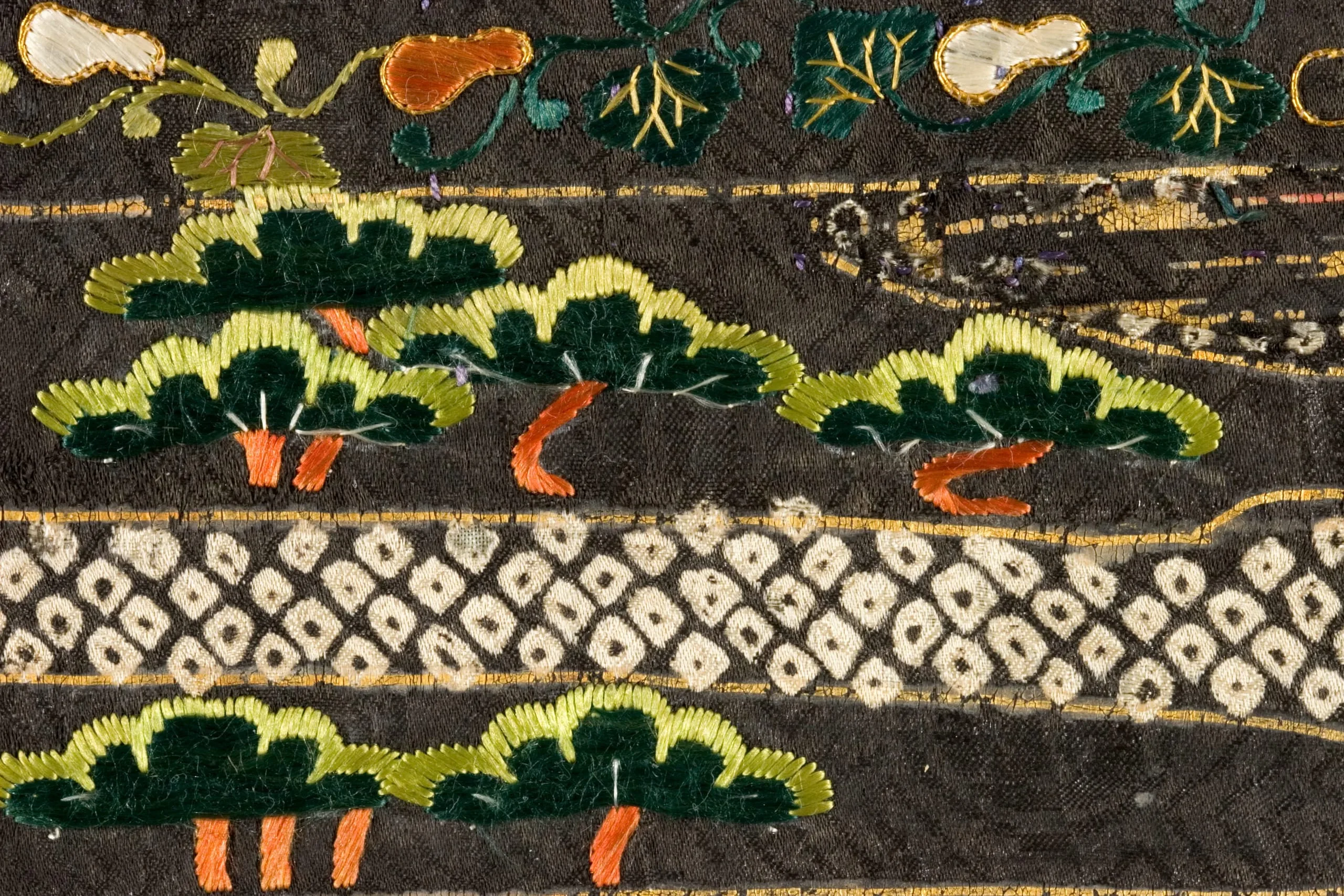
Embroidered textile fragment on dark brown ground, with horizontal bands featuring stylized pine trees in dark green and yellow-green with orange trunks, a central band of white diamond-patterned weave edged in gold, and an upper border of vines with gourd-shaped fruit in orange and green.
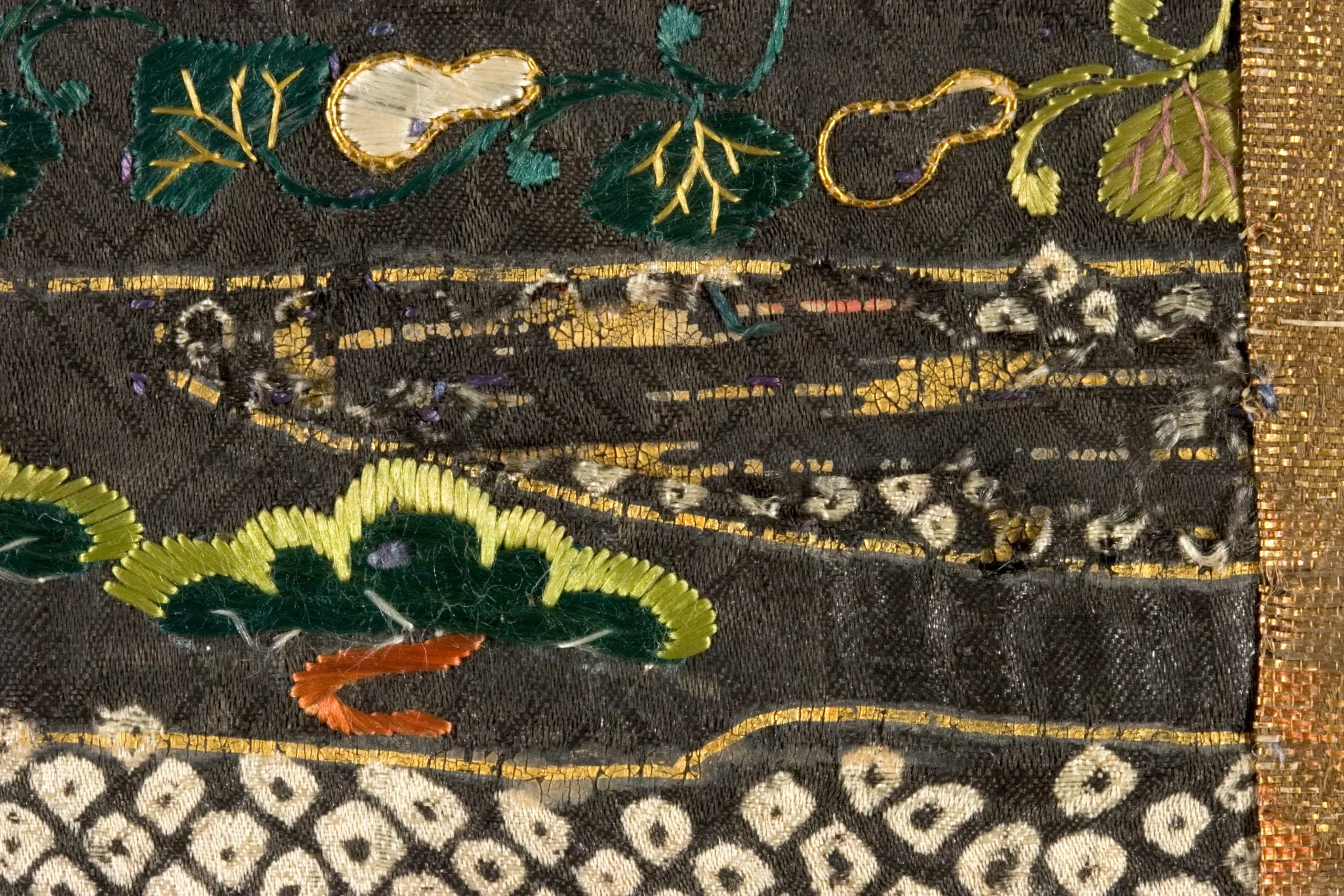
Close-up detail of embroidered textile on dark ground, with silk and metallic gold thread work depicting gourds, foliage, and flowering plants arranged in horizontal bands, with a scalloped white pattern border at bottom and gold braid at right edge.
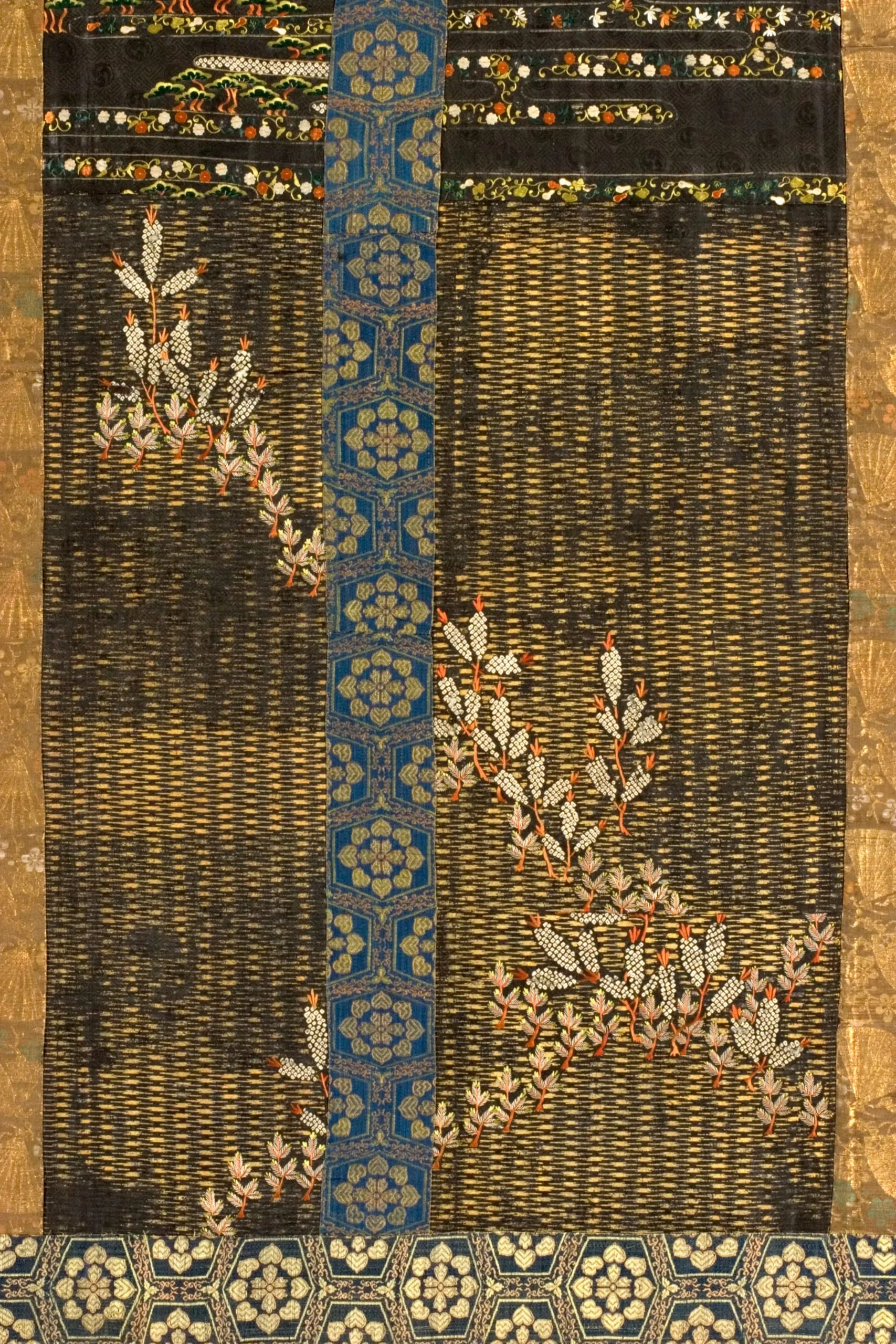
Detail of a Japanese hanging scroll or folding screen, depicting flowering branches with white blossoms and red buds cascading diagonally across a dense gold-and-black hatched background, divided by a vertical blue band with repeated floral roundels in gold; blue hexagonal border with floral motifs along the bottom edge.
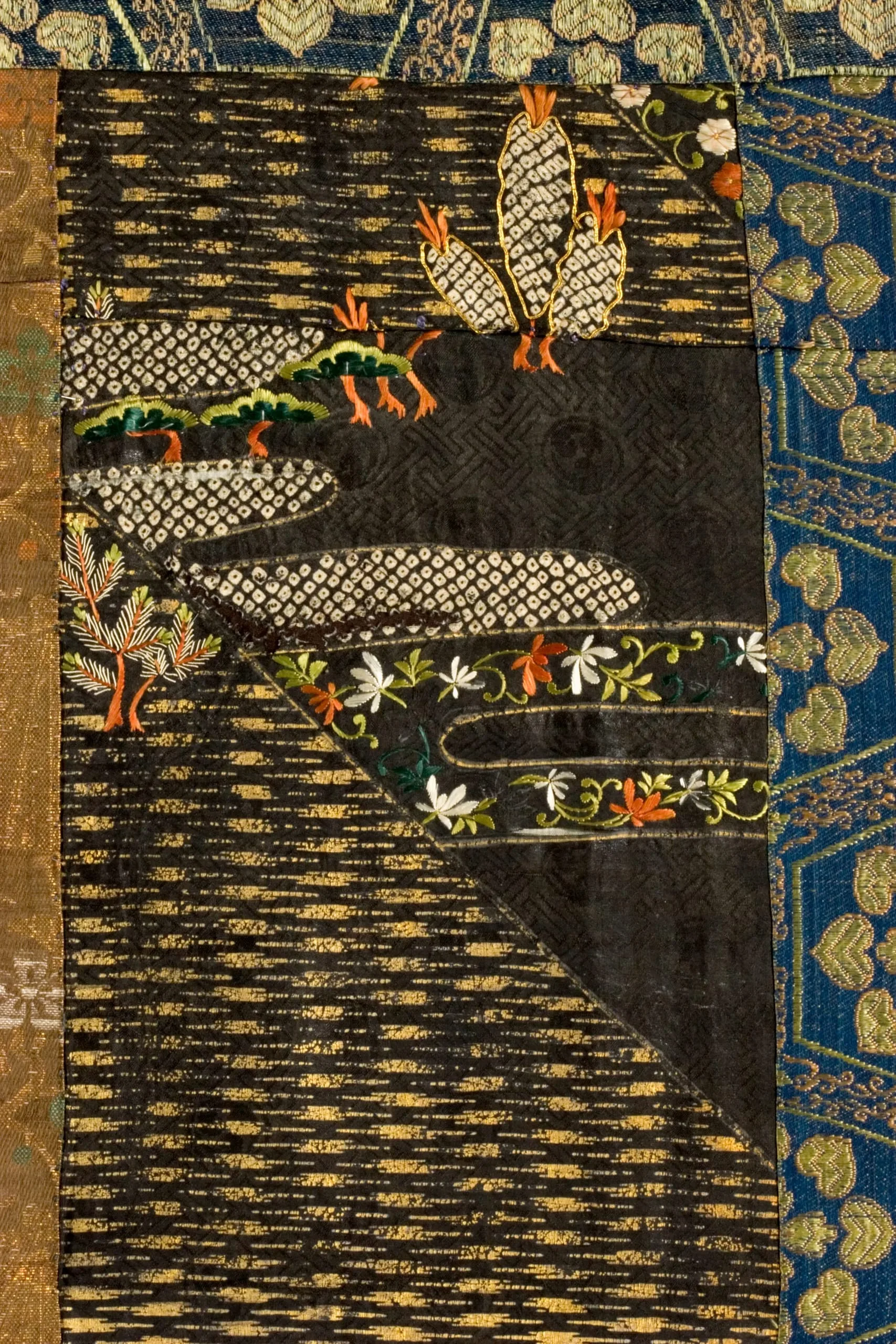
Fragment of Japanese textile, black ground with gold horizontal stripe weave, embroidered landscape featuring pine trees, patterned rock forms, and flowering vines in green, white, orange, and gold; blue and gold brocade border at right.
Textile fragment composed of pieced Japanese fabric panels; central black ground shows embroidered cranes with orange legs and patterned wings, pine trees, and floral sprigs, surrounded by gold-thread brocade and indigo woven borders.
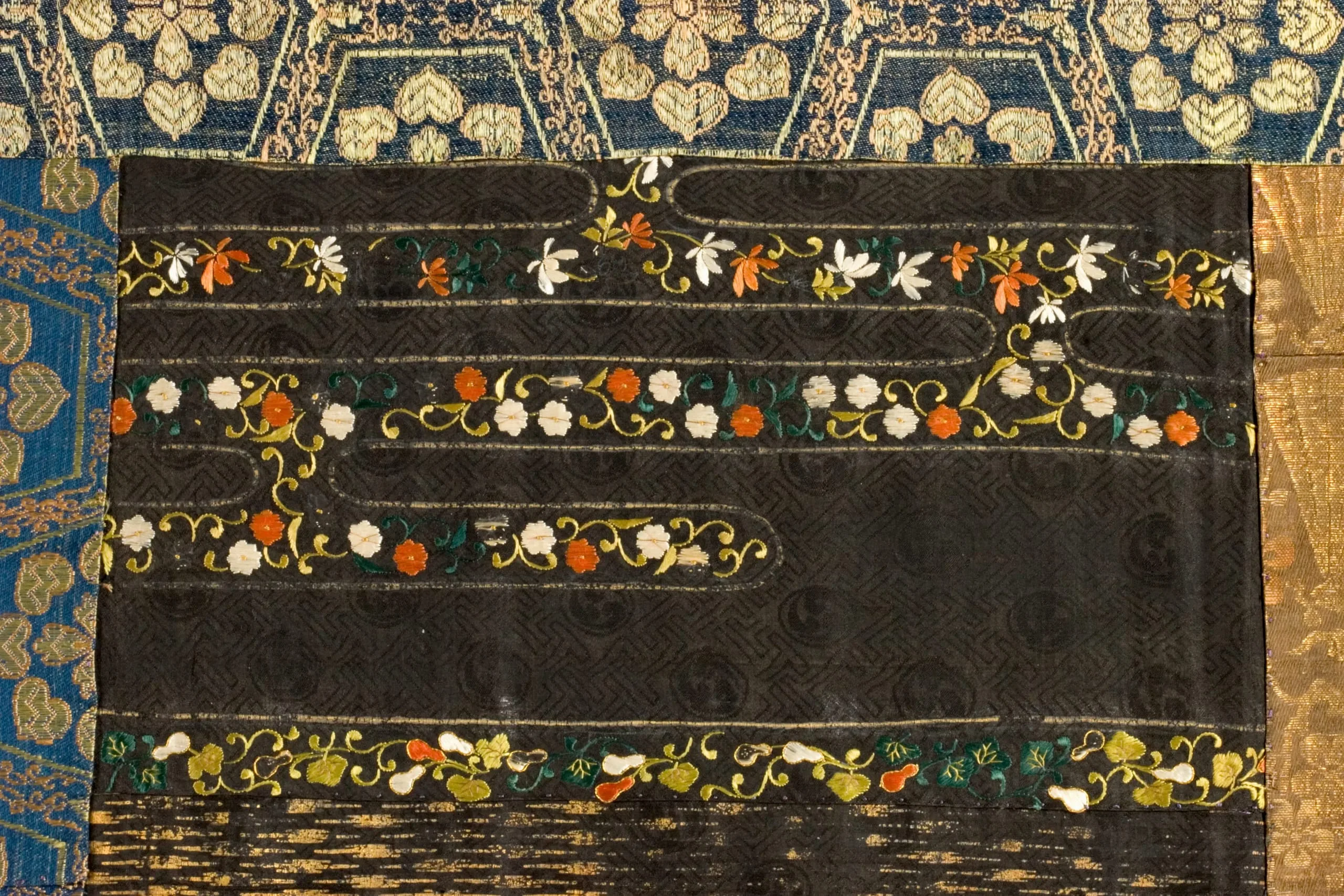
Embroidered textile panel with black ground, featuring horizontal bands of floral motifs in white, orange, red, and green with gold vine scrollwork; surrounding border of blue and gold brocade with geometric and floral patterns.
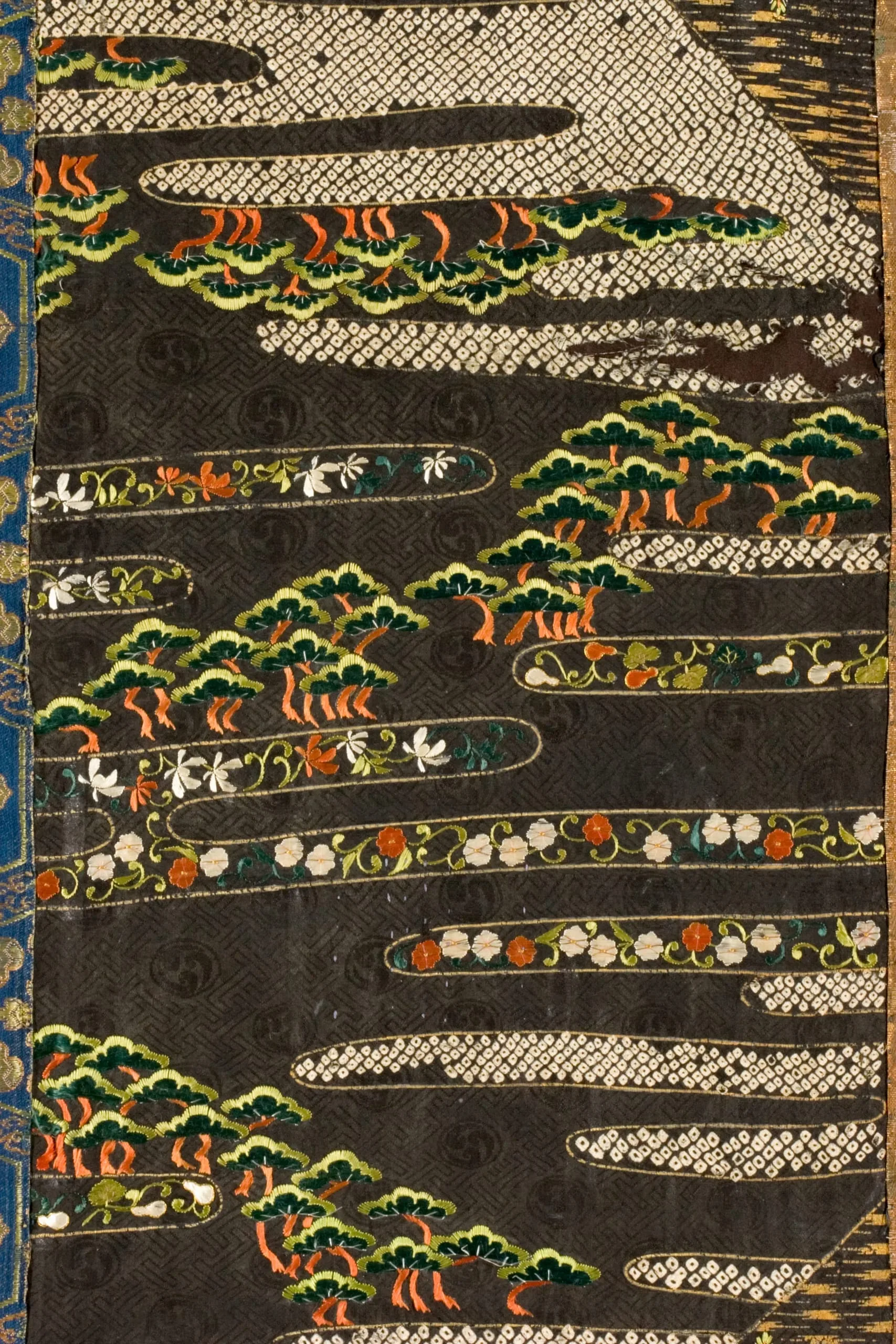
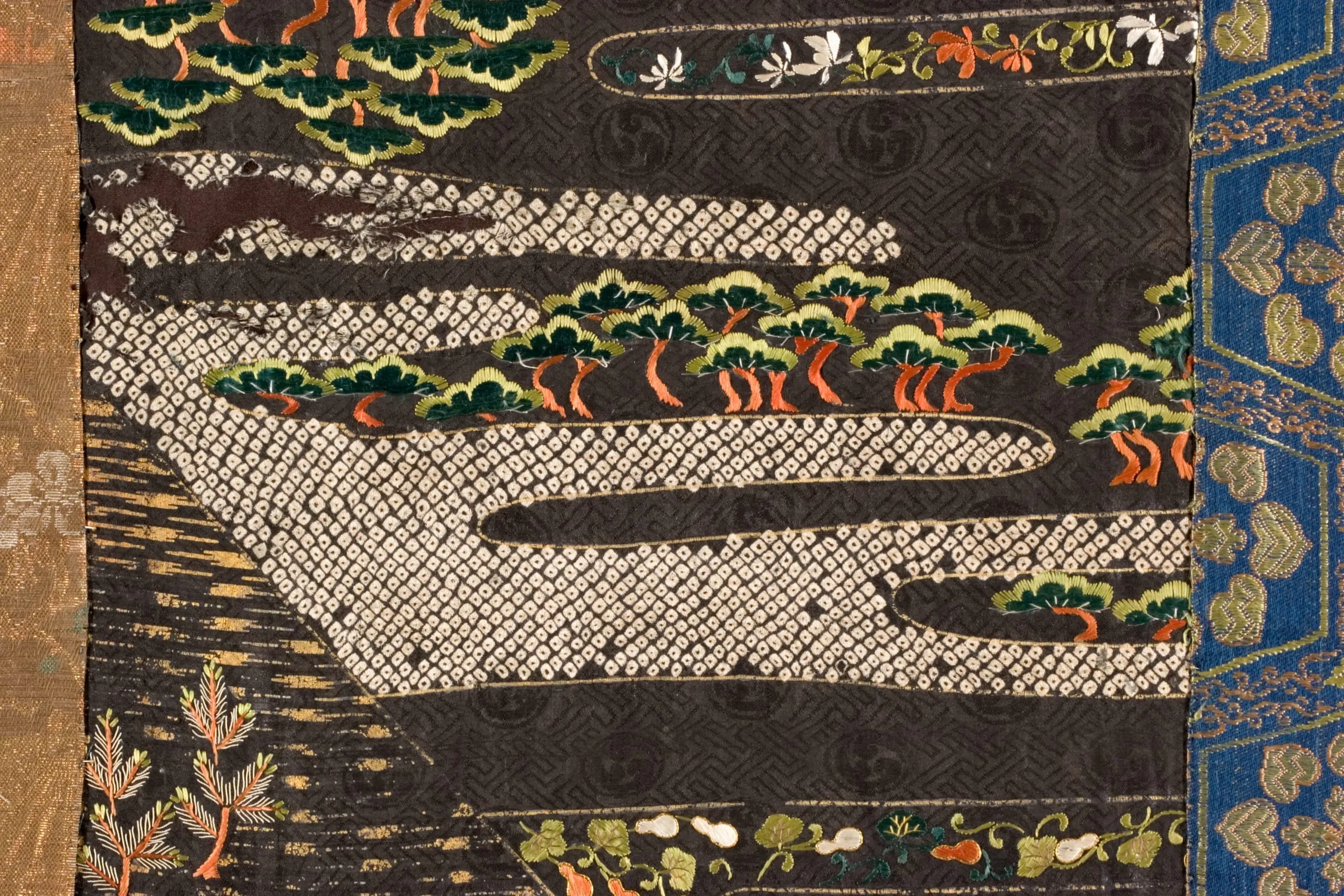
Embroidered textile fragment with dark ground, featuring horizontal bands of pine trees, flowering vines, and white cloud forms in green, orange, red, and gold thread; blue woven border at left edge.
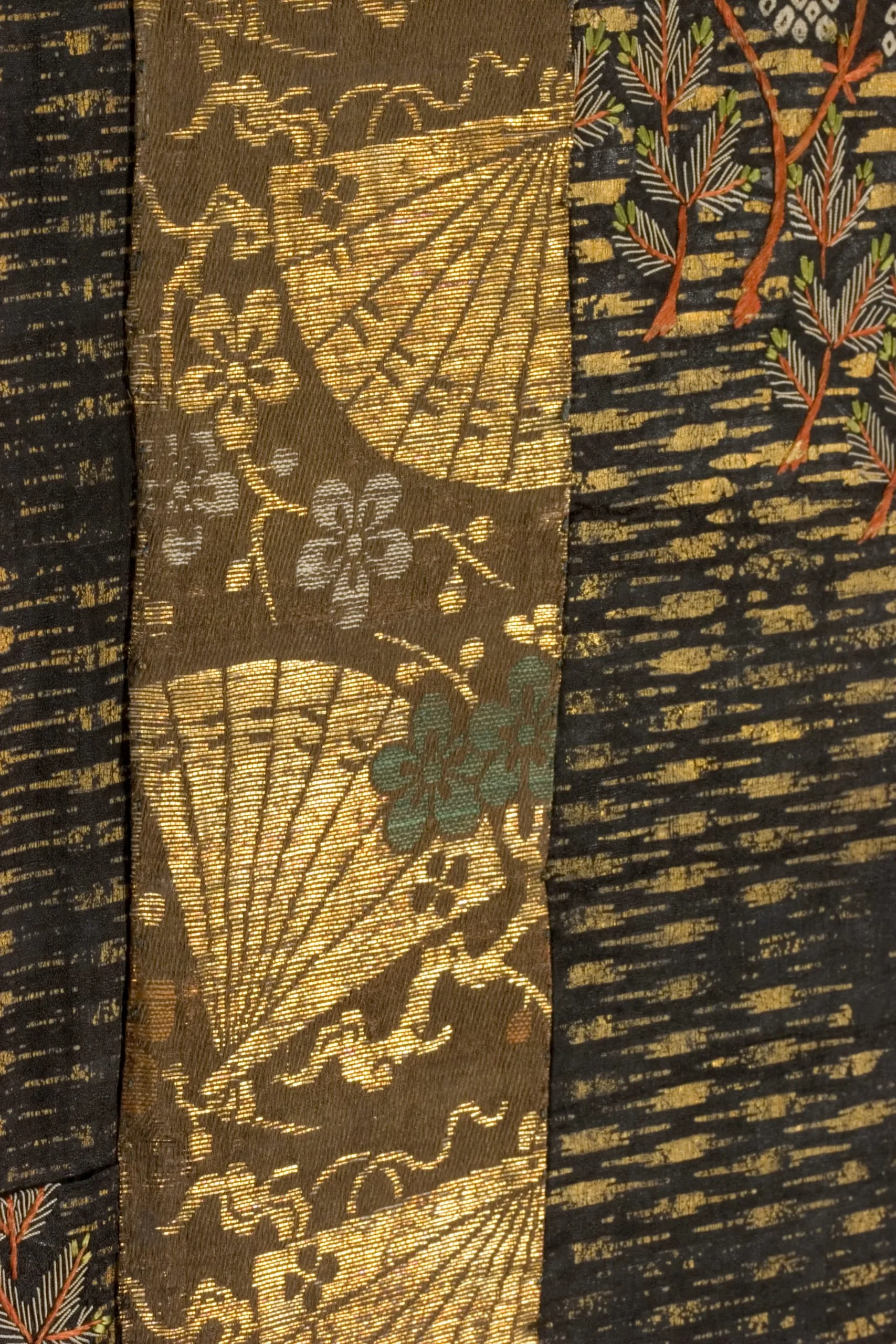
Close-up detail of a Japanese textile, likely a kimono, showing a central brocade panel with gold metallic fan and floral motifs on dark brown ground, flanked by black fabric panels with gold horizontal dash patterns and embroidered pine branch designs in orange and green.
Title
Buddhist Priest's Mantle (Kesa)
Place Made
Japan
Date Made
early Edo period, 17th century
Medium
Silk figured satin (rinzu) with tie-dye (kanako shibori), silk- and gilt -paper wrapped silk-thread embroidery, and gold leaf (surihaku); silk twill with gilt-paper thread supplementary weft patterning trim
Dimensions
Textile: 44 1/2 × 91 in. (113.03 × 231.14 cm) Cover: 62 × 112 × 3 5/8 in. (157.48 × 284.48 × 9.21 cm)
Credit Line
Purchased with funds provided by David G. Booth and Suzanne Deal Booth, and Camilla Chandler Frost through the 2006 Collectors Committee
Accession Number
M.2006.46
Classification
Costumes
Collecting Area
Costume and Textiles
Curatorial Notes
Originally symbolizing the rags worn by the Buddha as a mendicant monk, the kesa (kasaya in Sanskrit) became the standard vestment of Japanese monks, nuns and priests in the sixth century, when Buddhism reached Japan. They are the most significant components of Buddhist clerical ensembles and the most intriguing.
As Buddhism expanded into a major religious institution in Japan, the kesa evolved into a sophisticated and often resplendent garment incorporating expensive cloth of silk and gold. Elegantly embellished lengths of fabric from a high-ranking samurai-class woman's robe are preserved in the Edo period (1615-1868) Buddhist Priest's Mantle (kesa). Characteristic of fashionable Keicho-era (1596-1615) style, the dark brown-black-figured silk satin ground dramatically complements the light, decorated areas, which are defined by clusters of tiny tie-dyed circles, delicate motifs rendered in fine silk and metallic thread embroidery, and an overall repeat mist pattern in gold-foil. Extremely expensive even in its day, only a handful of Keicho-style kimono exist in Japanese national museum collections today.
The way in which this rare, early 17th-century kimono came to be an integral part of a sacred garment can be explained by the tradition of donating a woman's most beloved kimono (along with prayers for the repose of her soul) to a temple at the time of her death. Her robe would later be taken apart, cut into pieces, and re-sewn into ritual textiles such as altar cloths and banners or religious clothing such as kesa. Simple in its typically rectangular shape, kesa are composed of contrasting pieces of donated cloth sewn together in a pre-determined symbolic layout. This prescribed arrangement of cloth is believed to have evolved from the Buddha instructing a disciple to create a garment based on the orderly rows of planted rice fields. The assembly of a kesa by monk, nun, priest, disciple or layperson is a meditative act of merit.
Selected Bibliography
  • "2005-2006 Selected Acquisitions." LACMA Insider 4, no.1 (2006): 4-7.