LACMA

ShopMembershipMyLACMATickets
LACMA
Los Angeles County Museum of Art
5905 Wilshire Blvd.
Los Angeles, CA 90036
info@lacma.org
(323) 857-6000
Sign up to receive emails
Subscribe
© Museum Associates 2026
  • About LACMA
  • Jobs
  • Building LACMA
  • Host An Event
  • Unframed
  • Press
  • FAQs
  • Log in to MyLACMA
  • Privacy Policy
© Museum Associates 2026
Collections

Adriaen Coorte
Strawberries in a Chinese Porcelain Bowl1704

On view:
Geffen Galleries
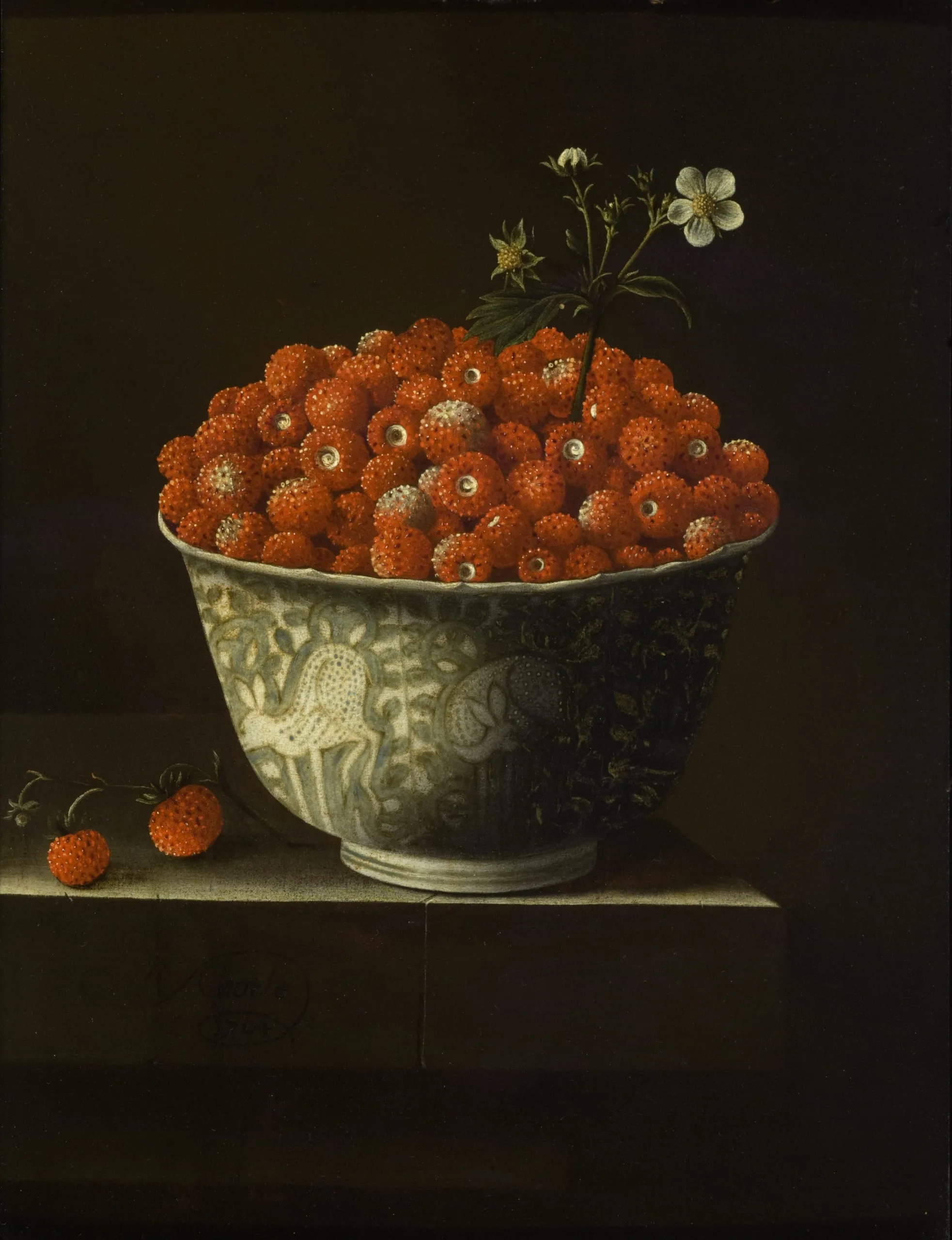
Oil painting still life, a grisaille-decorated ceramic bowl overflowing with orange-red raspberries on a stone ledge, two loose berries to the left, small white flowering sprig emerging from the pile
Artist or Maker
Adriaen Coorte
Northern Netherlands, Middelburg (?), circa 1665 - after 1707
Title
Strawberries in a Chinese Porcelain Bowl
Date Made
1704
Medium
Oil on paper, mounted on wood panel
Dimensions
Panel: 11 5/8 × 8 7/8 in. (29.53 × 22.54 cm) Framed: 19 × 15 × 2 in. (48.26 × 38.1 × 5.08 cm)
Credit Line
Gift of Mr. and Mrs. Edward William Carter
Accession Number
M.2009.106.5
Classification
Paintings
Collecting Area
European Painting and Sculpture
Curatorial Notes

Positioned near the edge of a tabletop, a blue-and-white porcelain bowl holds a mound of strawberries and a single stem of blossoming flowers. Two additional berries rest on the receding stone surface, which itself blends into the muted backdrop. The table bears the signature of Adriaen Coorte, a Dutch artist whose extant paintings number less than seventy. His unusual penchant for focused compositions is especially striking when juxtaposed with the extravagant still lifes of his compatriot and competitor Jan van Huysum (M.91.164.2). Nevertheless, Coorte’s treatment of the bowl—both as a dynamic form and as a surface for painting—showcases his attentiveness as an artist. The undulating texture of the berries echoes the dotted rendering of the prancing deer; the outlines of the fruit also follow the rim of the bowl, imitating its scalloped form.

Although seldom portrayed by Coorte, Chinese porcelain was commonplace in seventeenth-century Dutch still-life paintings. Evidence suggests that this vessel was a personal possession of the artist, possibly a gift from his brother Michiel, who forged a career in the Dutch East India Company, a global trade firm that introduced Chinese porcelain—among many coveted goods such as spices, textiles, and tea—to Europe. Crafted in Jingdezhen specifically for the European market, this type of porcelain emerged during the reign of the Jiajing emperor (1521−67) and was mass-produced in Wanli’s reign (1572−1620). Jiajing’s pursuit of longevity and Daoism is reflected in Coorte’s inclusion of the deer, a long-life symbol, though neither the Dutch artist nor his buyer would have been familiar with its Chinese cultural context.

2024
Provenance

[Goudstikker, Amsterdam, 1933]. Anonymous (sale, London, Christie’s, 28 June 1974, lot 76, sold for 12,500 guineas to); [Newhouse Gallery, New York, sold 1974 to]; Mr. and Mrs. Edward William Carter, Los Angeles, given 2009 to; LACMA.

Selected Bibliography
  • Walsh, Jr., John., and Cynthis P. Schneider. A Mirror of Nature: Dutch Paintings from the Collection of Mr. and Mrs. Edward William Carter (Second Edition). Los Angeles: Los Angeles County Museum of Art, 1992.

  • Bol, Laurens J. Adriaen Coorte: a Unique Late Seventeenth Century Dutch Still-Life Painter. Assen: Van Gorcum & Comp., 1977.
  • King, Jennifer, ed. Vera Lutter: Museum in the Camera. Los Angeles: Los Angeles County Museum of Art; Munich: DelMonico Books-Prestel, 2020.

  • Walsh, Amy L. The Mr. and Mrs. Edward Carter Collection of Dutch Paintings. Los Angeles: Los Angeles County Museum of Art, 2019. https://archive.org/details/Carter_Collection_Dutch_Paintings (accessed May 23, 2022).
  • Zumaya, Diva. The World Made Wondrous: the Dutch Collector's Cabinet and the Politics of Possession. Los Angeles: Los Angeles County Museum of Art, 2023.